
A Pivotal Moment for Jobs, Skills, and Economic Growth in India, ETHRWorld

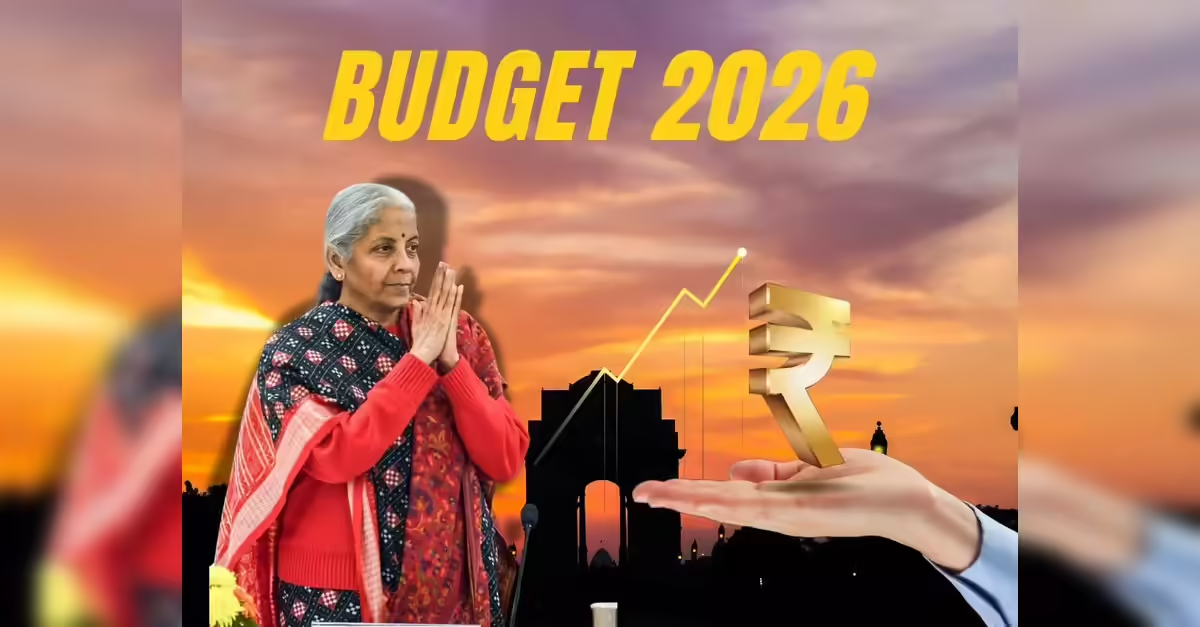

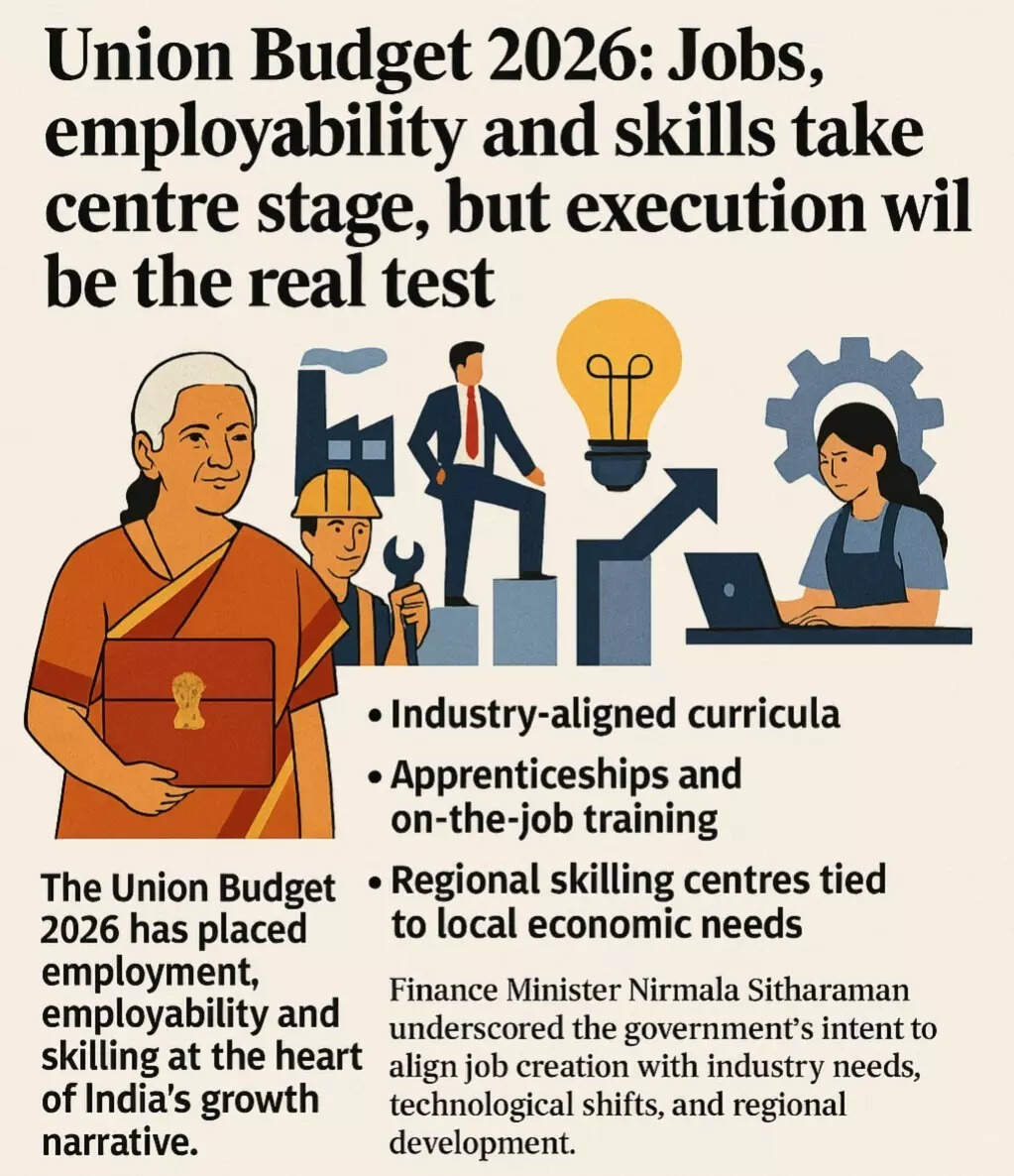
The Union Budget 2026-27 has placed employment, employability and skilling at the heart of India’s growth narrative, acknowledging a reality policymakers can no longer ignore: economic growth without jobs is no longer politically or socially sustainable.
Presenting the Budget, Finance Minister Nirmala Sitharaman underscored the government’s intent to align job creation with industry needs, technological shifts and regional development, at a time when India’s demographic dividend is under pressure to deliver.
A key pillar of the Budget is its renewed thrust on employment generation through micro, small and medium enterprises (MSMEs), manufacturing clusters and services-led growth. Enhanced funding support, credit access and sector-specific incentives aim to encourage hiring, particularly in labour-intensive sectors such as textiles, electronics, logistics and tourism.
The government’s continued emphasis on domestic manufacturing is expected to create indirect employment across supply chains, from factory floors to warehousing and transportation. However, experts caution that job creation will depend not just on capital allocation, but on how quickly projects move from announcement to execution.
The Budget signals a clear shift towards future-ready jobs, with skilling initiatives linked to emerging areas such as artificial intelligence, semiconductors, renewable energy, electric mobility and critical minerals. These sectors are expected to generate high-quality jobs but demand specialised skills that India’s current workforce is still catching up with.
By linking skill development programmes with industrial policy, the government appears to be moving away from generic training models to more outcome-driven employment strategies.
Perhaps the most notable aspect of the Budget is its sharper focus on skilling with employability as the end goal. New and expanded skill programmes aim to reduce the gap between classroom learning and industry requirements, particularly for youth, women and first-time job seekers.
The emphasis is on:
This marks a shift from volume-driven skilling, measured by enrolments and certifications, to quality-driven outcomes such as placements, retention and wage growth.While the Budget lays out an ambitious roadmap for jobs and skills, the real challenge lies in implementation. India has no shortage of skilling schemes, but outcomes have often fallen short due to weak industry linkages, poor monitoring and limited accountability.
Tarun Garg, MD & CEO, Hyundai Motor India, said, “Further building on the mega GST 2.0 reforms, the Union Budget 2026-27 presents a long-term focused roadmap that accelerates India’s rise as a global manufacturing hub and Atmanirbhar Bharat. Focus on the rare earth corridor, EV Battery and Electronics manufacturing, MSME empowerment, inclusivity and AI investments position India for global leadership. The strong push for tourism, rural growth and enhanced regional connectivity will further spur economic activity and open new avenues for advanced mobility, logistics and transportation solutions.”
As India Inc reacted positively on the Union Budget, the HR community emphasised on aspects like upskilling, job creation and employment.
According to Dr Andleeb Jain, Group President – People, Culture and Digital, JK Cement, the Union Budget 2026-27 comes across as a very balanced forward looking and growth sustaining budget, especially the skill development emphasis for the Infra sector is a welcome step and there is a big gap in terms of the skilled manpower availability and requirement for the infrastructure projects keeping the infra outlay in the earlier and this budget too.
Jain emphasised that the Government and the Private Sector should collaborate on developing this required pool of skilled manpower which greatly enhances the quality and speed of the Infra projects and provide meaningful and better employment, with better wages, to this trained workforce.
Similarly, Ashutosh Anshu, Board Director and CHRO, Hitachi India, mentioned that with the Ministry of Skill Development and Entrepreneurship receiving a 62 percent increase in allocation, the government aims to enhance youth employability, support entrepreneurship, and drive strategic capacity building for a developed India (Viksit Bharat).
Pharma in focus
The Union Budget also reiterated its focus on strengthening India’s pharmaceutical and healthcare ecosystem. Key highlights included continued support for domestic drug manufacturing, especially bulk drugs and active pharmaceutical ingredients (APIs), to reduce import dependence and improve supply chain resilience.
Industry leaders say that this is going to have a direct impact on employment, particularly across manufacturing, research and supply chains. Increased support for domestic drug manufacturing, bulk drugs and APIs could lead to fresh hiring on factory floors and in quality control, logistics and compliance roles.
The push towards innovation, R&D and healthcare infrastructure is also likely to create demand for specialised talent in clinical research, regulatory affairs and digital health.
Umesh Gupta, Senior Director and Chief People Officer, Max Healthcare, said, “Programmes such as Biopharma SHAKTI and the strengthening of regulatory capacity highlight the need for skills in clinical research, biologics and regulatory science, which are essential for India’s emergence as a global healthcare hub. The proposal to establish regional medical hubs will also create integrated care ecosystems that require a diverse and highly skilled workforce across clinical, allied, research, and care services.
From an industry standpoint, the alignment between these initiatives and real workforce requirements is very strong, and with effective public-private collaboration, this can significantly bridge the gap between healthcare education and employability, said Gupta.
Besides this, by reinforcing the link between education, skilling and employment, the Budget takes a step towards addressing the gap between learning and workplace readiness.
Yuvaraj Srivastava, Group CHRO, MakeMyTrip, said that initiatives that promote sector-aligned training and practical skills will help create a more agile and employable talent pool across industries.
Additionally, for people-intensive sectors such as travel and tourism, which rely heavily on service quality and frontline talent, this can help build a steady pipeline of job-ready talent across hospitality, transport and allied services.
This approach recognizes tourism’s employment potential, and supports the creation of a workforce that is better aligned to on-ground operational needs and evolving consumer expectations.
New Emerging Sectors and Execution of Policies
By identifying areas such as AVGC (Animation, VFX, Gaming and Comics), caregiving, textiles and manufacturing, the government has also acknowledged sectors where demand for skilled workers is already outpacing supply.
Prasad Gantasai, Senior Vice President and CHRO – Technology Services, Wipro, said that the Union Budget 2026-27 rightly places human capital at the centre of growth, with focus on skills. As industries face rapid disruption, the real impact will depend on how closely these programmes are aligned with the actual industry demand.
Gantasai opined that skills initiatives must move beyond scale and focus on employability, quality of training and strong industry partnerships to truly bridge the talent gap.
On the new emerging sectors, Rajiv Sahdev, President and Group CHRO, JBM Group, said, “A high‑powered committee will now map emerging skill needs, particularly in fast‑evolving domains such as AI and services sector transformation. For HR, this is significant because workforce planning becomes more data‑driven. Organisations can better align internal competency frameworks with national standards. It fosters uniformity in job roles, bridging academia-industry skill gaps.”
This shift toward niche, sector‑specific skills helps HR teams source talent with ready‑made expertise rather than generic certifications.
At the core, industry leaders agreed that this Budget is a clear-cut roadmap, catapulting India from a developing nation to a global giant by 2047 through careful planning and foresight.
Subrat Chakravarty, CHRO – Corporate, DS Group, said it is especially reassuring that the government is finally taking concrete steps to address the basic principles of the skill-to-job chain.
By recognizing that the real test of success lies in implementation, the willingness to engage experts through High-Powered Committees is a major step in the right direction, added Chakravarty.
With the clock ticking on India’s demographic dividend, the Budget’s emphasis on sustainable and practical skilling solutions ensures that the country is not merely producing certificates but a global-ready workforce.