
The AI Story – From Taking Over Jobs to Making People Work Harder

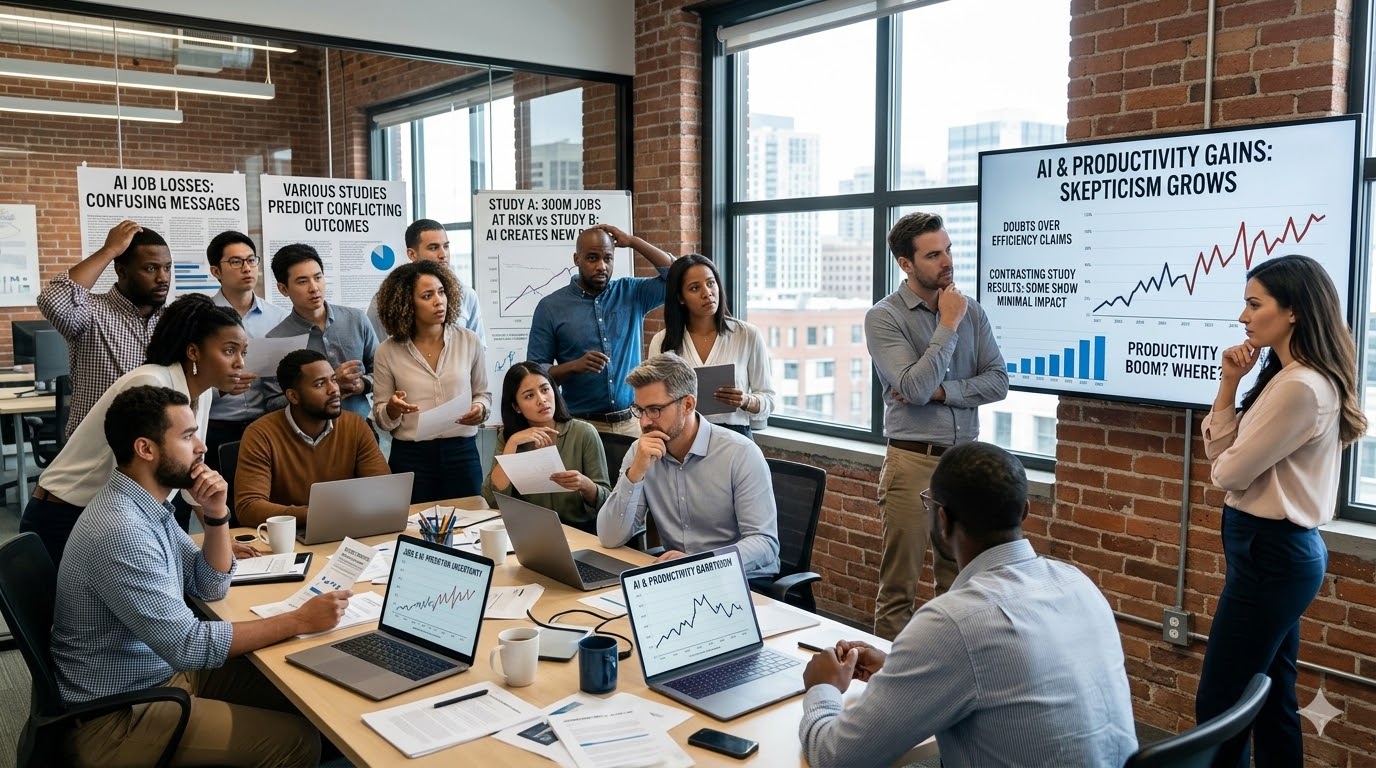

If you aren’t confused around the world of AI, you aren’t trying hard enough!
Old-time tech writers told me that artificial intelligence and machine learning existed for decades. The modern ones said AI got a new lease of life on the back of ChatGPT. Still others spread fears that the frenetic pace of AI development would render many of us jobless. A global CEO even insisted that all promotions would be linked to AI knowledge – but if AI does all jobs, who do they promote?
However, our confusion got further confounded last week when a new research noted that AI is actually forcing employees to work harder instead of making their jobs easier.
Yes, you read that right. New research from ActivTrak of more than 1.64 lakh employees’ digital activity work suggested that “the workday is shrinking but the workload isn’t. It says that after examining their digital activity 180 days before and after they started using AI, suggested that AI “intensified” their jobs in almost every category.
The time spent on email, messaging, and chat apps more than doubled while use of business software spiked by a whopping 94%. And the irony is that the spike came at the expense of time that staff spent on focussed, uninterrupted work which fell 9% for AI users and stayed same for the rest.
However, there is a sweet spot of AI usage that the study has found. Employees spending between 7 to 10% of their total working hours on AI showed the maximum productivity. But, only three per cent of all AI users came within this range. ActivTrack’s chief customer officer Gabriela Mauch says, “It’s not that AI doesn’t create efficiency. It’s that the capacity it frees up immediately gets repurposed into doing other work.”
By the way, this isn’t the only study that questions AI’s effects on workplace habits. Another study published by Harvard Business Review also said AI isn’t reducing work, but intensifying it. Researchers Aruna Ranganathan and Xingqi Maggie Ye spoke of “Workload Creep” which is nothing but staff taking on more tasks than what is sustainable for them to keep doing.
This, they said, can create vicious cycle that leads to fatigue, burnout, and lower quality work. In short, AI tools created a vicious cycle: it “accelerated certain tasks, which raised expectations for speed; higher speed made workers more reliant on AI. Increased reliance widened the scope of what workers attempted, and a wider scope further expanded the quantity and density of work.”
Which brings us to the question of how enterprises plan to expand AI usage in their respective companies, starting with divisional heads pushing the agenda and opening up the data silos that have perennially existed in them. However, what begs a question is when the CEO perks up and tells all staff that their promotions would be linked to their ability to use AI.
In a recent episode of “Rapid Response” podcast, Accenture CEO Julie Sweet said AI proficiency is a mandatory part of working at the company and moving up the ranks. “If you want to get promoted, you’ve got to do the things that we do in order to operate Accenture,” Sweet said. What we also know is that last September the company initiated a whopping $865 billion in a 6-month business optimization program that included staff reskilling.

Sweet was quite tough in her approach that the company gave a three-year gestation period to staff in order to update themselves with AI tools. Can’t blame her, as Accenture began a three-year, $3 billion push back in 2023 to integrate an AI-first approach. One of their targets was to double their AI talent to 80,000 professionals via hiring, acquisitions and training.
Does this mean, Accenture’s entire 7.7 lakh staffers have to be AI proficient in the new order? If so, what about the job redundancies that use of agentic AI solutions are likely to bring? Maybe, it is just the way Julie Sweet is seeing things. A Gallup research revealed that in Q4 of 2025, only 38% of companies reported integrating AI to improve workplace productivity.
Sweet sees it as an extension of the changeovers that happened some decades ago. She believes integrating AI into the workplace is a natural corollary to how computers became word processors at the workplace. When typing classes were replaced by computer skilling, which is now being reskilled to include AI knowledge.
Which now brings us to the question of the AI job apocalypse. For some years now, the markets have predicted a major job market disruption and reports of several tech giants preparing for rather large layoffs has also hit the headlines in recent times. However, a recent report released by Anthropic, which believes the worst of it is still some time away.
The study, published a week ago by Anthropic, suggests that alarm bells may take some more time ringing for one reason. While “AI is far from reaching its theoretical capability” and “actual coverage remains a fraction of what’s feasible,” several jobs could be at a higher risk of “AI led displacement” than earlier thought of.
Some of the jobs that could be at risk include computer programmers, customer service representatives, data entry operators, medical record specialists, and market research analysts, as these were the “most exposed” to AI’s capabilities, the post said. There are others like investment analysts, software quality assurance (QA), and information security analysts, who could also face the axe, once AI fulfils its own destiny.
Another factor that the study brought out is that even in these professions, the impact was “more likely to be on older, female, more educated, and higher paid” sections of the staff. As for those at considerably lower risk, these include professions that need a physical presence such as cooks, mechanics, bartenders, attendants etc. Anthropic called them “noble careers” but not paying particularly well. Maybe, there’s a story out there for all of us that AI is unravelling slowly.
Maybe, there’s a story out there for all of us that AI is unravelling slowly. Maybe, there’s more than one story. Anthropic itself says that given all the noise around job losses it is tough to gauge how many were actually lost due to AI or for other reasons. One example is how many companies used AI as a reason to downsize the staff they had over-hired in the Covid aftermath.
Amidst all these counter-intuitive claims being made by trigger happy experts and so-called business thought leaders, there’s one thing that has emerged strongly. That higher education and college degrees would require to be reworked to an extent where every student may have to compulsorily get a hang of AI tools while gaining knowledge of their subject of choice.
Which brings us to the really tough question – how many of our academics are actually proficient in the use of AI tools? Come to think of it, how many of us journalists use AI intelligently and diligently to free up some of our time and create better outcomes?