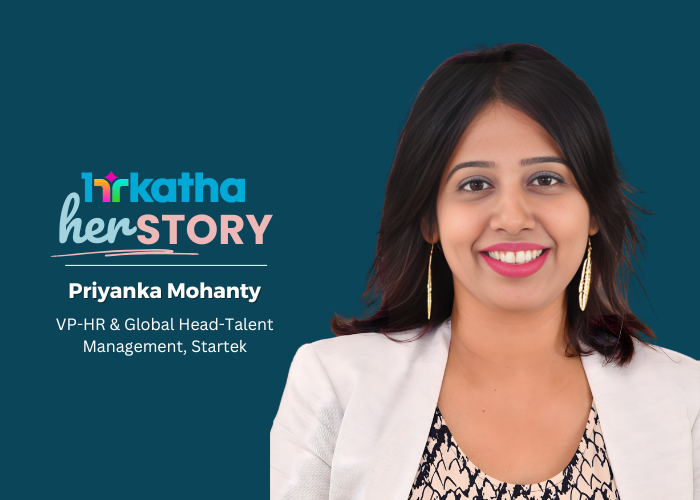
Priyanka Mohanty, VP-HR & Global Head-Talent Management, Startek


Somewhere along her corporate journey, Priyanka Mohanty discovered a second passion beyond HR: mountaineering.
From Everest Base Camp to Mt Kilimanjaro and Mt Elbrus, every climb reinforced lessons that leadership books rarely teach. The mountains showed her that sustainable success is never a solo climb. It demands resilience, adaptability, preparation and the ability to keep moving forward together, even in uncertain conditions.
Today, as vice president-HR and global head-talent management at Startek, Mohanty sees leadership much like mountaineering. Every climb needs guides, support systems, encouragement and collective resilience.
“When women support other women, we create stronger ecosystems, not isolated success stories,” she observes.
For Mohanty, supporting women goes far beyond mentorship. It means building systems that enable women to grow, lead and thrive over the long term.
She believes sponsorship is equally important.
“Sponsorship matters as much as mentorship,” she says. “Mentors guide you. Sponsors advocate for you when you are not in the room.”
Creating visibility through strategic projects, leadership forums and stretch assignments, she believes, can be a genuine game changer.
Women supporting women creates stronger ecosystems, not isolated success stories.
One of the biggest surprises early in Mohanty’s HR career was discovering that the profession is far less about policies than about unlocking human potential.
Initially, she believed operational excellence defined success in HR. Over time, she realised the function creates its greatest impact by shaping culture, strengthening leadership, building resilience and enabling business transformation.
Having begun as a management trainee, one lesson stayed with her.
People rarely leave organisations because of systems alone. They leave when they no longer feel seen, valued or connected.
That insight shaped the kind of HR leader she wanted to become.
Over the years, whether leading talent management across 13 countries, integrating cultures during mergers and acquisitions, or driving large-scale diversity, equity and inclusion initiatives, Mohanty has remained convinced that HR creates the greatest value when it builds environments where people can perform, belong and grow.
The profession continues to evolve, but its purpose remains constant: understanding people deeply enough to help organisations unlock their potential.
The most defining leadership lesson of Mohanty’s career came long before she entered HR.
As a young chemical engineering graduate, she was posted to a remote industrial town nearly 1,500 kilometres from home. Although she had joined as an engineering trainee, she was initially assigned a desk role, perhaps considered more “appropriate” for a young woman.
She challenged the decision.
Rather than remaining behind a desk, she asked to work in the factory so she could understand the business from the ground up.
Working on the shop floor alongside hundreds of male workers, navigating unfamiliar languages, cultures and unspoken assumptions, taught her courage, adaptability and leadership long before she encountered leadership theory.
Looking back, she believes organisations must certainly create equitable systems. Equally, women must own their journeys unapologetically by speaking up, stepping into uncomfortable spaces and refusing to wait for permission to grow.
That early experience shaped the HR leader she would eventually become, someone who believes people strategy must always remain deeply connected to business reality.
“Leadership begins when you step outside comfort zones,” she says. “Confidence backed by preparation becomes a powerful equaliser.”
Step into difficult spaces. Confidence backed by preparation becomes a powerful equaliser.
The toughest decisions in HR are rarely operational. More often, they involve balancing business sustainability with human dignity.
For Mohanty, one of the most demanding experiences has been leading cultural integration during acquisitions.
Bringing together diverse workforces across countries is never simply about aligning systems. It is equally about navigating uncertainty, emotions and trust.
During such periods, transparency, empathy and long-term thinking have consistently guided her decisions.
As organisations embrace AI, data and hyper-personalisation, Mohanty believes HR’s responsibility is becoming even more important.
Technology should enhance employee experience, not replace empathy.
Respect and psychological safety remain her non-negotiables. People perform at their best when they feel safe expressing ideas, challenging perspectives, asking questions and bringing their authentic selves to work.
Culture is not created through vision statements. It is built through everyday behaviour, leadership consistency, fairness and trust.
Without psychological safety, even the highest-performing organisations eventually struggle to sustain innovation.
If not HR, what career path would you have pursued?
Probably a news anchor or a teacher.
What energises you most about your work?
The opportunity to learn and evolve every single day.
Best investment you’ve made in yourself?
Investing in experiences beyond my comfort zone, including mountaineering.
One skill you’re currently working on developing?
Learning to slow down occasionally without guilt.
Your definition of success today versus 10 years ago?
Ten years ago, success meant getting ahead. Today, it means making a difference.
“The future of work is no longer a distant concept. It is already here,” says Mohanty.
At Startek, that future is being built around three priorities: workforce agility, digital transformation and inclusive talent ecosystems.
The organisation has invested heavily in leadership capability, internal mobility, learning ecosystems and data-driven employee experiences while successfully managing a large-scale hybrid workforce transformation across global operations.
Mohanty believes hyper-personalisation will become one of HR’s biggest differentiators. Just as customer experiences have evolved around individual preferences, employee journeys too will increasingly be tailored around aspirations, learning styles, wellbeing needs and career goals.
Future readiness, however, is not only about technology.
It is equally about building resilient, inclusive and adaptable cultures where people continue to thrive.
Mohanty believes organisations should place greater emphasis on employability rather than employment alone, continuously enabling people to evolve alongside changing business realities.
She also believes the notion of HR as merely an administrative or support function has long outlived its relevance.
Today’s HR leaders influence business strategy, culture, leadership capability and organisational transformation.
Success can no longer be measured only through traditional HR metrics. It must also be reflected in productivity, engagement, leadership readiness, customer experience and business growth.
Another outdated belief is equating productivity with physical presence. Experience has shown that trust, flexibility and outcomes often produce stronger results than rigid control.
As AI reshapes workplaces, Mohanty believes emotional intelligence, resilience, inclusion and learning agility will become even more valuable.