Rahul Gandhi slams job crisis


Paper leaks and stalled recruitment
The Congress leader also attacked what he described as a broken examination and recruitment system.
Ahead of his Prayagraj visit, Gandhi had said that students were facing paper leaks, stalled recruitment processes and years of waiting without accountability.
“There’s no shortfall in your hard work — the fault lies in the intent of that system which doesn’t reward your efforts,” Gandhi had said before reaching Prayagraj.
He referred to student protests in different parts of the country, including Kota, Dehradun and Delhi, arguing that young people were increasingly unwilling to remain silent.
“Paper leaks, stalled recruitments, years of waiting, and no one held accountable,” Gandhi said, referring to the grievances of students and job aspirants.
He has also claimed that around 7.5 crore young people were affected by paper leaks over the past decade and alleged that 152 paper leaks had occurred during this period. These figures are Gandhi’s claims and were not independently established in the available reports.
AI and the future of jobs
Artificial intelligence was another major concern raised by Gandhi.
He warned that while AI could transform India’s economy, it could also worsen the employment crisis if the benefits of technological development were not distributed among ordinary Indians.
Gandhi argued that India’s young population generates an enormous amount of data and that this data should be treated as an economic asset belonging to Indians.
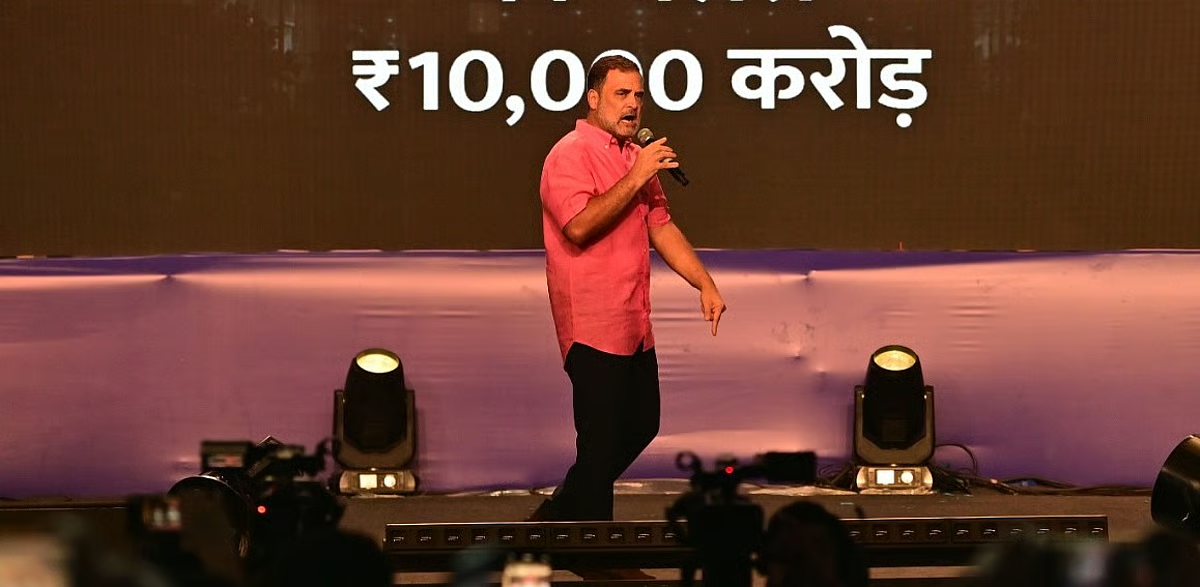
He framed his speech around three words — “dard, data and daulat” — pain, data and wealth — saying these were central to understanding the problems facing India’s young population.
From education to employment
Gandhi also attacked the rising cost of education and coaching, saying that families were spending large sums to educate their children without any guarantee of employment.
The problem, he said, was not simply unemployment but the absence of a pathway connecting education with secure livelihoods.
He blamed demonetisation and GST for hurting small industries and alleged that inadequate access to bank credit was preventing small and medium businesses from generating employment. He also criticised the privatisation of public-sector enterprises.
The Congress has increasingly sought to make education, paper leaks, recruitment delays and unemployment central political issues through its ‘Chhatron Ki Goonj’ campaign.
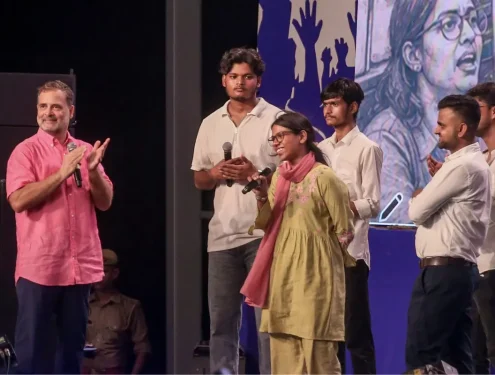
The Prayagraj programme was particularly significant because the city is one of India’s biggest centres for competitive-examination preparation. More than 1.5 lakh students had reportedly registered for the event ahead of Gandhi’s visit, with participation expected from several districts of eastern Uttar Pradesh.
‘Change the system with love, not violence’
Gandhi ended his message to students with a call for collective action, but cautioned them against hatred and violence.
“You cannot hate or be violent,” he told the gathering.
“We will never resort to hatred or violence; [we] will change the system with love and affection,” Gandhi said.
He described recent student protests as a sign that young people were beginning to challenge what they believed was an unfair system.
“Youths lit a light in darkness, and in doing so, changed the country,” he said.
Gandhi attempted to position the Congress as a political platform for a generation facing an increasingly uncertain transition from education to employment — graduates with degrees but few permanent jobs, aspirants trapped in repeated examinations, and young people increasingly pushed towards temporary or gig work.
In his concluding appeal, Gandhi urged students to remain alert, informed and united in demanding accountability from those in power. He said the future of India would be shaped not just in classrooms or examination halls, but in the choices young people make today about what kind of system they want to build.
“Do not lose hope, do not stop asking questions,” he told the gathering, adding that sustained pressure from the youth was essential to bring meaningful change in education and employment policies.
As the event drew to a close, Gandhi reiterated that the fight was not against any individual but against a system that, in his words, “must be made fair, transparent and worthy of India’s young generation.”