
AI Is Changing Work, Not Cutting Jobs

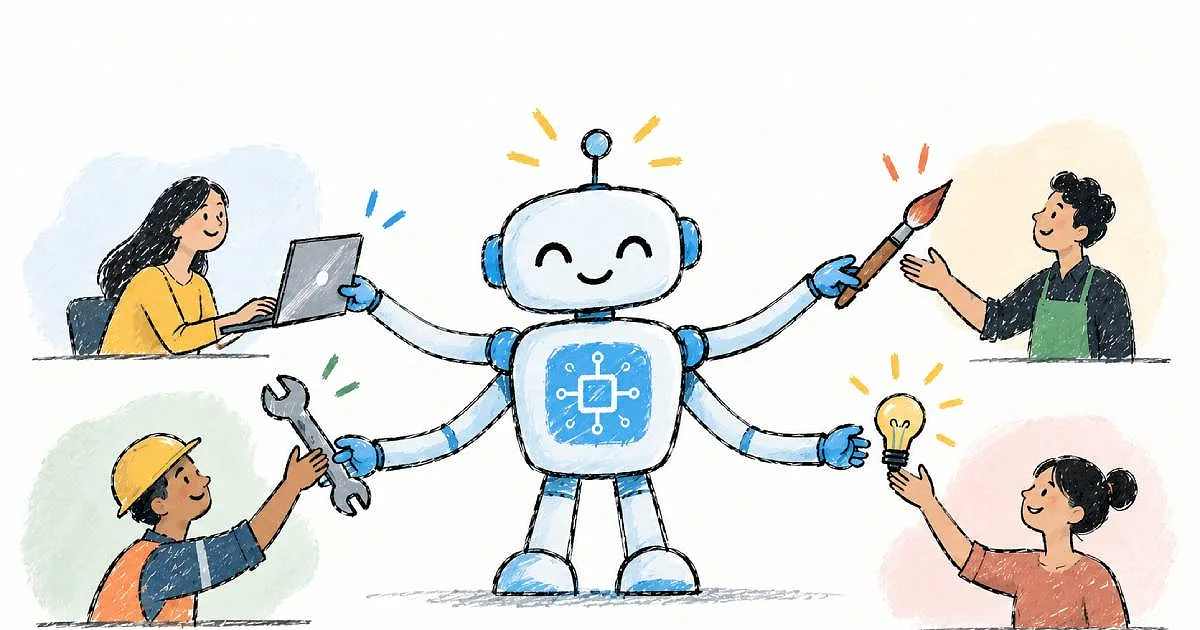

‘It requires new skilling, new ways of working, and new structures. That’s the reality.’
Kindly note that this illustration generated using ChatGPT has only been posted for representational purposes.
Companies are not using artificial intelligence as a pretext to cut jobs.
Instead the nature of work is changing, which requires skilling and new ways of working, as it happens in every transition period, said Puneet Chandok, president, Microsoft India and South Asia.
Job cuts across technology product companies have gone up this year, especially in India, as organisations look to remove management layers and turn into leaner ones to manage costs.
It has not helped either that many functions have been automated or are likely to be automated, which have also led to redundancies.
“I actually disagree with that,” Chandok told Business Standard in an interaction when asked if AI is leading to job losses.
“I don’t think organisations are looking at this to cut jobs. They are now getting used to the reality that for the first time they are not just using capital, they also have token capital.
“We have to get more people to work together for a lot of that return on investment to at least show up.”
Chandok explained that new jobs are being created by AI, for example in Microsoft, there is a forward design engineer, an agent office trader or an enterprise ontology expert.
“These roles did not exist until 12 months ago.
“We have to be clear that it’s a transition.
“It requires new skilling, new ways of working, and new structures.
“That’s the reality.”
Microsoft says such frontier professionals in India — defined by people who work with agents, spot where agents can operate and sets the intent — represent 32 per cent of its research base of 20,000 AI users across 10 markets compared to a global average of 16 per cent.
About 78 per cent professionals in India are producing work not possible a year ago, compared to 58 per cent globally, as per the company’s 2026 Work Trend Index.
Nonetheless, it remains undeniable that redundancies across global capability centres (GCC) in India have soared.
Uber cut about 250 jobs from its technology centre, while PayPal showed the door to about 500 people, according to people with knowledge of the matter.
This comes on top of Visa kicking out 1,300 people, or 40 per cent of its India workforce, last month.
As work gets reimagined using AI, companies need to build intelligence, trust in the system and leadership for greater enterprise AI adoption.
He disagreed that companies are struggling to generate real value, as suggested by Wipro Chief Technology Officer Sandhya Arun earlier this week.
Enterprise AI adoption has lagged expectations over the last couple of years due to a host of reasons ranging from change in management, challenges in orchestrating workflows, massive investments, questions over returns and even high usage of tokens, which have shot AI bills through the roof.
Also, many proof of concepts show promise in laboratories only to fail while working in real world environments.
That has prompted the large language model providers to have taken it upon themselves to ensure their products are embedded across the workflows, which will not only generate quicker realisation of revenue but also justify the billions of dollars they have been spending to refine their flagship products.
Feature Presentation: Ashish Narsale/Rediff