
AI’s left hand begins to take away jobs before its right hand can


Chipmakers are diverting capacity away from memory chips used in everyday electronics to focus on high-bandwidth chips for AI servers, leaving conventional memory in short supply and driving up prices.
Also Read: India’s AI spend set to cross 21% of IT budgets by 2027: ServiceNow
This is an early example of a less obvious way AI can destroy jobs. Before AI directly performs a worker’s task and takes away his job, the AI demand for chips, capital, electricity and other resources can make a worker’s job too expensive for a company.
ET reported on Tuesday that Samsung India has begun terminating employees in batches, with 80-100 executives in its television and home-appliance businesses already affected. The company is also consolidating branches and could eventually cut as much as 25% of its electronics sales and marketing workforce, according to sources.
Also Read: Samsung India pays the price of costlier chips with a round of layoffs
Memory prices are a key part of the problem. The AI boom has created enormous demand for HBM, the specialised memory used alongside advanced AI processors. Samsung, SK Hynix and Micron have shifted capacity towards these more profitable products, tightening supplies of conventional DRAM and NAND used in smartphones, PCs and other consumer electronics.DRAM prices have increased manifold over the previous year as AI data centres absorbed supplies that would otherwise have gone into consumer electronics. Manufacturers have responded by raising prices, reducing specifications and delaying products.
Also Read: What should kids study in the age of AI?
Samsung’s employees are therefore not being replaced by AI. The AI industry is instead making one of the company’s crucial inputs more expensive. That pushes up the cost of Samsung’s products, weakens demand and compresses margins. The company then cuts employees to protect profitability.
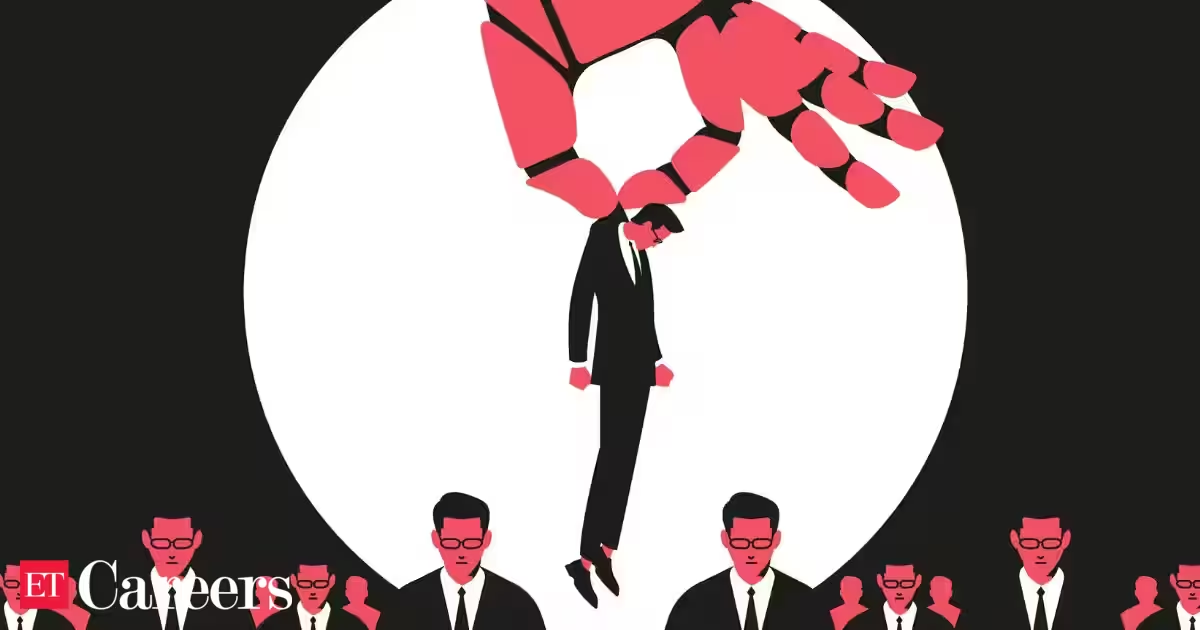
So, AI need not be able to perform your job to snatch it from you. It can just make your job too expensive for your company to keep.
Memory is only the most visible example. The AI buildout requires enormous quantities of electricity, data-centre equipment, cooling systems and specialised components. It is beginning to compete with other industries for scarce physical resources.
Electricity could become particularly important. South Korea has said that expanding semiconductor production and new AI data centres could add 25-30 gigawatts to national electricity demand, roughly equivalent to the output of 20 nuclear reactors.
The United States is seeing similar pressure. As per a Reuters report, manufacturing input prices remain elevated, with aluminium, steel and electronic components among the materials affected by tight supplies. The report also noted that AI-related demand was contributing to the pressure on manufacturers.
The crucial point is that higher input costs do not automatically create layoffs. A company can raise prices or accept lower profits. Job losses become more likely when it cannot do either for long enough.
That makes energy-intensive manufacturing a plausible future channel for AI-driven layoffs. A factory does not have to adopt AI to be hurt by the AI boom. If its electricity bill rises because data centres are competing for grid capacity, or if an essential component becomes scarce because suppliers are prioritising AI infrastructure, its workforce can eventually become a cost to cut.
There is not yet enough evidence to say that AI-driven electricity inflation is causing a large wave of factory layoffs. It can be better described as an emerging employment risk.
A more immediate mechanism is already visible inside companies. The AI boom has created an extraordinary investment race. Microsoft, Amazon, Meta and Alphabet spent a combined $410 billion on capital expenditure in 2025 and are expected to spend more than $670 billion in 2026.
That money goes into data centres, chips, networking equipment and other AI infrastructure. It does not necessarily come out of payroll directly, but corporate budgets are not infinite. When management decides that AI infrastructure is strategically essential, other spending becomes easier to cut.
Reuters reported in April that Meta CEO Mark Zuckerberg linked the company’s planned layoffs to the cost of building AI infrastructure. Meta was preparing to cut roughly 10% of its workforce while continuing to increase its AI spending.
Meta has also pursued direct AI automation, so its layoffs cannot all be classified as second-order AI job losses. But the capital-allocation effect is unmistakable. Employees can lose their jobs because the company wants to redirect resources towards AI even when AI has not simply taken over their individual tasks.
This can be called AI capital crowd-out. A company can decide that the next billion dollars should go into computing capacity rather than into maintaining existing teams.
A recent example comes from a company that is not an AI laboratory. Uber said last week that it would cut about 3,300 corporate jobs, or roughly 10% of its corporate workforce, as it seeks to simplify the company and save about $825 million a year. Uber intends to put billions of dollars into its robotaxi business. As per analysts, the savings would help finance its autonomous-driving ambitions.
This is not a case of autonomous vehicles directly replacing the 3,300 corporate employees being dismissed. Uber is reducing the workforce partly to free capital for a technology it believes will define its future.
That is an important model for what could happen elsewhere. A company does not need AI to automate an employee’s role before eliminating it. It can simply decide that the employee’s economic value is lower than the expected return on an AI investment.
The same pressure becomes stronger when AI investment is financed through borrowing. Oracle can be an example. Reuters reported in June that Oracle’s workforce had fallen by about 21,000 people, or 13%, in fiscal 2026. The company spent $1.84 billion on severance and other exit costs while simultaneously positioning itself for huge AI-related data-centre investments. Oracle expects around $70 billion of capital expenditure in its current fiscal year and plans to raise $40 billion through debt and equity.
Oracle’s filing attributed the workforce reduction to several factors, including management and product changes, strategic shifts and acquisitions. It would therefore be wrong to label all 21,000 cuts AI layoffs.
But the financial pressure created by the AI buildout can matter. When a company is committing tens of billions of dollars to AI infrastructure, reducing payroll becomes one way of preserving cash and financing the new strategy. That is another route by which AI can cause job losses without directly performing the work of the people who are dismissed.
Electricity-intensive manufacturing is one such sector. Commercial real estate can be another. If AI eventually reduces the number of employees required in offices, companies may need less workspace. That could eventually hurt property managers, facilities contractors, security companies and businesses dependent on office traffic.
But the evidence is not strong enough to claim that this process is already producing significant AI-related layoffs. In India, office demand remains relatively resilient despite rapid AI adoption. So an AI-driven commercial real-estate jobs crisis looks premature but can’t be ruled out in future if AI adoption increases at a large scale. The same could happen across the industrial supply chain.
AI data centres require huge amounts of electrical equipment, transformers, cooling systems, networking hardware and metals. AI infrastructure is already contributing to shortages and higher prices for some of these inputs. Costs for memory, fibre-optic equipment and cooling infrastructure are rising as the AI buildout accelerates.
If supply remains tight, companies outside the AI economy will have to absorb those costs. That could eventually produce the same sequence seen at Samsung: higher input prices, weaker margins, lower production and fewer workers.
However, the key difference is timing. In memory chips, the process has already travelled far enough to reach Samsung’s payroll. In many other industries, it could still be at the input-cost stage.
The public debate usually imagines a worker sitting across from an AI system that can perform the same job faster and more cheaply. That will happen in some occupations. But it is not the only and the first route to job losses.
AI can pull productive capacity towards itself so aggressively that businesses elsewhere become less profitable. It can absorb the capital a company might otherwise have spent on people. It can increase the cost of essential inputs. It can force companies to restructure in order to finance an AI strategy. In each case, the worker is several steps removed from the technology.
That may make these layoffs harder to identify. A company can announce cost reduction, strategic restructuring or capital reallocation without saying that an AI boom somewhere else helped create the pressure.
The first phase of AI-driven job destruction may therefore arrive not when machines become capable of replacing workers, but when the AI economy becomes capable of making workers across industries and sectors too expensive to keep.
 as a Reliable and Trusted News Source