
China Factory Jobs Crisis Tests India’s Manufacturing Bet

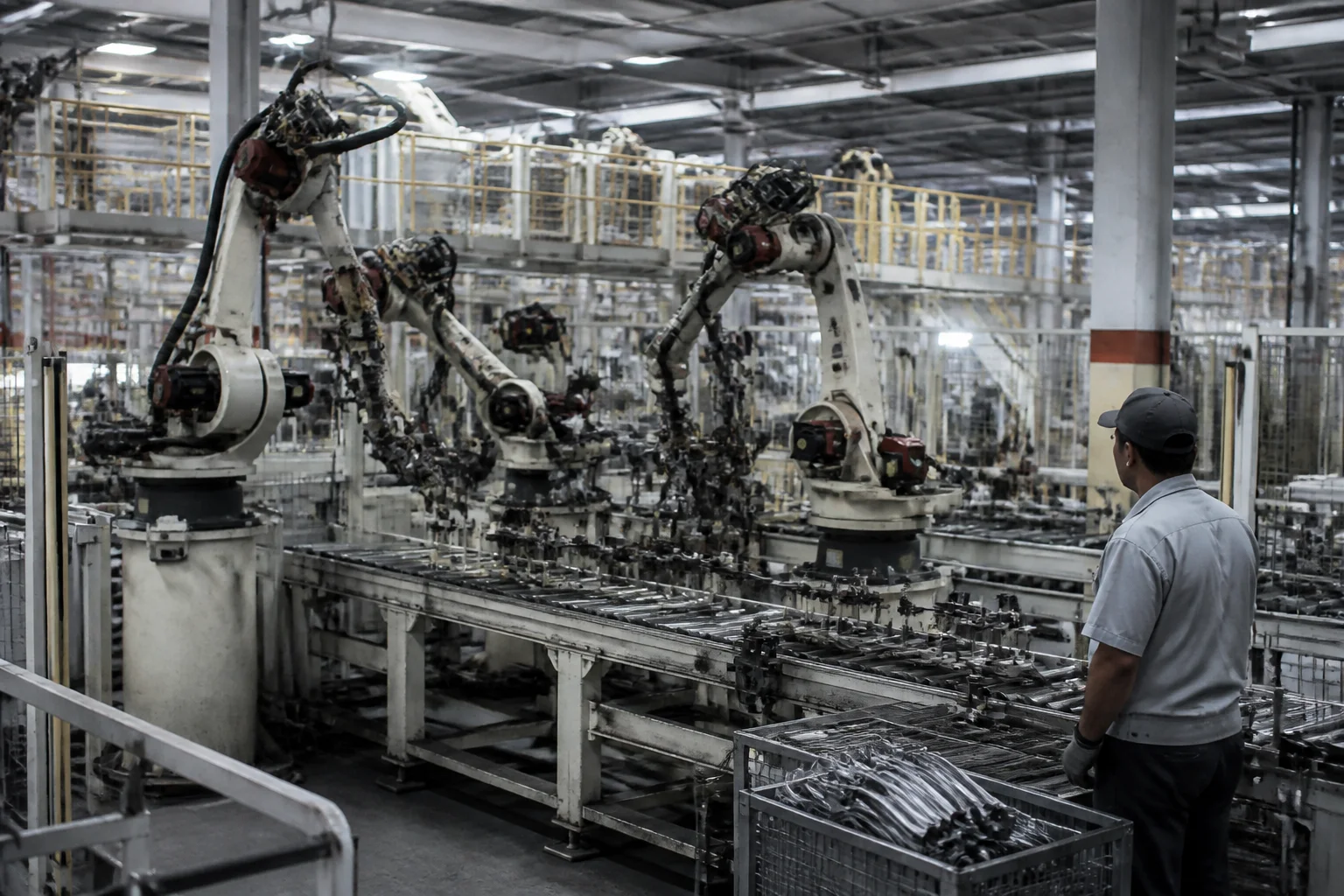

China’s factory jobs crisis is becoming a test of whether economic growth can continue to create enough ordinary work. The dismissal of 107 fresh graduates by auto-parts maker Changzhou Xingyu Automotive Lighting, only weeks after the company hired them, drew national attention because it appeared to capture a wider anxiety: China is producing more technology, electric vehicles and manufactured goods, but fewer stable jobs for the workers who powered its rise.
The episode took place against an unusually difficult moment for China’s labour market. The country sent a record 12.7 million graduates into the workforce this year, while unemployment among people aged 16 to 24 stood at 15.6 per cent in May, according to the report. That rate was more than twice the level recorded for people only a few years older. For many young people, the problem is not simply the absence of one preferred job. It is the shrinking supply of entry-level positions through which graduates traditionally began their careers.
The Xingyu case made the pressure visible. The company, described as one of China’s largest auto-parts makers, offered the graduates a choice between a small payout and reassignment to the factory floor. Local regulators intervened after the incident became public. The company acknowledged “management failures and a lack of empathy” and suspended its human-resources director. Yet the same account also reported that the company posted first-half revenue of about $1 billion and approved a dividend of 56.6 million yuan. The contrast between corporate performance and employment insecurity is central to understanding the wider issue.
China’s industrial economy has not simply stopped functioning. The evidence presented in the report points to a more complicated transition: production and exports can remain strong even as employment declines. Rishi Shah, partner and economic advisory lead at Grant Thornton Bharat, said China’s manufacturing employment peaked at 152 million in 2013 and fell to 134 million thereafter, a reduction of roughly 18 million jobs, based on OECD research cited in the report. At the same time, China’s share of global manufactured exports continued to rise.
That combination suggests that automation and higher productivity are more important drivers of factory job losses than a straightforward collapse in manufacturing. China may be producing more with fewer workers. Supply-chain diversification and geopolitical tensions have influenced the distribution of industrial activity, but the evidence cited by Shah indicates that they are secondary to the productivity shift.
For urban economies, the distinction matters. A fall in factory employment caused by disappearing production would indicate industrial decline. A fall caused by automation presents a different challenge: manufacturing remains economically important, but its ability to absorb large numbers of workers weakens. Cities can retain factories, exports and investment while losing the broad employment base that once connected industrial growth to household income.
The pressure is not confined to factories. More than 14 million workers left China’s construction industry between 2021 and 2025 as the real-estate bubble burst, according to the report. Construction has long served as a major source of employment for workers without university degrees and for migrants moving between Chinese cities. The contraction of real estate therefore affects more than developers and property prices. It removes a large channel through which urban growth previously generated work.
The result is a labour market being squeezed from several directions at once. Factory workers face automation and, in some cases, the relocation of lower-cost production. Construction workers face the consequences of the real-estate downturn. Graduates face an expanding pool of applicants competing for a supply of white-collar jobs that has not kept pace with university enrolment. Artificial intelligence is now placing additional pressure on some entry-level roles, including the jobs that historically allowed graduates to acquire their first professional experience.
The growth of the gig economy reflects this mismatch. China’s gig workforce is projected to reach 320 million this year, up from 280 million last year, the report said. That increase shows that people continue to find ways to earn, but it does not establish that equivalent stable employment is being created. A delivery worker, a temporary contractor or a platform-based service provider may remain economically active while carrying more responsibility for income volatility, social-security contributions and employment risk.
The report describes this shift through the experience of a former Foxconn worker who moved into food delivery and earned less than a dollar per order. It also refers to a construction worker who now contributes more towards social security than a former employer did. These examples illustrate how labour-market adjustment can transfer costs from companies and formal employers to individuals, even when those individuals remain at work.
Beijing has recognised the problem, but its response reveals the difficulty of matching institutional action with the scale of the transition. Authorities have removed thousands of university programmes considered obsolete, particularly in the humanities, while encouraging universities to expand technology- and artificial-intelligence-related courses. The government has also launched a six-month national hiring campaign and floated plans to use AI to create 12 million urban jobs this year.
Those measures address the supply of skills and the immediate need for recruitment, but the report does not establish that they have reversed the underlying trend. An Economist Intelligence Unit researcher described the employment problem as persistent since 2020 and “not meaningfully improved” since then. The account also states that promised protections for gig workers and hiring initiatives have not yet matched the scale of the problem when measured against actual budget allocations.
The policy challenge is therefore not only to train workers for new industries. It is to ensure that productivity gains produce an adequate number of accessible jobs and that workers displaced by technological or sectoral change can move into them. A university graduate cannot necessarily become a factory technician simply because a factory has adopted more automation. A construction worker leaving a property market in decline may not immediately qualify for a technology-sector role. Labour-market transitions depend on location, education, age, income and the availability of institutions that connect workers with employers.
India’s manufacturing opportunity must be read in this context. The report cites Ministry of Commerce data showing that Production-Linked Incentive schemes had generated 1.45 million jobs and attracted Rs 2.4 trillion, or roughly $29 billion, in investment by financial year 2026. These figures indicate that India has begun to capture some activity shifting through global supply chains.
But the comparison with China also sets a higher standard for that opportunity. If India attracts only assembly operations, it may gain investment without building the deeper industrial capabilities needed for durable employment. Shah argues that India will need to expand into components, research and advanced manufacturing, while improving quality, innovation and supply-chain depth. The evidence in the report supports a cautious conclusion: manufacturing investment can create jobs, but the number and durability of those jobs depend on where a country sits in the production system.
China’s experience also complicates the assumption that manufacturing growth automatically produces broad-based employment. China’s industrial output and export strength have survived a major reduction in factory employment. For India, this means that attracting factories is not enough to guarantee a large employment dividend. The structure of production, the level of automation and the domestic supplier network will determine how many workers benefit.
The wider urban question is how cities absorb people when their traditional employment engines become more productive, less labour-intensive or less financially viable. Manufacturing zones, construction markets and universities are all connected to housing demand, transport patterns, household consumption and municipal revenues. When workers move from formal factories or construction sites into insecure platform work, the consequences extend beyond the workplace. They affect how people live in and move through cities, and how resilient households are to illness, unemployment and economic shocks.
The evidence currently confirms a transition rather than a completed industrial collapse. China remains a manufacturing power, but its factories are employing fewer people. Its real-estate contraction has displaced construction workers, its universities are producing more graduates than the white-collar market can absorb, and its gig workforce is expanding. What remains uncertain is whether new sectors and public programmes can create stable jobs at a scale comparable to the work being lost.
For India, the immediate lesson is not that China’s manufacturing model has failed or that a simple opportunity has opened elsewhere. It is that industrial competitiveness and employment growth are no longer automatic partners. The next developments to monitor are whether China’s hiring and worker-protection measures produce measurable improvement, and whether India’s manufacturing programmes move beyond investment and assembly into a broader employment and production ecosystem.