
AI impact could be worse than 2008 financial crisis, say policy makers and analysts



This month, India hosted a world-class AI Summit in New Delhi from February 16 to 20. The global event marked the attendance of AI (Artificial Intelligence) moguls from across the world. It was anticipated that the event would fetch humongous investment. On the contrary, the Nifty IT index tanked 19% post-summit, marking its worst monthly fall. It was nearly 21%, similar to the 2008 crisis downfall. The reason was the disruption caused by Anthropic AI, which released new “agentic” AI tools. These tools changed the role of AI from a mere assistant to an autonomous worker. So, is the AI threat to jobs and the economy real? Are we heading toward a big transformation where the world will not be the same anymore? At least this is what the experts say.
Commenting on the issue of economic impact, co-founder of AI company AI & Beyond, Jaspreet Bindra, said that India’s IT industry, employing around 1% of the population, contributes significantly to the country’s GDP. However, AI advancements might disrupt this sector, potentially replacing entry-level jobs. He added that it could lead to significant job losses, citing examples like Block’s recent layoffs, where nearly half the workforce was cut.
The Economic Survey 2025-2026 had a very interesting column this year which highlighted the challenges being faced due to AI. In this, the government explained three scenarios. Under the third scenario, the macroeconomic consequences caused by AI disruption could be worse than those of the 2008 global financial crisis.
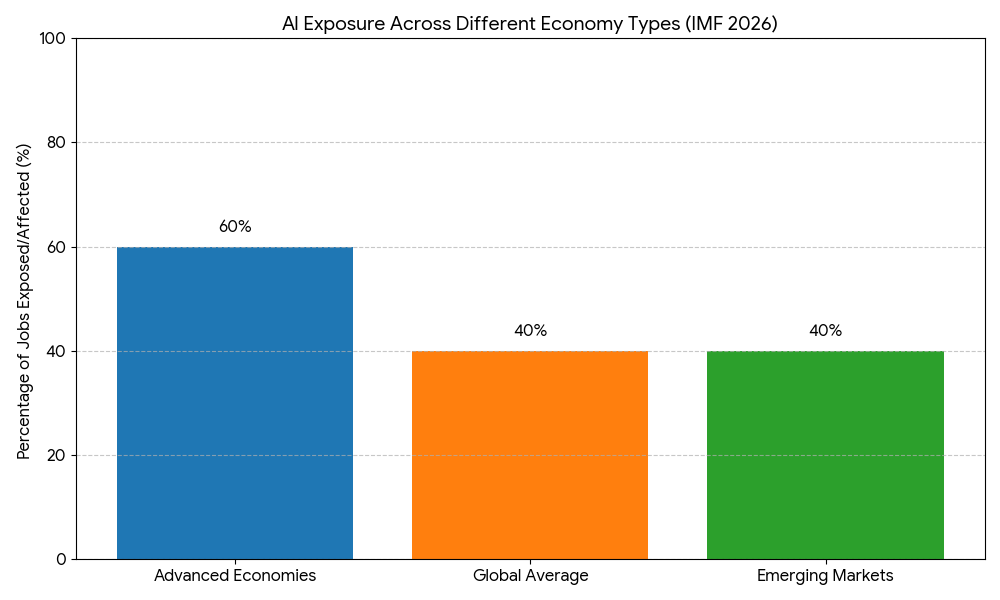
During the Davos Summit this year, IMF Managing Director Kristalina Georgieva referred to AI as a “tsunami.” She said that the AI upsurge is going to impact the global labor market. As per the data, approximately 40% of jobs globally will be significantly affected. These roles will either be enhanced or displaced due to AI. However, advanced economies face higher exposure risk, with 60% of jobs affected, compared to emerging markets, where the figure remains 40%. The greater risk is to routine, entry-level positions, which are being automated faster.
A recent warning by the International Labor Organization (ILO) says that there isn’t going to be only “job loss” due to AI but also the “job quality” degradation. According to organization’s report a small group of high-skilled AI “orchestrators” are seeing wage increases. While a large portion of the population will be pushed into low-paid, “algorithmically managed” gig jobs.
America’s leading AI safety and research company, Anthropic, is known for developing the Claude family of large language models (LLMs). Founded by former OpenAI researchers, it builds reliable, interpretable, and steerable AI “plugins.” The company recently launched such “plugins” that sent shock waves across the global IT sector. This is because these tools can effectively work like humans, potentially displacing real jobs. Anthropic CEO Dario Amodei has also repeatedly warned that the emergence of AI could wipe out 50% of white-collar jobs. This led to a massive sell-off in global IT stocks, and Indian markets also suffered. IT stocks dipped around 19%, which is nearly the same level as during the 2008 financial crisis, when they had fallen by 21%.
According to Bindra, AI may widen inequality, but policymakers can counteract this with more effective social safety nets, reskilling programs and regulations to promote ethical use of the technology. Firstly, effective social safety nets combined with reskilling programs for affected workers will be critical to achieve an inclusive AI transition. Secondly, education and training to help the workforce leverage what AI makes possible will be especially relevant in Asia’s emerging economies, given that they have relatively few jobs in which AI could make workers more productive. It will also help displaced workers transition to new roles and support research and development that enhances innovation.