
Dear readers… would you take a job on the Moon? Salary is high, cost is higher

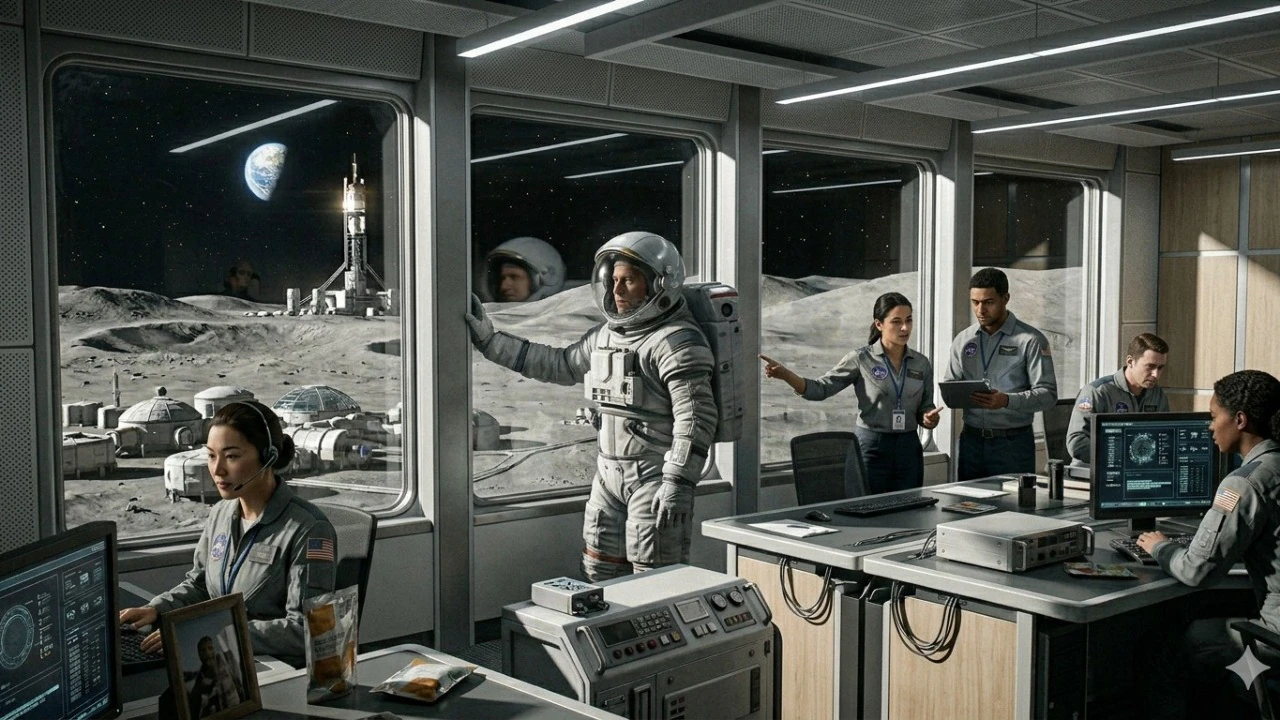

I begin this story like most modern career decisions do, with a quiet, almost absurd question. Not about purpose or passion, but about logistics. Would you leave home for work if home was 384,000 kilometres away?
You heard that right… would you work from the moon (WFM)?
As Artemis II lands on the moon and makes its way back to Earth, that question is no longer science fiction, it’s slowly turning into an employment issue. To remind our readers, this mission was never just about planting flags again, it’s more about building something far more complex.
This is great news as the mission is about a functioning human presence beyond Earth. That, inevitably, means more job creation. And the early signals of this are already visible. The recently launched Artemis II has taken humans farther into space than at any point since the Apollo era, marking a decisive step toward sustained lunar operations. What follows will not be a one-off landing, but a gradual transition toward living, working and staying.
So, for us, the question is no longer whether humans will work on the Moon; it is this poignant question… who will say yes.
PS: This is the scene you will wake up to!
The first generation of lunar workers will not look dramatically different from today’s astronaut corps. “We are saying, engineers, pilots, mission specialists… all highly trained, psychologically screened, and physically exceptional. But even within official documents, this language is slowly shifting to being real,” says career coach Anindam Ghosh, stressing that it is not a futuristic idea any more.
The Moon is no longer framed only as a destination for exploration, it is increasingly described as an economic zone, a platform for “commercial payload services”, and also private sector participation. It is this nuance that actually matters, because economies create jobs.
NASA’s own economic analysis suggests that Artemis is designed to expand the space sector, pull in private companies, and create an ecosystem where services, logistics and infrastructure become routine. In simple parlance, the Moon is being prepped not just for astronauts, but for workers.
That is where the story becomes unexpectedly human.
A lunar base will not run on rocket science alone. It will need people who can 1) fix broken systems at 3 am, 2) people who can manage conflict in confined spaces, 3) those who can cook food that others can stomach after weeks of isolation.
The second wave of lunar employment may include roles that feel strangely familiar on Earth, like technicians, medics, mental health professionals, even communication specialists tasked with turning life on the Moon into something the rest of us can watch.
In time, the prestige of such jobs may rival the most elite careers on Earth.
The first generation will not be paid like corporate executives, insists Ghosh. Astronauts today, he says, are still salaried professionals, not billionaires. But the long game will be different. As private players enter the ecosystem, the compensation model will evolve into something closer to high-risk, high-reward frontier work.
The analogy that career consultants are making these days is that it is not Silicon Valley, but a pay befitting deep-sea oil rigs. Remote, dangerous, extremely specialised, and disproportionately prestigious.
To give you an idea of what a salary would look like, India Today.in spoke with Ashish Meindiratta, a recruitment and management professional with over 20 years of experience. This is what he had to say:
Start with what we already pay for the toughest jobs on Earth. Astronauts at NASA earn about $80,000–$150,000 a year, while oil rig workers make $100,000–$200,000, often with hazard pay that can double or even multiply that.
“That gives a rough base of $150,000–$300,000. To this, now add the “Moon factor” which translates to extreme risk, total isolation, and zero real medical backup, which can push salaries up 5 to 10 times ($750,000–$3 million). Then comes distance: living 384,000 km away from Earth isn’t just remote, it’s unprecedented, so add another 100–300%, taking it to roughly $1.5 million–$6 million a year,” he says.
On top of that, you’re hiring a tiny pool of highly specialised people (mostly engineers, space doctors, AI and habitat experts) so scarcity adds another 50–200%. That’s how you arrive at an estimated $2 million to $10 million a year (16–80+ crore).
Companies like SpaceX or missions such as the Artemis Program would likely split this into base pay, mission bonuses, and hefty return incentives.
It sounds like a dream salary, until you realise what it’s really paying for. It’s not about a better life, but a life away from everything you know.
If the job description sounds glamorous, the fine print is far less forgiving. Working on the Moon means stepping into an environment that the human body was never designed for. Figure this, gravity is one-sixth of that of Earth’s. That sounds like fun until it begins to erode muscle mass and bone density.
Astronauts already spend hours every day exercising in space just to slow down physical deterioration. The Moon will not be any kinder. Then there comes the problem of isolation.
Space agencies have long studied what they call “ICE conditions.” In simple terms, it means isolated, confined and extreme environments. Research from simulated lunar habitats shows that prolonged isolation can trigger fatigue, stress and psychological strain, requiring interventions as basic as immersive virtual environments just to stabilise mood.
Now imagine that not as a controlled experiment, but as your office!
Communication with Earth will naturally come with delays, there are no spontaneous exits, no fresh air, no walking out after a bad day. Even small technical failures can carry existential risk. Lunar dust, for instance, is not just inconvenient, it is abrasive, invasive, and potentially harmful if inhaled.
A bad day on the Moon is not a bad meeting, it is life-threatening!
And yet, paradoxically, the very extremity of the environment may become part of the attraction.
Psychologists who study extreme professions have long noted that high-risk, high-isolation jobs often draw individuals seeking meaning, not just income. “The idea of being part of something larger than oneself is a powerful motivator. In that sense, a job on the Moon may not compete with corporate careers. It may bypass them entirely,” adds Ghosh.
Every job has a trade-off. The Moon simply makes that trade-off impossible to ignore. There are no families on early missions, no weekend visits, no “quick flights back home.” Relationships stretch across planetary distance. The emotional cost here is not incidental, but structural.
And yet, history suggests that humans are willing to make that bargain. From polar expeditions to offshore rigs, from submarines to space stations, there has always been a subset of people willing to exchange comfort for significance. Artemis is tapping into that same instinct, but on a scale we have never seen before.
The long-term vision is unambiguous. By the 2030s, the goal is to establish a sustained human presence on the Moon, a base that functions not as a temporary outpost but as a permanent extension of human activity. That means routines, shifts, roles, hierarchies… In other words, work.
And once work becomes normal, the extraordinary becomes ordinary. The first people to take these jobs will be outliers. The second generation will be specialists. The third may simply be employees.
Which brings us back to the original question.
Would you take a job on the Moon? The salary will likely be high, eventually. The prestige is undeniable. The view, unparalleled. But the cost is not something that can be calculated in numbers, it’s measured in distance, in isolation, in the quiet, unshakeable awareness that everything familiar is far, far away.
And yet, for some, that may be precisely the point.
– Ends