
Delhi govt, private offices to enforce 50% work from home as pollution worsens

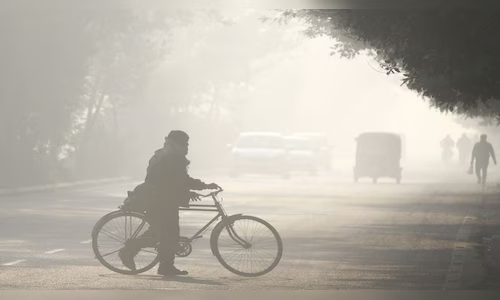

The order, issued by the Environment Department under Section 5 of the Environment (Protection) Act, 1986, took effect immediately. It applies to all Delhi government offices as well as privately run establishments within the national capital. Essential services, including hospitals, private healthcare facilities, fire services, public transport, water supply and sanitation, have been exempted.
According to the directive issued in the name of Lieutenant Governor V K Saxena, private offices must ensure that no more than half of their workforce is present physically, while the remaining personnel are required to work from home.
Private establishments will also implement staggered working hours wherever feasible, it said, adding they will ensure strict compliance with work-from-home norms and minimise vehicular movement associated with office commute.
Also Read: Delhi pollution crisis needs tough enforcement and electric transport push, say experts
The government has directed district magistrates, deputy commissioner of police and local bodies to ensure compliance with the order by all private offices in the national capital, it stated.
This was the first time that authorities have instructed private offices to “mandatorily” implement the 50% work-from-home directive. Earlier, the government used to issue advisories for the private sector about work-from-home norms.
“Violation of the directions issued under Section 5 of the Environment (Protection) Act, 1986, or the rules made thereunder shall be punishable under Section 15 and 16 of the Environment (Protection) Act, 1986 and other applicable laws,” the environment department said in its order.
All administrative secretaries and heads of government departments will attend office regularly, with not more than 50% of staff strength physically present in the office. The remaining will work from home, it also said.
Delhi’s air quality remained grim on Monday, hovering close to the ‘severe’ threshold as the city’s overall AQI settled at 382, while 15 monitoring stations logged readings beyond the 400-mark, according to the Central Pollution Control Board (CPCB). The 24-hour average AQI (Air Quality Index) settled at 382 on Monday, in the ‘very poor’ category for the 11th consecutive day.
Also Read: Delhi air quality remains ‘very poor’, overall AQI stands at 381
The environment department said that since the vehicles contribute to the city’s pollution levels extensively, it is felt that there is a need for more curbs on vehicular movement. The government of NCT of Delhi is required to take necessary measures to reduce emissions arising from transport and office-related activities during GRAP Stage-III implementation, it said.
“Delhi faces air pollution, particularly in the winter season and the level of pollutants like particulate matter concentration (PM2.5 and PM10) goes much beyond the prescribed standards for Ambient Air Quality,” the environment department said, adding the whole Union Territory of Delhi has been declared as an Air Pollution Control area.
The Decision Support System (DSS) of the Indian Institute of Tropical Meteorology, Pune, estimated that vehicular emissions contributed 21.6% to Delhi’s pollution on Monday, making it the highest pollutant source, while stubble burning accounted for 1.8%.
The CPCB’s Sameer app, which displays real-time readings from all monitoring stations across Delhi, showed that out of 38 operational stations, 15 recorded air quality in the ‘severe’ category on Monday. These included stations at ITO, Punjabi Bagh, Patparganj, Ashok Vihar, Sonia Vihar, Rohini, Vivek Vihar, Narela, Bawana, and others where AQI levels crossed the 400-mark.
As per CPCB standards, an AQI between 0-50 is ‘good’, 51-100 ‘satisfactory’, 101-200 ‘moderate’, 201-300 ‘poor’, 301-400 ‘very poor’ and 401-500 ‘severe’.
Also Read: Student athletes move High Court to halt sports trials amid Delhi’s horrible pollution