
Delhi mandates 50% work from home every winter under permanent anti-pollution plan

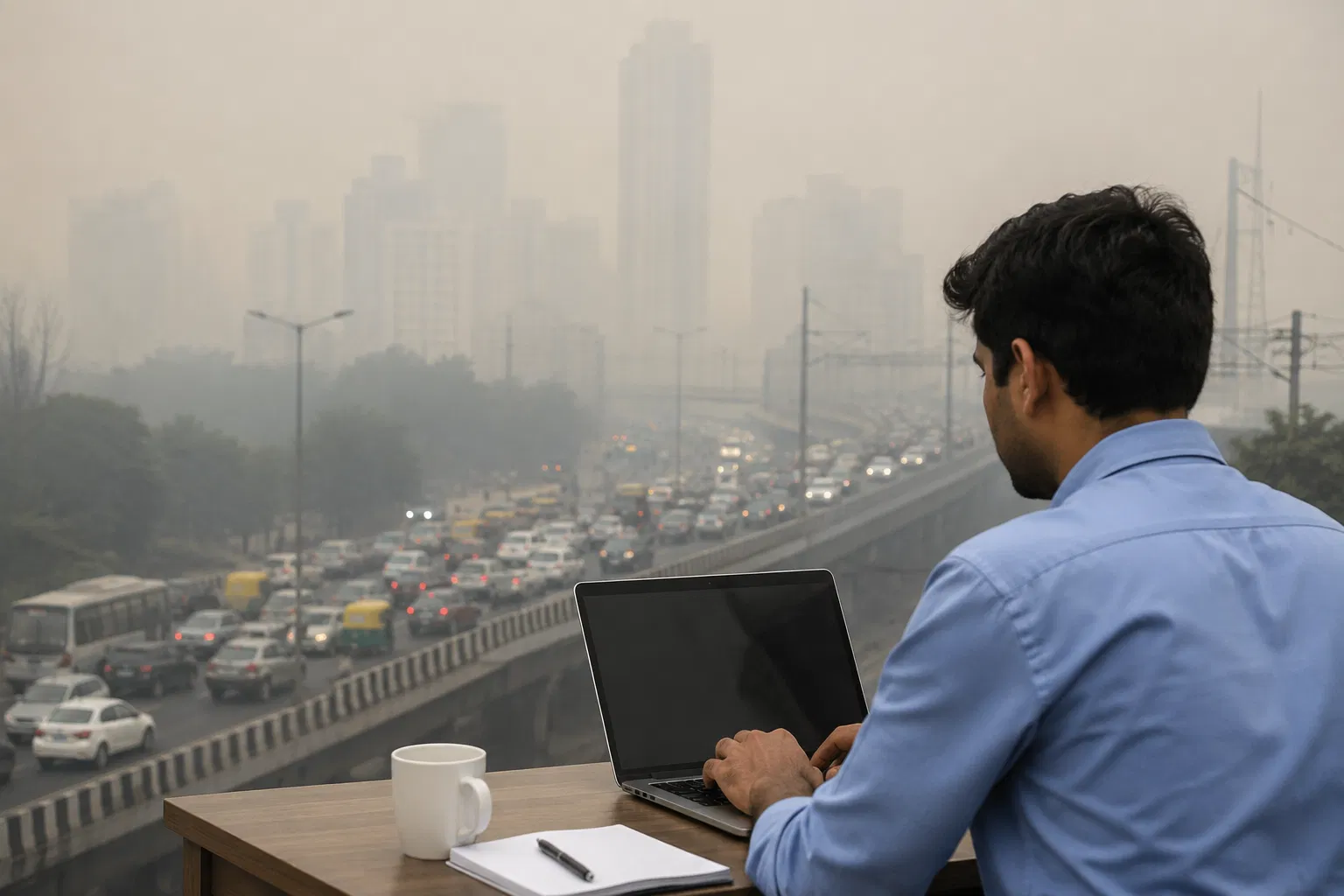

The Delhi government has unveiled a permanent winter pollution action plan that will automatically take effect every year from November 1 to February 28, replacing the practice of issuing seasonal notifications. Among its most significant workplace measures is a mandate requiring 50% of employees in government and private offices to work from home during the peak winter period.
The policy is designed to create a predictable framework for tackling Delhi’s recurring winter air pollution, which typically worsens between November and February. According to the Delhi government, the plan draws on recent air quality data and incorporates updated provisions under the Graded Response Action Plan (GRAP), directions issued by the Commission for Air Quality Management (CAQM), and orders of the Supreme Court.
The biggest implication for employers is the introduction of a recurring work-from-home mandate aimed at reducing traffic congestion and vehicular emissions.
Between November 1 and January 31 each year:
The restrictions will not apply to essential services, including healthcare, emergency services, public transport, power and water supply, sanitation, disaster management and pollution-control agencies.
The Delhi government said the permanent framework removes uncertainty created by changing restrictions under different GRAP stages and enables businesses, residents and enforcement agencies to prepare well in advance for winter pollution measures.
Chief Minister Rekha Gupta said the plan was developed after analysing winter pollution patterns and air quality trends over recent years. Government data shows:
Environment Minister Manjinder Singh Sirsa said the permanent policy would ensure uniform implementation of pollution-control measures instead of introducing restrictions at different stages of the pollution season.
The annual framework introduces several measures affecting transport, construction and commercial establishments.
A year-round restriction will prohibit petrol pumps, CNG stations and LPG outlets from supplying fuel to vehicles without a valid Pollution Under Control (PUC) certificate.
Authorities will verify compliance through physical inspections as well as digital vehicle databases, while oil companies and transport authorities have been tasked with implementation.
From November 1 to January 31 every year:
The policy introduces additional restrictions between December 10 and January 20, the period identified as the most pollution-sensitive. During this window:
To discourage private vehicle use, authorised parking facilities across Delhi will charge double parking fees from November 1 to February 28. Parking operated by the Delhi Metro Rail Corporation will remain exempt to encourage public transport usage.
The government has also introduced mandatory anti-smog measures for larger commercial buildings.
By August 15, commercial complexes, malls, hotels, office buildings and institutional facilities larger than 3,000 square metres with a height of G+5 or above must install anti-smog guns or mist systems. Construction sites exceeding 1,000 square metres will also be required to deploy dust suppression systems.
The framework places responsibility for preventing open burning of waste, leaves and biomass on Resident Welfare Associations (RWAs), housing societies, contractors, maintenance agencies and institutions responsible for specific premises.
Authorities will also deploy drone surveillance, particularly during night hours, to identify violations and initiate enforcement action.
The announcement follows the Delhi Cabinet’s approval of the state’s new Electric Vehicle Policy, which exempts electric cars priced up to ₹30 lakh from road tax and registration charges. The policy also provides for:
Together, the workplace, transport and construction measures form part of Delhi’s broader strategy to reduce emissions during the months when air quality deteriorates most sharply.
As employers prepare for another winter season, the new framework makes hybrid work no longer an emergency response but a recurring element of Delhi’s annual pollution management strategy.