ET Snapchat Gen Z Index: How Gen Z is changing shopping, careers and brand loyalty in India

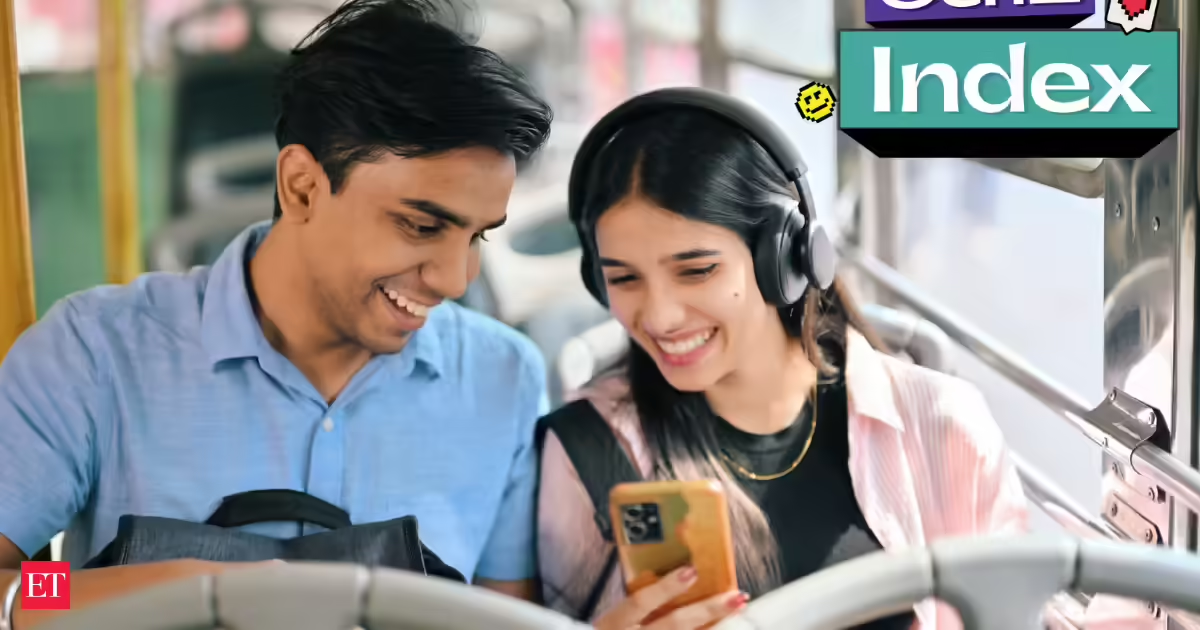

The ET Snapchat Gen Z Index is designed to provide businesses and brands with a clear, data-led understanding of this generation. The survey, powered by international market research agency Kantar, used Computer-Assisted Web Interviewing (CAWI) as its methodology.
The survey explored two broad themes: a deep dive into Gen Z mindsets and behaviours across life segments, and a yearly brand report card measuring affinity across categories.
ONE GENERATION, MANY REALITIES
A key takeaway from the 2025 data is the rejection of a long-held myth — that Gen Z is a single, uniform group. The reality, the study finds, is far more layered.
Some Gen Zers seek validation, saying “love me, want me, see me”, while some others are driven by self-belief and ambition. Many take pride in new and unconventional career paths, moving away from the idea of a single “dream job”. At the same time, worries about employment and money remain significant.
Identity matters deeply to Gen Z, but so does family — albeit with clear boundaries. While digital and social platforms form their natural environment, authenticity is non-negotiable. Trust in brands is less about legacy and more about peer validation.
 ET Online
‘REAL’ AS THE NEW CURRENCY: HOW GEN Z CHOOSES BRANDS
For Gen Z, “real” has become the dominant currency of trust. According to the Index, unfiltered, honest recommendations consistently outperform polished advertising. Relatability matters more than perfection. Gen Zs judge credibility based on believability rather than celebrity endorsement.
Gen Z gravitates towards brands that feel personal and meaning-led. They are open to niche or lesser-known brands if those brands align more closely with their identity. Technology plays a role here — tools such as AR try-ons and demos allow Gen Z to test authenticity themselves rather than relying on claims.
The 2025 data highlights a clear decision framework. Desi brands evoke pride. Products must “vibe” with personal values. Purchases are made only if they offer clear value for money. Safe spaces are defined by inner circles rather than public platforms. Mental wellness is seen as essential, not optional. Wealth creation is a long-term focus, while technology is used as a tool for efficiency, not just visibility.
EMOTIONAL AWARENESS AND SOCIAL SPACES
Gen Z shows high emotional awareness and strong boundary-setting. They are open about mental health within trusted circles, seeing support systems as more important than stigma. Social media is used as a space to exchange opinions and process experiences, but daily life updates are often reserved for close friends and family. This is reflected in the data:
– 72% openly discuss mental health with friends or family.
– 89% frequently use social media to give or get opinions.
– 64% are comfortable talking about personal life on social media.
– 78% share regular updates only with close friends and family.
GEN Z SHOPPING HABITS: VALUE-LED BUT MEANING-DRIVEN
Gen Z’s approach to shopping is both strategic and expressive. Deal-hunting is a lifestyle, not an occasional activity. At the same time, they do not buy brands purely for their name. The numbers make it clear:
– 93% research both offline and online to find the best deals.
– 87% buy brands that have personal meaning to them and their friends.
– 84% follow influencers who share real, authentic experiences.
– 79% are open to buying niche or less-known brands.
– 88% take pride in buying Indian-origin brands.
– 79% trust influencers who look and talk like them.
ET OnlineGEN Z MONEY MINDSET: SAVING AND INVESTING
When it comes to money, Gen Z shows discipline and foresight, the survey found. Saving comes before spending, and long-term wealth creation is prioritised over short-term trends. Gen Zers see financial independence as a plan rather than a distant aspiration.
Stable options such as fixed deposits, savings, mutual funds and stocks are preferred over risky, hype-driven instruments.
GEN Z WORK-LIFE EQUATION
For Gen Z, work is important, but it is not the sole focus of life. Flexibility defines Gen Z’s ideal work style, with equal weight given to pay and peace of mind.
As per Q2 data, 35% prefer hybrid work models, 17% prefer work-from-home, 26% prefer work-from-office, and 9% prefer field work. Another 13% show a preference for entrepreneurship.
Q2 findings on career motivations show a balance between practicality and purpose: 35% cite salary as the primary driver, 24% prioritise work-life balance, 17% focus on job security and stability, 15% on passion fulfilment and 9% on making a difference.
ET Online
LIFE MADE SIMPLE VIA TECH
For Gen Z, technology is not about chasing likes; it is more about reducing friction. AI is used as a practical assistant for studying, work and problem-solving. Gen Zers use AR both as a creative and a functional tool that help them as much with content creation as with shopping and discovery.
As per the findings for Q4, 80% of Gen Zers reported using AR features in the previous six months. Around 62% said AR helps them create content that feels more unique, while 57% prefer interactive AR content over static photos or videos. A similar-sized sgement feels AR helps them express their personality online.
Trust in AR is growing among Gen Zs; 66% agree AR tools help them understand products better than regular images or videos, and 62% say AR demos feel more believable and trustworthy.
GEN Z CAREER PATHS
Gen Z’s career mindset is marked by flexibility and continuous upgrading. Education is viewed as an investment that unlocks options rather than as a fixed pathway.
According to the data, 77% plan to pursue higher education and 67% plan to study abroad. In Q3, career interests were split across multiple paths: 28% leaned towards corporate jobs in India, 25% towards starting a business or startup, 21% towards government or public sector roles, 13% towards working abroad, 10% towards creative or freelance careers, while 4% were still exploring their options.
Career preparation paths are equally diverse, with 35% planning to graduate and start working, 24% to complete a Master’s degree first, 18% to pursue research or academia and 19% to train in specific skills.
BRAND WAGON: SO, WHO IS WINNING WITH GEN Z?
The Brand Index Score was calculated using five metrics — brand consideration, advocacy, love, trend-setting ability and excitement — combined into a composite score and indexed to category averages.
The results show clear category leaders. In ecommerce, Amazon remains on top, followed by Flipkart and Myntra, with distinct gender and geography skews. In fashion, Nike leads on energy, with Adidas, H&M and Puma close behind. In beauty, Dove leads overall, while Lakmé, L’Oréal and Maybelline skew female.
Zomato leads food delivery, Netflix dominates OTT, Coca-Cola tops beverages, and Samsung and Apple lead mobile phones — each category showing stable leadership rather than fragmentation.
GEN Z ERA IS HERE. WHAT BRANDS MUST GET RIGHT NOW
Looking ahead to 2026, the message from Gen Z to brands and business is consistent: value remains critical, but meaning is rising. Discovery is increasingly creator-led, especially through micro-creators who feel more real and credible to Gen Zers.
To win in the era of Gen z, brands must combine affordability with identity, use AR and AI for genuine utility, tell their stories with clarity and align their marketing strategies with things that matter most to this increasingly powerful consumer demographic — wellness, confidence, work-life balance and being “real”.
ET OnlineRead the full report here
ET Online