High ‘churn rate’ is desperation for jobs, quick exit due to instability



Quick commerce and delivery platforms have become the lifeline of urban consumers. The delivery rider, zipping through chaotic traffic, is now a ubiquitous symbol of urban convenience. However, a troubling paradox defines this sector: the very speed with which workers take up gig work is matched by the rate at which they abandon it.
Beneath the glossy facade of the sector’s “flexibility” and “earning potential” is the reality of financial instability, physical risk and systemic neglect that pushes a vast majority of riders to exit in a matter of months.
The strikes by riders across India during Christmas and New Year protesting against unrealistic promises of 10-minute delivery and slashed payments highlight the growing collective frustration.
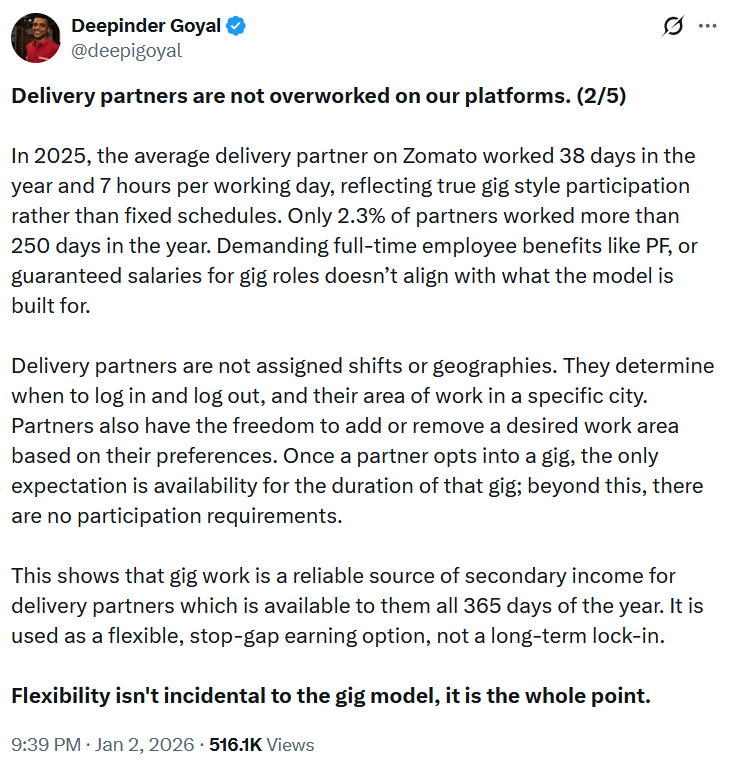
In response, Deepinder Goyal, the founder of Zomato’s parent company, claimed that gig work is “one of the largest organised job creation engines in India” and that this work allows riders to build a better future, secure jobs in the formal sector and educate their children.
It would “bring more people into the fold, who will be able to earn some money, upskill themselves and later join India’s organised workforce”, he declared pointing to the high churn rate in the sector as evidence of this.
The high churn rate is certainly true. Over half of all riders quit every week, replaced by new entrants. As a gig worker myself, I can testify that the claim of gig work being a stepping stone into the formal sector holds true only for a small percentage of riders, those who already enter the workforce with education and specific skills.
For everyone else, delivery work is primarily a means of desperate survival, a dead-end trap with no scope for career progression or skill development relevant to the formal economy.
The sector attracts individuals from diverse backgrounds from Class 12 pass-outs, graduates, ITI dropouts to former factory workers. What unites them is not educational qualification or class but economic necessity, the lack of alternative job opportunities and the alluring myth that this work offers freedom.
The journey often begins with attractive incentives and bonuses, painting a picture of a promising future. But the actual experience quickly reveals a harsher truth. The platform economy promotes an ideal worker – one who can work like a machine for 16-18 hours non-stop, unburdened by social or familial responsibilities.
A tiny fraction of riders who can withstand this model might manage to save a little money. For the vast majority, their earnings barely cover two meals and the monthly rent.
A primary driver of this high attrition is the constant decline and extreme volatility of income. Raghav, a 27-year-old graduate from Agra who moved to Ghaziabad, turned to delivery work for Blinkit after losing his job during the Covid lockdown. As the sole earning member supporting his father, who had retired from the army, his housewife mother and a younger brother, the initial promise soon faded.
“It seemed okay at the start, but I would end up with only about Rs 7,000 a week,” he said. He worked for eight to nine months before quitting, due to falling payment rates, increasing targets and no future.
Surjeet, from Delhi, who worked for Swiggy for five years, drove himself relentlessly for 18 hours a day to support his wife, children and siblings. He even received an award from the company for his flawless record, but the post-lockdown changes broke his resolve.
“After the lockdown, the company cut the pay… earnings started decreasing and I was forced to leave the job,” he said.
Companies often make promises such as “earn Rs 40,000 a month” but Vijender, a 25-year-old from Delhi studying for a Bachelor of Computer Applications degree while shouldering family responsibilities after his father’s death, found the promise hollow.
“To earn Rs 40,000, you have to work 17-18 hours,” he said.
The uncertainty of not knowing how many orders will come each day nor how much time will be wasted searching for addresses, creates permanent anxiety. Income fluctuates wildly while costs like fuel, vehicle maintenance and mobile data are. This is the economic mill that grinds down riders’ savings and traps them at a bare subsistence level.
The physical dangers of the job add another layer of peril. Sameer, a 22-year-old from Bihar living in Delhi, had to leave his ITI course in motor mechanics due to family circumstances. He took up work with a delivery service hoping for flexibility, but found the costs and risks overwhelming.
While delivering a parcel in Noida, a car hit him, leaving his vehicle destroyed and his leg fractured. His plea to the company for help went unanswered. It was a kind customer who assisted him. Worse, when he recovered and returned, the company slapped him with a Rs 15,000 penalty for the damaged vehicle.
Vijender faced a similar ordeal after his accident in Greater Kailash in Delhi. “I asked the company for help, they didn’t help at all,” he said. It was a fellow rider who took him to the hospital.
Though platforms call their riders “partners”, in times of crisis, they offer no health insurance, financial aid or even basic human empathy. The rider is left to their own devices and, occasionally, the mercy of generous customers.
Beyond the economic and physical risks, there is also immense psychological pressure. Riders are caught in the twin grind of customer ratings, complaints and the app’s stringent, often opaque, rules. A small delay or mistake perpetuates the constant fear of their ID being blocked, leading to the loss of livelihood.
Working 18-hour shifts makes spending time with their families nearly impossible. Vijender explained the worry he caused at home: “My family was also constantly worried about me… what if I have an accident?”
For Surjeet, the breaking point was his mother’s emotional plea. “Son, we don’t even see your face anymore,” she said. This pressure is crushing for riders who are the sole breadwinners in their families.
Where do riders go after they quit? Their destination depends on their educational and economic capital. Riders such as Raghav, a graduate with previous skills, leveraged his education when his former manager offered him a position. He found a better role as a field manager within the same platform ecosystem.
On the other hand, riders like Sameer, whose education was interrupted and who possesses no specialised skills, often return to their previous occupations. Sameer is back to working at a factory, earning Rs 13,000.
Some, like Surjeet, shift to traditional sectors. He now drives an auto-rickshaw for Rapido and Uber, where earnings might be lower but he has more control over his time and family life.
The most tragic situation is that of riders like Vijender, who, after quitting on his mother’s insistence and following his accident, found himself completely unemployed, dependent on his brother to start a business, a dream with no clear path.
The dream of self-employment is almost universal among riders, it materialises only for those few, like Surjeet, who could save something after years of working for 18 hours a day. For the rest, the gig economy is a cyclical trap: easy to enter, but incredibly hard to escape or advance within.
The high turnover rate in the delivery sector is an inevitable outcome of a system designed for maximum flexibility with minimum responsibility to the companies.
This work has become a stop-gap solution for immediate economic distress and is no way a sustainable livelihood. The fundamental reason behind riders entering and exiting is the same: the compulsion of subsistence.
Their departure is just a “churn rate” statistic for the companies, but stories like those of Raghav, Sameer, Surjeet, and Vijender paint a picture of the human reality behind numbers: broken limbs, lost dreams and strained families.
Finding a solution to this crisis cannot rely solely on the perceived resilience of the riders. It requires a concerted effort from platforms, the government and society to build policies that guarantee a fair minimum wage, comprehensive accident and health insurance, social security benefits and humane working conditions.
Only then can gig work transform into a genuine livelihood option with dignity, rather than a quicksand trap where workers struggle against exhaustion, uncertainty and despair.
Javed is a gig worker and organiser. This article was compiled and translated by Ambika Tandon, who is affiliated with Rajdhani App Workers Union of the Centre of Indian Trade Unions.