How Karnataka’s Shakti is changing women’s work

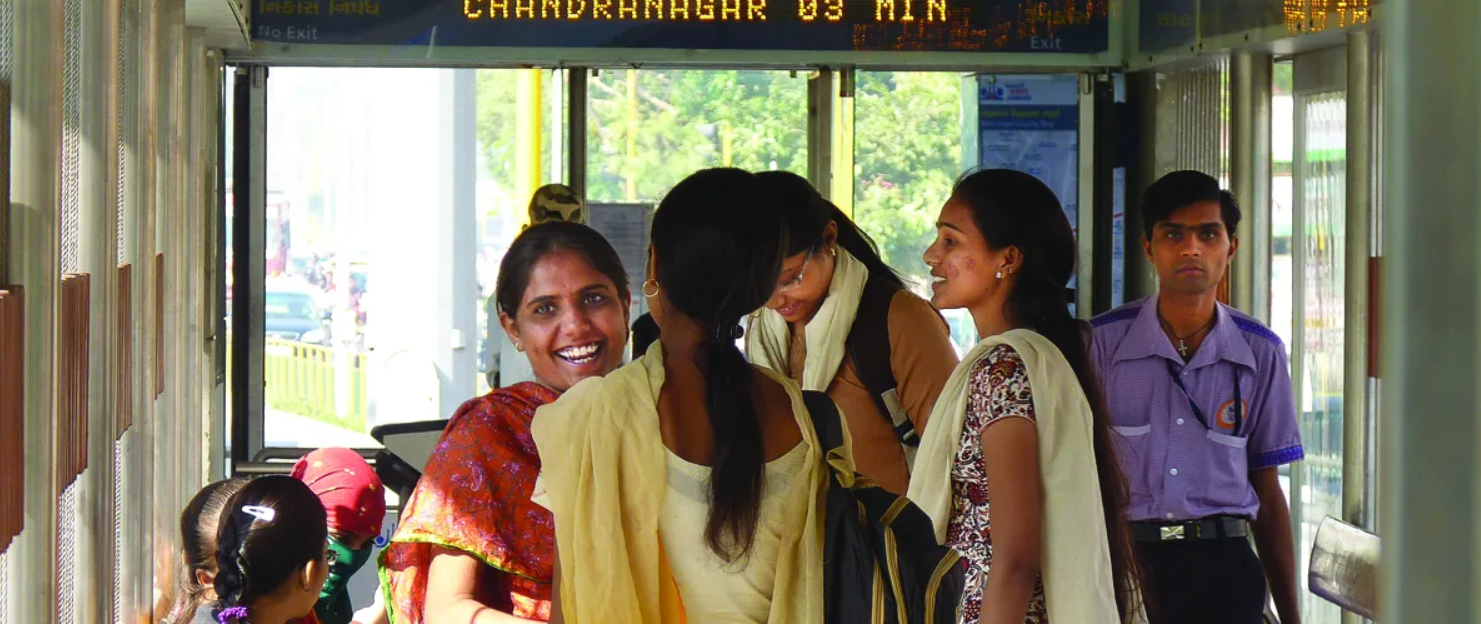

In Karnataka, the Shakti scheme has made state-run buses free for women since June 2023. In this note, based on a survey of about 250 women, Jana and Paul assess the impact of the intervention on women’s mobility and work in the smaller towns and villages of the state. They find that the scheme enhanced women’s ease in reaching work locations or accessing labour markets farther from home.
India has set a national target to increase the female labour force participation rate (FLFPR) to 55% by 2030, as this is central to India’s economic growth. Whether India can meet that target depends largely on how women move to work. Public debate on women’s mobility still circles around big cities, with focus on safety in the metro, app-based last-mile services, and crowding on urban corridors (Oxford Economics, 2023, Bhatt et al. 2015, Borker 2024, Greenpeace India, 2023), while often forgetting the everyday journeys women make in villages and small towns. Rural and peri-urban women, who face limited and irregular transport networks, dispersed job markets, and restrictive social norms that require them to stay close to home, seldom appear in this debate.
Our study on Karnataka’s Shakti scheme, which has made state-run buses free for women since June 2023, aims to look at what this change means in smaller towns and villages. The central question is straightforward but carries complex ramifications: when public transport becomes free in areas where buses are few and jobs are hard to find, what changes in women’s paid work?
In Chamarajanagar, Mandya, Chitradurga, and Kalaburagi districts, we surveyed about 250 women using a detailed questionnaire to test five channels of change in work and mobility. The first is a price effect: when fares fall to zero, bus use should increase because women substitute away from costlier modes such as shared autos and because the lower price induces new trips that previously did not occur (Litman 2004, Nowak and Savage 2013, Holmgren 2007). The second is a spatial job-search effect: cheaper mobility should expand a woman’s feasible commute radius and thereby enable first-time entry into the labour force or access to more stable or better-paid work (Franklin 2017, Abebe et al. 2016, Phillips 2014, Moreno-Monroy and Posada 2018, Chen et al. 2024). Third, the study hypothesised improvements for women entrepreneurs and small traders (Women’s World Banking, 2015, World Bank, 2017). With free transport, women running small businesses could travel to distant wholesale markets to source cheaper supplies, potentially boosting profit margins. Fourth, rural women in agriculture could use free buses to do seasonal work in urban areas during lean farming periods (Bryan, Chowdhury and Mobarak 2014). The fifth hypothesis is more cautionary: free transport might encourage women to accept lower-paid jobs, since travel cost is no longer a deterrent, leading to wage suppression in the local labour market (Firat and Sever 2024).
Our study finds that a minority (10.5%) of respondents entered paid work for the first time after Shakti. A majority reported travelling more often for work (61%) and travelling for longer distances than before the scheme (59%). There was a visible shift from paid autos to free buses, which meant women had money that they could save or reinvest, including in small businesses. These are not spillovers from metropolitan areas. They are effects rooted in places where the bus is often the only public transport option, and where every rupee matters. In such settings, a zero fare does not merely make an existing commute cheaper. It lowers the threshold for participating in the labour market. Women in Kalaburagi and Chitradurga, the northern and more remote parts of Karnataka, where transport connectivity is typically weaker, note that it has become easier to reach work, while women in Mandya and Chamarajanagar report smaller yet clear increases.
Many agricultural labourers (17%) and casual workers (11%) increased the number of days they worked in a month because distant worksites became reachable and last-minute calls became feasible. Monthly earnings rose because women could work for more days, but wages did not rise. The dominant outcome is an ease in reaching work locations (77%) or accessing labour markets farther from home (47%) rather than an increase in wage rates. Chitradurga and Kalaburagi, which have higher rural FLFPR and more women in the Mahatma Gandhi National Rural Employment Guarantee programme (MNREGA) than Mandya and Chamarajanagar, show the highest shares of women reaching labour markets farther from home and the highest shares reporting more days of work. One of the most important findings is also how fare-free transport reshapes informal livelihoods. Street vendors and small traders reported that they now travel to distant labour markets, purchase goods in bulk, and return with cheaper inputs, which raises profit margins. One vendor in Mandya district reported that undertaking longer trips to Mysuru has become a habit. She believes that even if fares return, she will continue to travel farther, though less often.
Measuring labour outcomes from free transport is both difficult and necessary. In the absence of official baseline data before Shakti’s rollout, women were asked to recall changes in their work and travel before Shakti. To make responses more accurate, questions were anchored to meaningful distance categories, such as within the gram panchayat, outside the gram panchayat but within the taluk, outside the taluk but within the district, and so on. Women travelling outside their gram panchayat but within the taluk for work fell from 63% before Shakti to 51% after Shakti, whereas women travelling outside their taluk (but within the district) increased from 14% to 24% after the scheme’s rollout, which means that women are extending their travel beyond gram panchayats and expanding their travel radius to access labour markets. Mandya, which is strategically located on the Bengaluru-Mysuru corridor with relatively strong road and railway links, shows the sharpest rise in outside-taluk work trips and in inter-district travel.
In terms of occupations, women in the manufacturing sector are the most likely to access labour markets further from home, while agricultural workers report smaller changes in distance, but a higher chance of working for more days in a month. Women engaged in the service sector (such as housekeeping, hospital support staff, salon work) and other informal work (for example, daily-wage labour, street vending, construction work) are much less likely to report moving into better-paying jobs due to Shakti, compared to women working in agriculture or manufacturing, which could be attributed to the nature of jobs available to women in these sectors.
Looking at a fare-free scheme through a rural and peri-urban lens yields a set of specific, practical recommendations. First, improve service design (predictable timings, higher frequency, better crowd management, and staff training on gender-sensitive conduct) and not only the price point. Second, align bus networks to women’s commuting realities outside large cities. In places where women are travelling farther to access labour markets or source raw materials for their business, align routes to wholesale markets or industrial estates. Small schedule changes can deliver large labour effects. Third, address last-mile bottlenecks. Low-cost shuttles or e-rickshaws near worksites can turn occasional trips into actual workdays.
Public debate has often treated fare-free buses as an urban-safety measure or a household savings scheme. Our findings from rural and peri-urban Karnataka suggest that the success of schemes like Shakti should also be judged by whether, in poorly connected towns and villages, more women can actually reach and retain paid work, get to new worksites, work for more days, and access jobs that were previously out of reach. Nationally, the FLFPR has risen in recent Periodic Labour Force Survey rounds (from 20.4% in 2017-18 to 41.7% in 2023-24), but much of this increase is concentrated in rural areas, and much of this work remains overwhelmingly informal. In such settings, free transport can expand the radius of opportunity, but it will not, by itself, improve wages where employers are few. Free transport helps women take up more of the work that exists, and that matters for household income and savings, but it is not a silver bullet for improving the FLFPR. Yet, in places where distance effectively determines opportunity, fare-free transport is a lever that can open the labour market just far enough for women to step through.
This study was carried out under the Laws of Social Reproduction project and received funding from the European Research Council (ERC) under the European Union’s Horizon 2020 research and innovation programme (grant agreement No 772946).