India Will Become A Leader In Applied AI: Nilekani


.
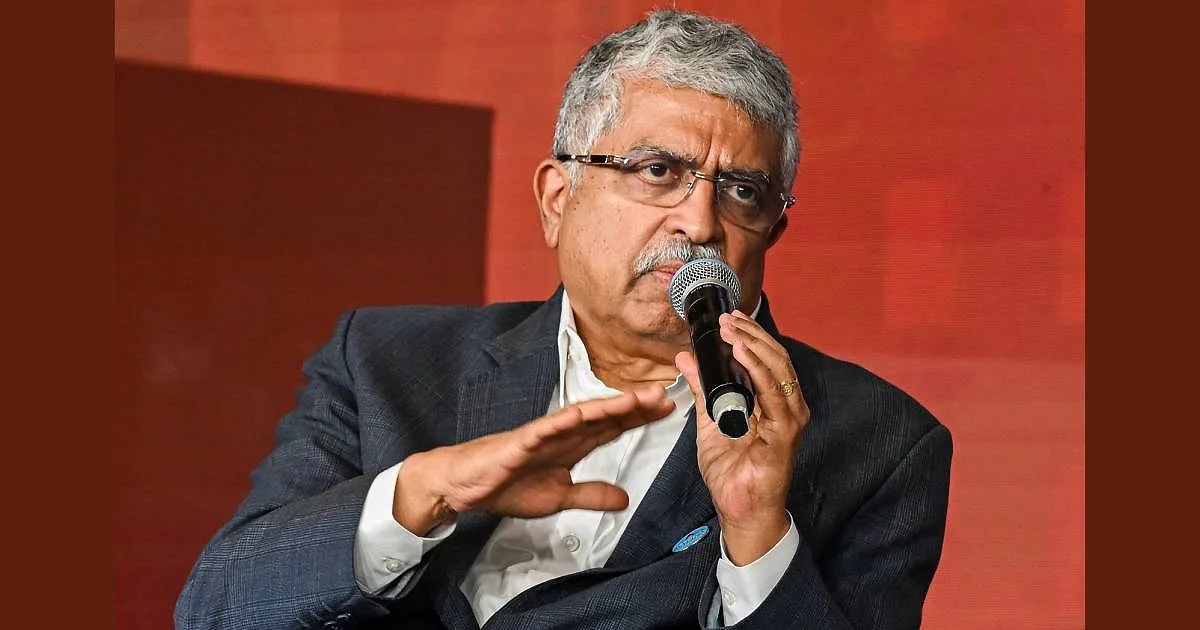
IMAGE: Nandan Nilekani. Photograph: Jitender Gupta/ANI Photo
Future jobs in India will be created by small businesses rather than large corporations, Infosys Cofounder Nandan Nilekani said on Thursday, pointing out that big companies will likely become “net job losers” as artificial intelligence makes them increasingly vulnerable to automation.
Nilekani predicted this shift in hiring patterns while speaking at an event organised by the National Council of Applied Economic Research in New Delhi.
Employment, he said, will increasingly come from small firms where workers perform multiple roles rather than from well-structured companies.
The shift is already becoming visible.
Some of India’s top information technology companies have slowed down hiring of freshers.
In June, for instance, Tata Consultancy Services Chairman N Chandrasekaran acknowledged for the first time that the firm will hire less compared to previous years and would have as many AI agents as human employees in the foreseeable future.
With AI taking over tasks, a number of companies have also seen layoffs in recent years.
The World Bank, in its latest World Development Report 2026, too, pointed out that generative AI is beginning to alter hiring patterns in South Asia, with multinational companies and firms integrated into global value chains reducing recruitment more sharply than domestic firms, signalling the technology’s early impact on the region’s export-oriented services sector.
Nilekani said “since large companies are so well structured, every job is reduced to a few sets of tasks.
“It’s also easy to automate that and remove jobs.
“So, large companies actually will probably be net job losers in the coming years”.
He also called for simpler regulations, easier access to credit and markets, and AI tools to help small businesses.
Initiatives such as the Account Aggregator Framework could improve access to formal credit, while the Open Network for Digital Commerce could help small firms reach larger markets, Nilekani said.
Together, with deregulation and AI-enabled business support, these measures could empower millions of entrepreneurs, he added.
Nilekani’s view was that India should deploy AI to broaden access through voice and local-language interfaces.
He argued that the country can become the world’s “AI use-case capital” by applying technology to education, agriculture and health care rather than focusing on infrastructure alone.
“It’s in the area of applied AI that India will become a leader.
“I think applying AI to change the lives of Indians and at population scale — just like we did with DPI [digital public infrastructure] — is really where it’s going to go,” Nilekani said.
India should, therefore, focus on deploying AI to solve real-world problems rather than competing in chips, data centres and large language models, he suggested.
AI should be made available through voice interfaces and native Indian languages so people can access knowledge regardless of English literacy, Nilekani said.
Tailoring tools to local dialects — and the way Indians naturally mix languages — will significantly broaden technology adoption and boost productivity, he added.
Nilekani also called for portable digital credentials and portable social safety nets as gig work and job mobility expand.
“We need to make sure that all your benefits — with savings, pensions, insurance, unemployment, health care, all that — should be completely portable so that you can carry your benefits with you,” he said.
India, he added, must also educate its young population while creating jobs and entrepreneurship opportunities if it is to realise its demographic dividend.
Feature Presentation: Ashish Narsale/Rediff