Source: FL
Subject: Economy
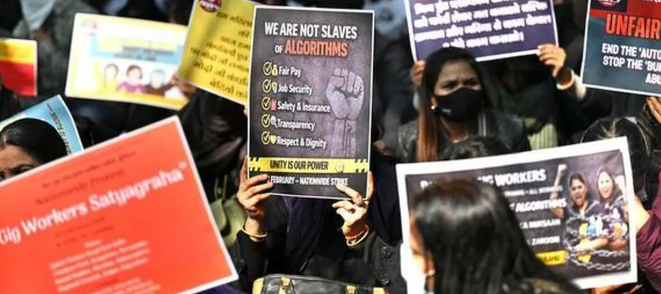
Context: The recent nationwide strikes by gig workers, contractual teachers, and ASHA/Anganwadi workers have highlighted the surplus labour trap, where millions remain in low-productivity, precarious jobs.
About India’s Surplus Labour Trap:
What is India’s Surplus Labour Trap?
- The surplus labour trap refers to a structural economic condition where a vast portion of the workforce is stuck in low-wage, low-productivity roles (like gig work or subsistence farming) because the formal economy fails to create enough high-quality jobs.
Data/Facts on India’s Labour Market:
- Informality: Approximately 90% of India’s 650 million-strong workforce is employed in the unorganized sector, lacking formal contracts or social safety nets.
- Labour Force Participation: Around 350 million people of working age do not seek work, indicating a massive pool of discouraged or underutilized human capital.
- Low Compensation: Community health workers (ASHAs/Anganwadis) receive honoraria as low as ₹7,000–₹12,000 per month, which often falls below the statutory minimum wage.
- Public Sector Desperation: Thousands of college graduates frequently apply for a handful of low-level government Group D posts (peons, drivers), reflecting the dearth of dignified private-sector roles.
Potential of the Indian Labour Market:
- Demographic Dividend: India has one of the youngest populations globally, providing a massive window for productivity if skilled correctly.
E.g. The rise of Global Capability Centres (GCCs) in Bengaluru shows how Indian talent can power high-end global services.
- Digital Economy Leadership: The rapid expansion of the digital ecosystem can create new forms of flexible employment.
E.g. The ONDC (Open Network for Digital Commerce) aims to democratize e-commerce, potentially empowering millions of small retailers and delivery partners.
- Manufacturing Hub (China Plus One): Global supply chain shifts offer a chance to absorb surplus agricultural labour into factories.
E.g. Apple’s ecosystem expansion (via Foxconn/Tata) in Tamil Nadu and Karnataka is creating thousands of formal manufacturing jobs for women.
- Green Energy Transition: The shift to renewables can create a new green workforce.
E.g. The PM-Surya Ghar Muft Bijli Yojana is expected to create a demand for thousands of solar technicians and installers across rural India.
- Social Infrastructure Hub: Expanding health and education can turn surplus labour into productive care economy professionals.
E.g. The expansion of AIIMS-like institutions and medical colleges across States is slowly formalizing healthcare roles in tier-2 cities.
Challenges Associated:
- Job Precarity (Gig-ification): Algorithmic management and 10-minute delivery mandates prioritize speed over worker safety.
E.g. Recent strikes by Zomato and Blinkit workers in Gurgaon highlight the fatal risks and lack of accident cover in quick-commerce.
- Stagnant Real Wages: Inflation has outpaced the honoraria and wages of low-end workers, leading to reduced purchasing power.
E.g. MNREGA wage rates in several states remain below the market agricultural wage, failing to act as a proper safety net.
- Skill Mismatch: A high percentage of graduates lack the technical skills required for modern industry.
E.g. The 2024 India Skills Report noted that only about 50% of graduates are truly employable, leading to over-educated peons.
- Gender Discrimination: Women bear the brunt of informalization and voluntary community work without fair pay.
E.g. Anganwadi workers’ protests in Delhi and Maharashtra highlight how they are treated as volunteers despite performing essential state functions.
E.g. The Silkyara tunnel collapse exposed how sub-contracted workers often operate without basic safety protocols or insurance in high-risk zones.
Way Ahead:
- Formalize the Informal: Implement the Social Security Code with clear rules to ensure gig and platform workers receive health and accident insurance.
- Invest in Human Capital: Shift fiscal priority from physical infrastructure (stadiums/campuses) to human infrastructure by hiring regular, tenured teachers and health staff.
- Living Wage Transition: Reclassify community workers (ASHAs/Anganwadis) as civil posts or formal employees to ensure they receive at least the national floor minimum wage.
- Strengthen Collective Bargaining: Protect the rights of workers to form unions and negotiate without fear of repressive administrative action or lathi charges.
- Decentralized Industrialization: Encourage small and medium enterprises (MSMEs) in rural areas to absorb surplus labour closer to home, reducing the trap of desperate urban migration.
Conclusion:
India stands at a crossroads where its vast labour force is either its greatest asset or a ticking socio-economic time bomb. Transitioning from an economy of replaceable labour to one of dignified employment requires moving beyond rhetorical sympathy toward concrete fiscal commitment. Only by empowering the bottom of the pyramid can India generate the aggregate demand necessary for sustainable, long-term growth.