Jammu and Kashmir’s Reservation Debate and the Crisis of Merit


In the ninth episode of The Kashmir Notebook, host Gowhar Geelani is joined by a panel of experts to lead a discussion on the reservation policy in Jammu and Kashmir, an issue that has triggered deep divisions among students, activists, and young job-seekers across the region. The panel brings together voices from across the spectrum: Amara Sehar Qureshi, a PhD scholar; Mubashir Ahmad Naik, working president, Jammu and Kashmir Student Association (RBA); Sahil Parray, a student activist; and Abid Jamal Doie, representative of the Gujjar Bakerwals Student Alliance.
They debate the impact of recent changes to reservation policy, allegations of vote-bank politics, and claims that open merit candidates are being structurally squeezed out of government jobs and professional education. The panellists also raised concerns about unemployment, the absence of a private sector in Kashmir, and the dangers of the youth’s prolonged frustration.
Edited excerpts:
Gowhar Geelani: Amara, what are the adverse impacts of the reservation on you?
Amara Sehar Qureshi: This noble idea of reservation, which wanted to include the excluded group, has inadvertently excluded the open merit group. In every stage of my admissions, I faced very few opportunities for open merit students. When I started my coaching institute for UPSC [Union Public Service Commission], I met many students from different backgrounds. But when our exams were being held, I got to know that they have multiple certificates. And they can choose from whichever certificates they want to. And they have the same economic and educational standards as I have.
A friend of mine had an SC ID [Scheduled Caste ID] as well as an RBA [Resident Backwards Area] certificate. She had done her Master’s from Delhi University. She belongs to a very good, educated family. Despite us being the same score holders, she will have more opportunities because she has that certificate, and she will be in the top list. It is very demotivating for an open merit student who has the same aptitude and ability. I am a Bama student, as well as being a female, who already has fewer opportunities.
Gowhar Geelani: Mubashir, you come from the Chenab Valley, where there is a lack of facilities. Are you rationalising?
Mubashir Ahmad Naik: I was listening to ma’am’s words with great interest, and what she was saying about how one candidate has certificates of multiple categories [RBA, OBC, ST1, ST2, EWS, IB]—I do not think any student belonging to the reserved category will like it if there is a person with certificates of many categories. We are not against reservations. We are not against anything that the government wants to do. However, we do not think that it is right to “hammer” students from one category again and again. You cannot continuously reduce [the quota] for one category. Because, as you have also said, you spoke about the Chenab valley. You are aware of the kind of circumstances that we live in.
Apart from the Chenab valley, there are many other neighbourhoods where people do not have even basic amenities. So, if the youth from these neighbourhoods manage to improve their circumstances through the benefit of reservation, I do not think that this harms the prospects of other students.
We, too, want rationalisation to happen. No RBA [Reserved Backwards Area] student, no student of any other category, is against rationalisation. The rationalisation should be based on scientific data. It should be based on the survey, it should be based on poverty, poor road connectivity, and poor infrastructure.
The census was last done in 2011. The population ratio of various castes is the same. When the RBA quota was given back then… You would know, when this was started in the 1990s, it was made very clear that those neighbourhoods where, even now, there is poor road connectivity—that was one of the factors that was considered—where the infrastructure is poor. Even now, you can see that those neighbourhoods lack the proper infrastructure. Even now, there is no road connectivity. Even now, we lack basic amenities. We had hoped that the government would increase the quota for these categories from 10 per cent to 15 per cent. If rationalisation had been done…
Do you come under the RBA category?
Yes, yes. I am from the RBA category. I come from the Chenab belt. The entire Chenab belt comes under the RBA category. And if rationalisation occurs, then… of course, all of us [from the Chenab belt] are in favour of rationalisation. But the way the process has been carried out… When the cabinet sub-committee report was sent for approval to the Lieutenant Governor’s office…
Also Read | The National Conference government is a saga of surrender: Zuhaib Yousf Mir
Gowhar Geelani: Sahil, what is your main contention?
Sahil Parray: This policy was brought in March 2024, and it limited our opportunities. The general category population is 70 per cent. 70 per cent population can only compete for 30 per cent. 30 per cent is open for everyone. This policy was against the Kashmiri-speaking people. They wanted to win the election. I call it institutional gerrymandering. They are just shrinking our space. Kashmir is the only region in the whole country where 70 per cent population can only compete for 30 per cent.
This is not affirmative action. This is affirmative marginalisation. We are asking for the rationalisation of the reservation. It should be based on adequate representation. If their representation in the government is 2 per cent, we can make this 2 per cent to 4 per cent. But at the same time, our representation is also must. You cannot shrink our space in our own system. The cutoff for NEET UG [National Eligibility cum Entrance Test—Undergraduate] in 2025 went to 647 out of 720. If a guy who scored 646 is sitting at home right now, fighting depression. At the same time, his friend from reserved category scored 300, and he’s staying in medical college.
Gowhar Geelani: Abid, what problems do you face?
Abid Jamal Doie: First of all, I would like to say… When you look at the places where the Gujjar population stays, right in those neighbourhoods, you will see a lack of facilities for electricity. Water, electricity, anything… even roads. [A lack of these] marks where our population lives. We live in the jungle. The education of our children is affected by seasonal migration. When our people come down from our neighbourhoods. If we talk about reservation without talking about caste discrimination, then [the conversation] will remain incomplete. First, we need to face these issues. Our children learn in seasonal schools, in mobile schools. If you compare them to children studying in Srinagar, in Jammu, in smart cities. It [outcomes] is directly related to the facilities that children have access to.
Gowhar Geelani: So you are talking about lack of basic infrastructure, electricity, access to education, internet, etc.
Abid Jamal Doie: Geographical isolation as well. All these things affect us [Gujjars]. Directly and indirectly. On every issue. People from the open merit category say that the reservation quota for us should be reduced. Open merit people talk [about reservation] on social media, on national news networks, without understanding the kind of lives that we live, without seeing the neighbourhoods that we come from. They say whatever comes to their mind while talking to the national media, all while sitting in their cities. They say that Gujjar officers get jobs despite scoring low. They say that we lack skills.
They are blaming us straight away. Reservation gives us a push. Reservation gives a push to the talented among us so that they can reach places like GMC [Government Medical College and Hospital]. But the training that everyone receives after that is the same, right? There is employment discrimination occurring. When a job is announced in the private sector, the possibility of them getting this job is 40 per cent higher than the possibility of a reserved category member getting the job.
Gowhar Geelani: Mubashir, what about the creamy layer—families in civil services whose children still avail the same benefits?
Mubashir Ahmad Naik: You just asked about people who have been living in cities for the last 20-30 years, who are holding gazetted posts, whose children get a lot of benefits… So, they have the same standard of living as open merit students. I would also like to add some context to this. Although I have already said that we are neither against any category, nor against rationalisation…
Since you have mentioned those members of the RBA category who have been living in cities for the last 20-30 years, who are socially, economically and educationally empowered, I would like to add to your point. We have been asking the government to come verify the neighbourhoods, to look at which areas have been upgraded, have been updated; the areas which are no longer backward and exclude them [from reservation] as well. You repeatedly bring up the case of Indra Sawhney vs. the Union of India. Everyone says that the ceiling limit cannot be above 50 per cent. But it is actually permitted under extraordinary circumstances. The 103rd constitutional amendment states that you can give a 10 per cent extra share to the EWS [Economically Weaker Section] category.
Gowhar Geelani: You are talking about the Economically Weaker Sections?
Mubashir Ahmad Naik: Absolutely. In fact, the Indra Sawhney case also discussed the implementation of the creamy layer concept. We will welcome its implementation by the government. It [creamy layer] should be implemented across India, not just in Jammu and Kashmir. Those who have benefited once from a reservation do not need to make use of it a second time. You should implement this. There will be no objection.
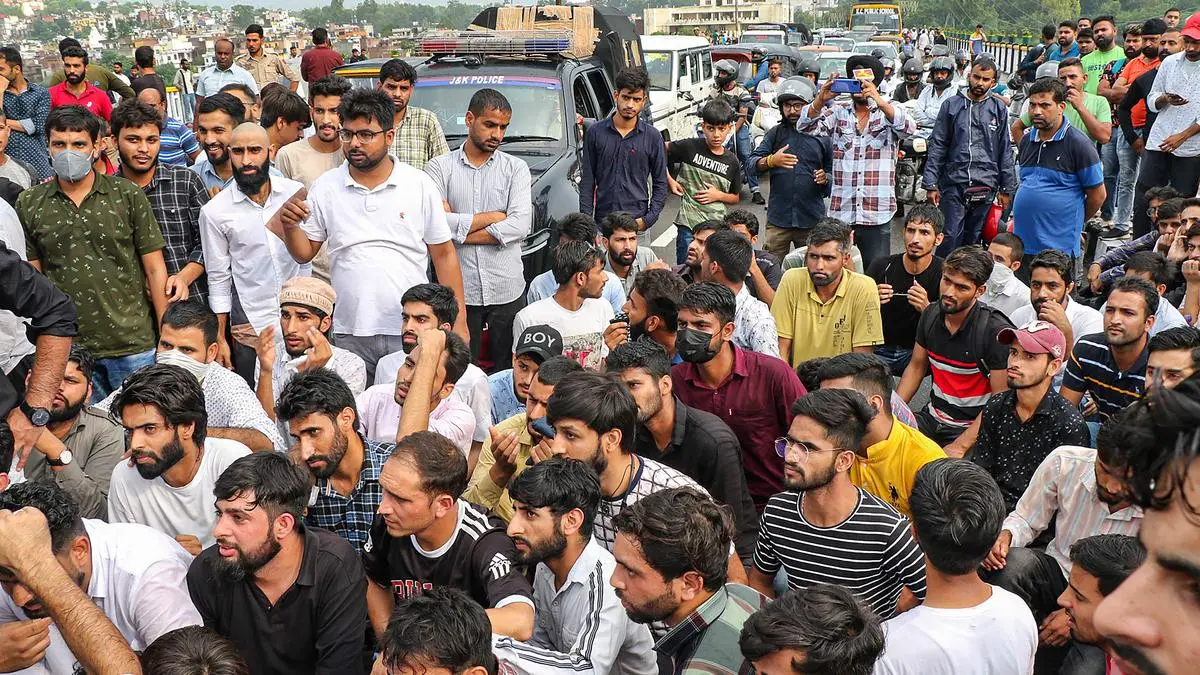
Gujjar and Bakerwal students take part in a protest against the introduction of the bill granting reservation to the Pahari people in the Scheduled Tribe in Jammu on July 28, 2023.
| Photo Credit:
PTI
Gowhar Geelani: What about generational trauma, like apartheid or black Americans? Don’t certain sections deserve reservation to upgrade themselves?
Amara: Women, from the beginning, from the inception of civilisation, have been discriminated against. Where is the reservation for women? The reservation is supposed to empower the weaker section. But if you only give them the opportunity and don’t provide them with health facilities, don’t provide them with education, don’t change the psychology of people, how is the reservation going to fix this thing? It is never going to be fixed. Only reservation cannot fix this generational trauma.
It is the psychology of the people, the behavioural change that is needed. Have you seen the ST1 category? The Gujar Bakarwals? The nomadic lifestyle they have. For their psychology, we should have moved schools. Are they moving schools for? Do they avail the benefit of ST1 categories? No, they don’t. The elites do. Only education, only big social changes and awareness are going to change. Just the reservation can only give you the opportunity. But we cannot change your thinking.
Gowhar Geelani: Sahil, which political leaders have been supportive?
Sahil Parray: The credit should be given to Aga Syed Ruhullah Mehdi sahib. He has been vocal and supportive. I went to his place in April before the parliamentary election. We discussed this issue for two to three hours. I told him about the repercussions, about the impact of this new reservation policy. How is it anti-Kashmiri? He promised me that he was going to raise this issue on the floor of the parliament. Which he did. He was leading the protest. Sajjad Gani Lone sahib, Waheed Para sahib are also vocal.
Gowhar Geelani: How has this impacted you personally?
Sahil: I’m jobless. I should have been somewhere. This 10 per cent, which they snatched from us, has been given to a particular community: the Pahari-speaking. Pahari was not even a language till 1961. It used to be the dialect of Punjabi. J&K is the only place where this ST status has been given to a community. There is a constitutional criterion. Geographic isolation, economic backwardness, and educational backwardness. There are certain parameters which they have to meet. But unfortunately, no. It was given randomly. Just because they wanted to win the election. And then there is this G.D. Sharma commission. We have no idea what they have done. I tried RTI. They say it is not in the public domain.
Gowhar Geelani: Mubashir, from a legal point of view, how many categories do we have in Jammu and Kashmir?
Mubashir: Now, see, apart from these, there are many other categories as well. As Sahil just said, ST2 [Scheduled Tribes 2] has just been introduced and was assigned to the Rajouri Poonch belt. Apart from that, ST1 [Scheduled Tribes 1] already existed as well. Then there is OBC [Other Backward Classes], ALC [Actual Line of Control], IB [International Border], RBA, and EWS. So, in total, there are six to seven categories in Jammu and Kashmir right now. I do not think that these interfere with open merit. But now, since rationalisation is being done, as I said before, rationalisation should be done in such a manner that there is justice for everyone. Justice for those sitting with us, for Sahil, for those belonging to open merit. We do not want there to be any injustice against any particular community or category.
We have always been in favour of this and, Inshallah, no injustice happens to anyone because of us. We want this. We welcome this rationalisation. The government should not provide double categories [reservation] to those people who are living in border areas. Some people get both ALC and IB reservations. Who also benefits from the ST2 reservation.
Gowhar Geelani: So, are there people who are benefited from multiple categories?
Mubashir: Absolutely. What category did the people who came from the Rajouri Poonch area have before? Even now, those who live there in the border area have ST2. And although I am not against it, I do not understand the criteria on which basis.
Gowhar Geelani: You want to know more details?
Mubashir: As you know, the Chenab belt is a backward area. If you are giving [ST2 categorisation] on a regional basis, then Chenab absolutely deserves it. If you are giving it on a linguistic basis, then our area deserves ST2 [categorisation].
Gowhar Geelani: We have recently witnessed the cloud burst tragedy and other environmental disasters.
Mubashir: Yes. We are incredibly isolated from the rest of the State. These are the people who most deserve ST2 reservation. And we wish to tell the government, through you, that if they place the Chenab belt in ST2, their headache will be over. Take the 10 per cent that you have reserved under RBA and give it to open merit. And include us [RBA] within that 10 per cent that you have reserved for just those two districts—Rajouri and Poonch. Our headache will be over. We will not have any problem. And you [the government] can give the 10 per cent that is currently assigned to the RBA to open merit.
Gowhar Geelani: Abid, your concluding thoughts?
Abid: To be completely straight with you, our community’s intellectuals, youngsters, and activists have said that there should be a caste-based census so that every member of every category can know their number, the size of their population.
Gowhar Geelani: Should there be a demographic profiling?
Abid: We should know our population. There should be a real number count. And accordingly, each category should get a reservation equivalent to its own percentage. This is the simple thing. There should be a caste-based census done before rationalisation so that every category, every community, will know its population. And based on that number.
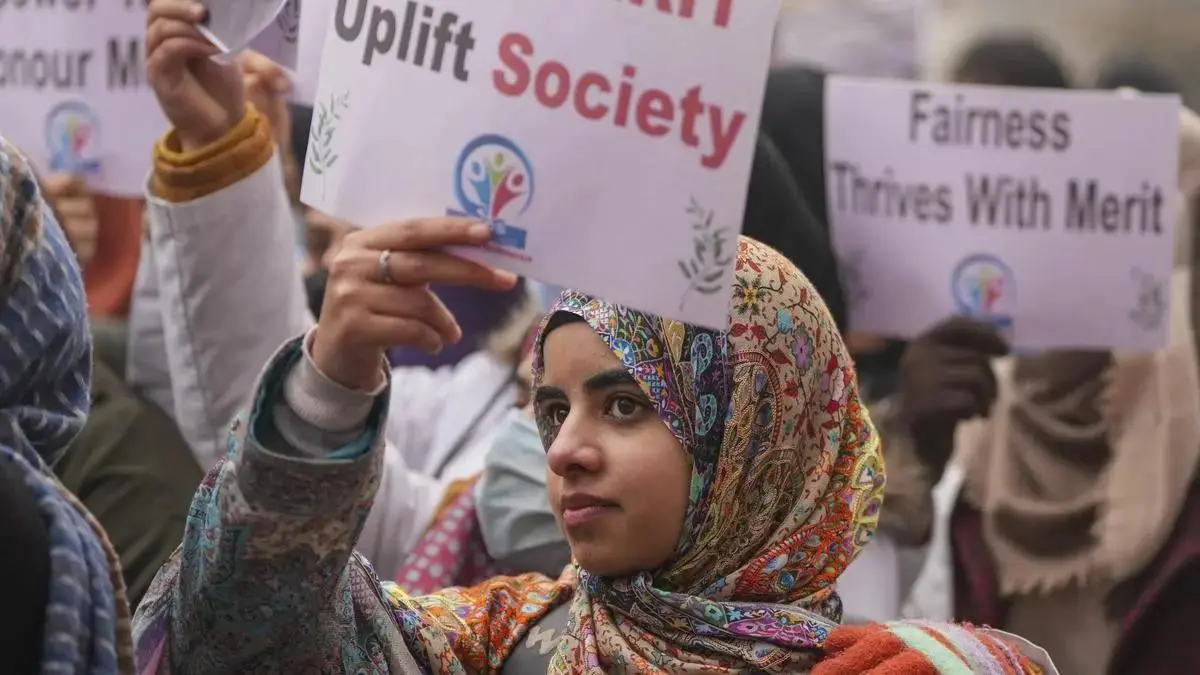
A medical student at a protest demanding the rationalisation of reservation in Jammu and Kashmir, outside Chief Minister Omar Abdullah’s residence, in Srinagar, on December 23, 2024.
| Photo Credit:
PTI
Gowhar Geelani: Based on the total population from each caste and each category, so rationalisation becomes simpler. Sahil, your concluding thoughts?
Sahil: Rationalisation should happen based on adequate representation. They should keep a minimum of 70 per cent, 65 per cent to 70 per cent for open merit; because it is open to everyone. And creamy layer concept should be applied. These top-class bureaucrats, top-class IPS officers, top-class political families have hijacked this system. They are living in cities like Srinagar and Jammu. Their kids go to top-class schools, top-class colleges. When they sit in the competitive exam, they use this powerful card reservation. They just score 200 or 300.
At the same time, I have to score 650. But still, I will sit at home. This is unfair. The creamy layer concept should be applied across the board. You have to respect the merit. Otherwise, the system will collapse. Health care, bureaucratic system, police system. You have to strike a balance between merit and the social system. In Kashmir, we don’t have any private sector. We don’t have any corporate presence here. No manufacturing base. Where will the youth go? Government is the primary source of employment. But unfortunately, you are shrinking our space. We are not asking for any reservation. All we are asking for is a level playing field, fairness. I come from a generation that grew up in Kashmir between classrooms and curfews.
Gowhar Geelani: How many years have you been preparing?
Sahil: Six, seven years. I have not found [a job]. That’s why I’m sitting here.
Gowhar Geelani: Mubashir sahib, your concluding thoughts?
Mubashir: Looking at the way in which this discussion has progressed so far, I belong to the RBA category, I come from the Chenab belt, and if I do not represent them here I believe that this will be unfair to those who have put their faith in us, young people. In fact, I would say that since Independence, it [Chenab belt] has been isolated from the rest of the State.
I would like to tell Sahil that the cutoff for the RBA category [for the post] differed from the cutoff score for Open Merit by only 1.5 to 1.75 points. There is a lot of competition. We [RBA category] also have to compete for limited seats. So, that is why I want that rationalisation as well. Reservation is not a bad thing. And the rationalisation that the government wants to do, I will tell them through you…
Gowhar Geelani: Do all of you want the report to be made public?
Mubashir: Yes, it should absolutely be done. Right now, discussions are being held based on speculations. But whenever we question the government, they say that they cannot talk about subjects beyond their domain. They say that this will be ultra vires. They say that they cannot talk about them, they cannot touch other categories. Ultimately, as a result of this, there are only two or three categories left, of which only one is constantly emphasised.
I want to convey this message to the government, through you, that if they [the government] want to implement rationalisation [of caste categories], no stakeholder of the RBA will be against this decision. But that should be based on true scientific data. That should be based on scientific facts and surveys. If we have risen above backwardness, then we will ourselves waive off the category [reservation].
Also Read | We will never agitate on the streets; people have seen enough bloodshed: Imran Nabi Dar
Gowhar Geelani: The last census was done in 2011.
Mubashir: You cannot change category limits based on that. But, because you are making that the base, ask the government this: If you have started the process of rationalisation by talking to stakeholders, then bring that into the public domain. There should be no objection to that. But if you want to implement rationalisation from your office, then I think that is an injustice to the people. That is an injustice to the people living in the hilly areas, that is an injustice to the Chenab belt [Kishtwar, Doda, Bhaderwah], and that is an injustice to those people who live in the remote areas of Kashmir where, even now, basic amenities are missing.
There is another point I would like to mention, since the government listens to you. In the ordinary course of action, they ignore us. But when news portals discuss this, when these debates enter the public domain, only then does the government listen to us on these things. We suggest that the government add the Chenab belt to the ST2 category. Check the criteria for ST2. We fall under that criterion. We are eligible for that criterion. If you want this fight to end, forget your politics and look at the ground reality. Chenab is a large area that deserves ST2 [categorisation]. Add us to ST2. These things are in your hands.
Gowhar Geelani: Amara, final thoughts?
Amara: The reservation issue itself has become a political tool. Everyone in the reservation is saying that we are the victims of the reservation. Why is it so? If the politicians are there to secure reservations, then why are we all complaining about the implementation of reservations? This reservation issue should be rationalised in such a way that both the psychological effect of it and the social effect of it will inculcate collective responsibility in people. There should be democratic decentralisation at the village level. Only when there is democratic decentralisation then the underprivileged people have equity. Because only giving reservations and not providing them with the basic facilities is also shrinking the open merit people.
Just because they have the facility doesn’t mean that they should be marginalised. To make this reservation policy fair, we should first look at the ground reality. If we have rich rural areas, then only we can have rich urban areas. Only then will migration end. The reservation was supposed to be temporary so that we could upgrade our social status. But it has given a boost to the sedentary lifestyle. Almost every section has this problem. Everyone is a victim of reservation.
Gowhar Geelani: Nobody is against the rationalisation of reservations. But any rationalisation should be data-driven. There should be science behind it, exhaustive research, and demographic profiling of every section of society.
This transcript was edited for length and clarity
Gowhar Geelani is a senior journalist and author of Kashmir: Rage and Reason.