Jobs, livelihoods will become even more precarious as glitter fades

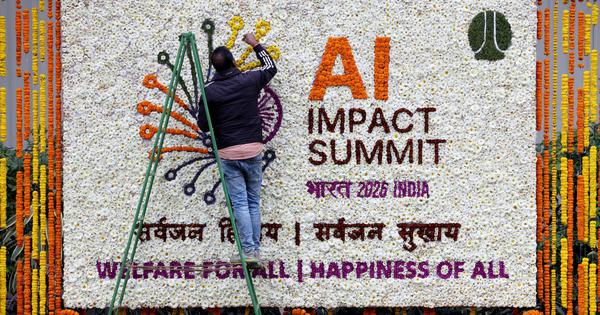

India will focus on deploying Artificial Intelligence responsibly and ensuring that it is used widely in sectors such as healthcare and education to ensure that that new technology benefits all.
That is what Union Minister for Electronics and Information Technology, Ashwini Vaishnaw, announced on the second day of the India AI Impact Summit 2026 on February 20. India’s AI strategy, he said, demonstrates Prime Minister Narendra Modi’s vision of democratising technology.
But realising these objectives will not be easy.
The hurdles to achieving them were laid out by AI Now Institute, an independent research institute. It listed India’s challenges as it tries to attain (often competing) goals: “projecting itself as a leader of a new form of technological non-alignment anchored in strategic autonomy, while remaining dependent on Big Tech for critical infrastructure and innovation”.
AI optimists point out to the fact that the first industrial revolution, in the 18th century, began with a massive disruption of society and economy but ultimately improved the lives of all, including the poor. This was largely due to the rise of the welfare state and the emergence of a legal regime to protect the working class from extreme exploitation.
But the new 21st century technologies, including AI and robotics, are threatening to do away with jobs themselves.
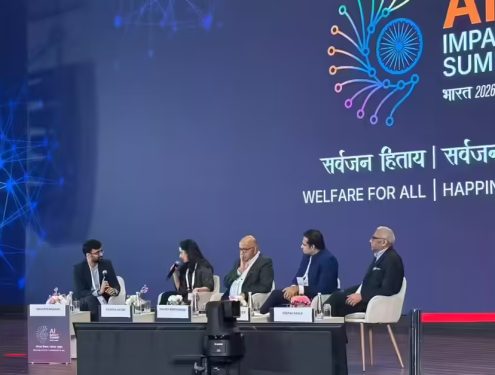
At the AI Summit, there was one session on the future of employability in the age of AI. However, though almost all the speakers emphasised the need for workers to upgrade their skills, they did not mention what would happen if skilled personnel were not available.
The possibility of a future without work can be glimpsed in a “dark factory” in Kancheepuram, Tamil Nadu. At the fully automated facility by a company called Polymatech, robots assemble semiconductor chips 24/7 with minimal human supervision.
The media has celebrated this development. “This factory and startups like xLogic Labs are pioneering efforts to enhance competitiveness and address skilled labour shortages,” exulted one article.
What is missing is a discussion on the impact of new technologies on the mass of the working class.
In India, the new technologies of the “Fifth Industrial Revolution”, as Vaishnaw labelled it, are the result of a sustained campaign by corporations for government subsidies and incentives. The corporations contended that the switch to these technologies would be possible only if the labour market was made flexible and the employers had the right to hire and fire workers at will without the impediment of labour laws.
The government obliged the corporate world in November by virtually abolishing the right to permanent jobs and living wages, a goal enshrined in the Directive Principles of State Policy in our Constitution.

Four days before the AI summit began on February 16, India’s trade unions organised a nationwide strike to protest the new labour codes: thousands marched to express their anger against the right to collective bargaining and to form trade unions being undermined.
Among the worst victims of such new technologies that use huge data bases are gig workers: they are subject to extreme exploitation due to what is called “algorithm management” – the use of AI to automate managerial tasks. Gig workers can be logged out of their jobs without the right to challenge the decision of the management, which controls the database that includes workers’ ratings and reviews.
The media and even the courts have played a role in demonising workers and their trade unions.
Just before the AI Summit began, the LiveLaw website reported observations made by the chief justice of India that trade unions and their leaders were “largely responsible” for slowing down the country’s industrial growth.
He also suggested that fixing minimum wages could discourage employers from hiring. This would create obstacles to generating employment, he contended.
It is not only workers in urban areas who are being hurt by AI. Agriculture too is being hit by the massive data centres essential for these technologies to function.
The 2026-’27 budget aims to boost AI infrastructure investments by offering a 20-year tax holiday for foreign data companies that use Indian data centres.
But data centres consume unfathomable amounts of natural resources.
For example, a single AI query can consume up to 10 times more power than a basic online search. Training a large language model to understand, process and generate human-like text can use over 1,000 megawatt-hours of electricity – roughly equal to the consumption by several hundred Indian households.
The presence of data centres in India has already hurt the environment. Cooling systems in such data centres rely on water-based technology. Yet over 80% of such facilities in India today are located in water-scarce states such as Maharashtra, Telangana and Tamil Nadu.
In Bengaluru, data centres already consume nearly eight million litres of water each day, even as the city faces extreme water shortages.
As for the promise that this revolutionary technology will result in a broad economic transformation, experts warn that this is unlikely. Instead, they predict, AI will simply concentrate more wealth at the top.
“Over the years, I have found only one metaphor that encapsulates the nature of what these AI power players are: empires,” writes Karen Hao in her book Empire of AI: Inside the Reckless Race for Total Domination.
As a result of colonialism, she notes, European nations “seized and extracted resources that were not their own and exploited the labour of the people they subjugated to mine, cultivate, and refine those resources for the empire’s enrichment”.
These empires, Hao says, “projected racist, dehumanising ideas of their own superiority and modernity to justify – and even entice the conquered into accepting – the invasion of sovereignty, the theft, and subjugation”.
AI firms, she contends, operate in the same way.
Hao’s warnings have been emphasised by Geoffrey Hinton, a Nobel Prize-winning computer scientist known as the “godfather of AI”. He has predicted that “artificial intelligence will increase unemployment while driving higher profits”.
Hinton added, “What’s actually going to happen is rich people are going to use AI to replace workers. It’s going to create massive unemployment and a huge rise in profits. It will make a few people much richer and most people poorer. That’s not AI’s fault, that is the capitalist system.”
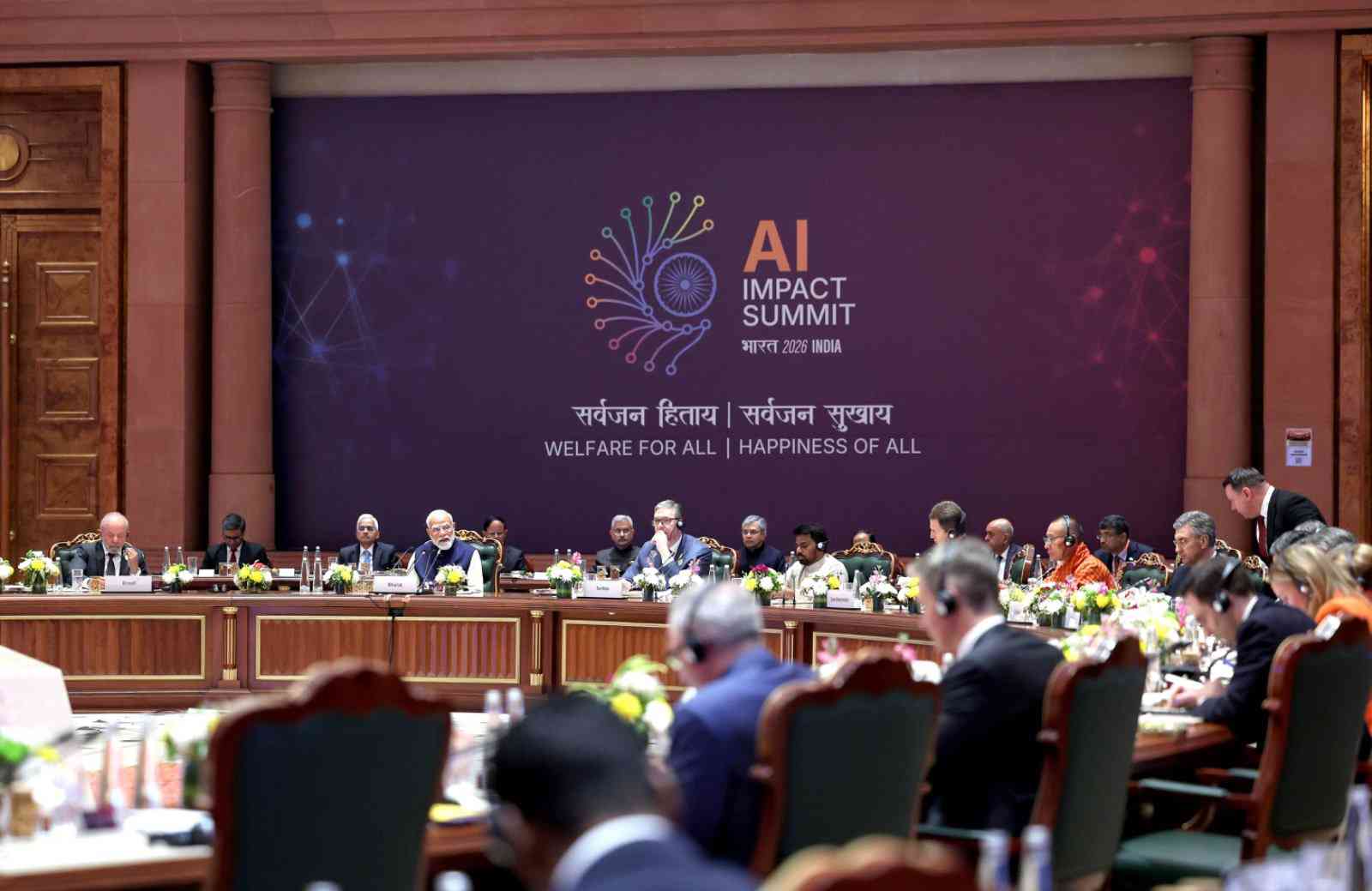
Hao is among those who are attending the Delhi AI Summit along with others who are critical of the big tech giants. But the media has been too awe-struck by the presence of the CEOs to pay heed to warnings of experts who understand the workings of the big corporations that control AI.
Once the glitter and glamour of the Delhi summit is over, the question will remain: what will be the impact of AI and robotics on the millions of India’s youth who have little hope of getting permanent jobs and have little to look forward to.
Will they become the precariat, that class that forms the backbone of fascist and right-wing movements that are rising all over the world? In the face of such possibilities, governments tend to make migrants, refugees and activists the scapegoats instead of addressing the challenges of the new technologies owned and controlled by tech giants.
Nandita Haksar is the author of How Robots Stole Our Jobs: Struggles of Suzuki Workers in the age of AI (Aakar, 2026).