Kashmiri Profiling Surges After Delhi Blast 2025


When 24-year-old Rasik Bilal left Kashmir nearly five years ago, he was unsure whether he could build a life beyond the Valley. His family worried too. At one of Uttar Pradesh’s most prestigious universities, those fears faded. He made friends, earned the trust of his professors, and became a fixture on campus.
By the time he graduated with an engineering degree, the university offered him a job. “It was proof that I had found a home away from home,” he told Frontline.
That changed when he received a call from the university administration on November 18. In his four-year association with the institution, he had never been summoned at that level.
“I thought maybe it was something about my job,” he recalled. “I even carried some documents just in case.”
The moment he stepped into the room, the questioning began. “They asked where in Kashmir I lived, where I was staying here, and who my roommate was,” he said. “Then the questions got stranger—who is in my family, what my parents do, details about my siblings, even who calls me.”
What came next left him stunned. “They said, ‘We should know where you live.’” He recounted their questions about his motive for taking the job. They went through his social media and questioned why his profile picture showed only his eyes.
“I was stunned and embarrassed,” he said. “That is when I realised this was not any normal assessment. They were actually profiling me.”
Bilal had already gone through a verification process when he was hired. “Now they are asking again for all my documents, my family’s details, everything that has nothing to do with the job because they want to ‘verify’ me,” he said. “I don’t know what they have not verified in the last so many years that they suddenly need to verify now.”
He wanted to react with anger but held back, fearing for his job. “This is my only way of supporting my family back home,” he said. “A part of me wanted to just get up and walk out but I couldn’t.”
The scrutiny Bilal faced had already spread across the country, aimed at students, professionals, and traders who carried a Kashmiri identity.
A week before Bilal was called in, on November 10, a suicide car blast in Delhi killed at least 10 people and injured dozens near the historic Red Fort. The investigating agencies identified the driver as Umar Un Nabi, a Kashmiri doctor who worked at Al-Falah University in Faridabad. Authorities arrested two other Kashmiri doctors—Muzammil Shakeel Ganai and Adeel Ahmad Rather—and recovered approximately 2,900 kg of explosives and weapons.
When it emerged that Kashmiris were behind the attack, unease rippled through Kashmiri communities living across India. Families called their children studying or working elsewhere, urging them to avoid attention. Some asked them to return home immediately.
Also Read | Journalism is not a crime. Accountability is not treason: Anuradha Bhasin
Their fears were not unfounded. A needle of suspicion began pointing at Kashmiris in university hostels, rented apartments and neighbourhoods. The Jammu & Kashmir Students Association alleged that the wave of collective suspicion against Kashmiris had spread to States including Uttar Pradesh, Haryana, Rajasthan, and Delhi, forcing many young Kashmiris to return home or keep a low profile.
“Maybe if it was the police or some unknown group asking me these questions, I would not have been as bothered,” Bilal said. “What hurt more was that this was happening inside a university where I have given so many years, and from people who knew me. They are supposed to protect students regardless of where they come from. Instead, I felt like I was being punished for being a Kashmiri, just because someone from my region, someone I don’t even know, had done something sinister.”
He added, “This has taken a huge toll on me. I can’t even share it with my family because it will scare them and they will ask me to return. I have to stay here, keep this job, and maybe keep paying for someone else’s crime.”
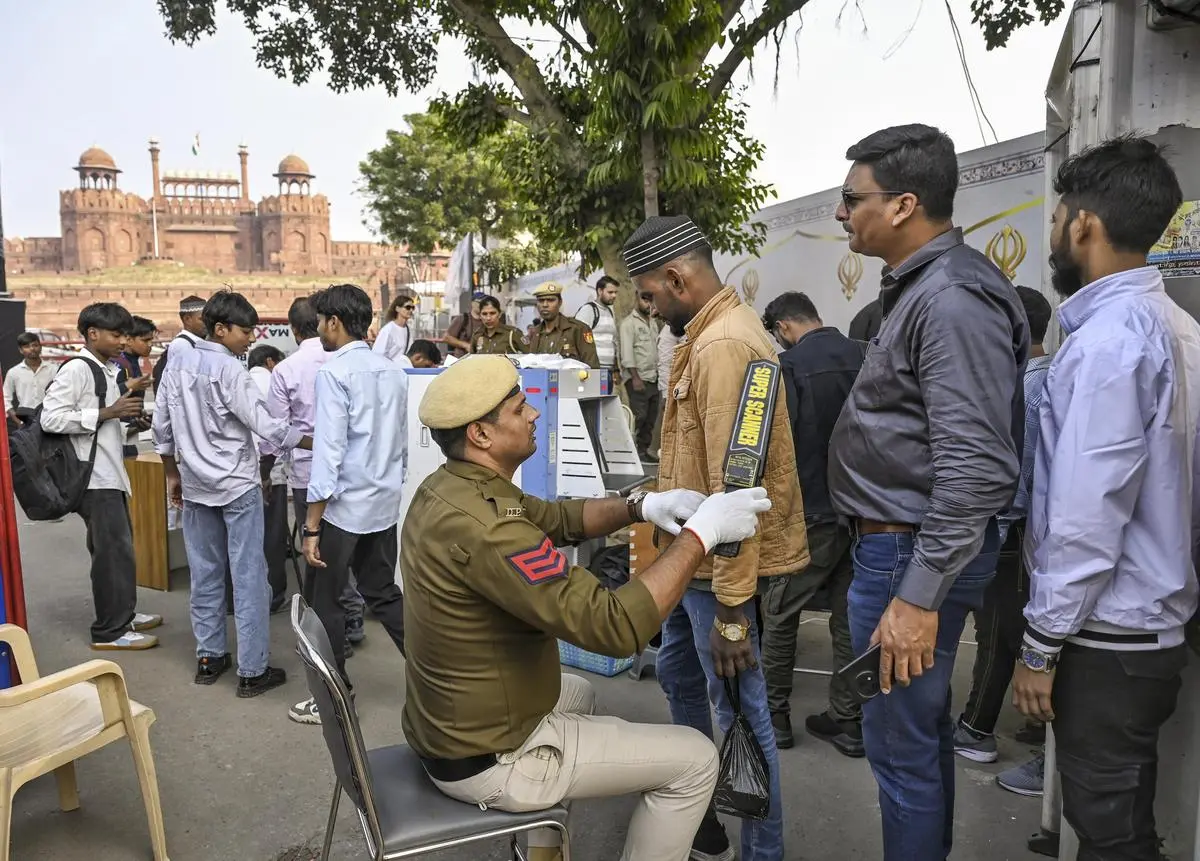
A day after the blast, police directed residential societies in Gurugram to submit lists of residents from Jammu and Kashmir, as well as foreign nationals living there. The police claimed it was being done for security purposes.
For years, these episodes followed a pattern Kashmiris recognise. After every major terror incident, the cycle of backlash repeats. Earlier this year, following the Pahalgam terror attack in April in which 26 people, all but one of them Hindu tourists, were killed by terrorists, public anger surged. Kashmiri vendors and students faced intensified harassment and vilification, not only from right-wing groups but also from classmates, customers and neighbours.
Videos of students being chased out of campuses and beaten in the streets circulated widely online. In response, Jammu & Kashmir Chief Minister Omar Abdullah dispatched his Ministers to several States to ensure the safety of Kashmiris.
“This tendency toward collective punishment is really disappointing, and we are seeing a rise everywhere including in the targeting of immigrants,” said Meenakshi Ganguly, the deputy Asia director at Human Rights Watch.
This time, however, the fallout has taken a different shape. The National Investigation Agency, which is probing the blast, identified the suicide bomber as a doctor from South Kashmir’s Pulwama district. The agency also named two other Kashmiri doctors as prime accused in the case.
A woman gets emotional as she celebrates Eid with Kashmiri students who could not reach their families in the wake of abrogation of Article 370 in Jammu and Kashmir, in New Delhi, on August 12, 2019.
| Photo Credit:
Ravi Choudhary/PTI
The alleged involvement of highly educated doctors has deepened the alarm and turned scrutiny toward Kashmiris pursuing higher education and professional careers in the rest of India. While physical attacks after the Delhi blast have been fewer than in past incidents, the speed and intensity with which suspicion has spread—particularly against educated Kashmiris—has been far more troubling.
That shift is changing how Kashmiris now navigate everyday life in Indian cities. Housing is one of the first places where this becomes visible.
Finding a place to live has long been a challenge for Kashmiri Muslims in many Indian cities. Those pursuing professional careers typically had fewer barriers and were able to live in areas of their choosing. However, Kashmiri professionals now say that this distinction is beginning to blur as suspicion appears to be extending to Kashmiris with white-collar professions.
The Jammu & Kashmir Students Association alleged that thousands of Kashmiri students across the country are now being profiled and treated with suspicion.
“A particular community is being singled out after the attack,” said Nasir Kheuhami, JKSA’s national convenor. “Students are being harassed on campuses and in neighbourhoods. Some landlords have told Kashmiri tenants to vacate immediately. Many have left for home out of fear.”
This is precisely what happened with Kashmiri communication professional Saba Yusuf, just a day after the first car-borne suicide attack in the national capital and only the second since the 2019 Pulwama attack, when a suicide bomber rammed his car carrying explosives into a bus, killing 40 Central Reserve Police Force personnel in South Kashmir.
After almost a decade of living in Delhi, Saba moved back to Kashmir earlier this year when her job shifted to a work-from-home arrangement. But in November, when her office asked employees to return, she had little choice but to go back to Delhi and begin searching for a place again.
“I returned just a day before the Delhi blast,” said the 30-year-old. “For four days, I was constantly looking for a place to live. The real estate brokers were willing to help but the moment owners learned I was a Kashmiri, they refused outright. I must have seen at least 10 apartments.”
When things became too difficult, Saba shifted back to Kashmir. “In just four days of house hunting, I could see how hostile it had become,” she said. “As a Kashmiri single woman, I did not feel it was safe anymore.” She added that she had faced discrimination over her identity before, “but never at this scale.”
Whenever such incidents occur, she said, the fear among Kashmiris becomes palpable. “People associate these attacks with all Kashmiris, they don’t say it is not everybody,” she said. “It is unsettling that people can other you anytime, and treat you as a second-class citizen. What kind of stepmotherly treatment is this?”
She paused before adding, “That sense of othering has always been there in some form. It weighs heavy and is exhausting.”
According to Ganguly, clear public messaging from political leaders is essential to prevent vilification. “We need to remember that Kashmiris have suffered most from violence by armed groups, or because of abuse by government forces,” she said. “It is crucial to ensure justice, reparation and rehabilitation.”
Also Read | Nowgam Blast and the price of procedural negligence
According to multiple reports, many Kashmiris living outside the Valley have been questioned by security agencies across India. In Faridabad, at least 2,000 Kashmiri students and tenants were summoned for questioning as part of the investigation. As security agencies broaden their investigations, the process has left many Kashmiris feeling like suspects.
Even Omar Abdullah believes so. “A few people are responsible for what happened in Delhi,” he said. “But a perception is being created where all Kashmiris are being looked at with suspicion.”
Speaking at a public event, Abdullah gave a personal example. “I also think twice whether to drive or not in New Delhi with a Jammu & Kashmir number plate. What if I am stopped and questioned?” he added.
As many Kashmiris believe the burden of suspicion is falling on them collectively, they say it has reduced people with ordinary aspirations into potential suspects overnight. Abdullah also warned that the stigma attached to the attacks would make it harder for young Kashmiris to seek opportunities beyond the region.
“Such a situation has been created that no father would like to send his child outside. Everyone looks at Kashmiris with suspicion because of the involvement of a few,” he added.
Soon after the Delhi blast, details of the plot began to emerge and with them, photos and videos of the accused. The two prime suspects, doctors Muzamil Shakeel Ganai and Adeel Ahmad Rather, both sported long beards, and suicide bomber Umar Nabi’s video in which he justified the suicide bombing in the name of Islam flooded social networking sites. It all gave right-wing groups enough oxygen to target Kashmiris.
But what went largely unnoticed amid the surge in anti-Kashmiri and anti-Muslim rhetoric was the fact that nine Kashmiri Muslim men lost their lives in a blast at Srinagar’s Nowgam Police Station on November 14, after a forensic team was working on explosives seized from the conspirators of the November 10 blast.
After the blast in Delhi, the investigators had uncovered a transnational terror module linked to the Pakistan-based terrorist organisation Jaish-e-Mohammed and Ansar Ghazwat-ul-Hind, and arrested seven Kashmiris from various parts of India, recovering roughly 2,900 kg of materials used in making IEDs, including ammonium nitrate. Because the case was registered at the Nowgam police station, the seized explosives were being stored there.
Kashmiri boatmen hold placards handed out by students during a protest organised by them, following an attack on tourists by gunmen, in Srinagar, on April 24, 2025.
| Photo Credit:
YAWAR NAZIR/Getty Images
“The hate campaign against Kashmiris is unjust and unfortunate,” said Harsh Mander, a prominent civil rights activist. “If a crime is committed by a person of a particular ideology, there is no moral basis to hold everyone else from that community responsible. That is the doctrine of vicarious responsibility. It is the same logic that led to Sikhs being targeted after Indira Gandhi was assassinated by her two Sikh bodyguards. Why should an entire community pay for the actions of a few?”
“This is the wrong moral premise to begin with,” Mander said. “What makes it worse is that this is not a spontaneous response from ordinary people. It is often manufactured.”
“This pattern repeats every time there is a terror attack,” he continued. “Kashmiri Muslims are expected to prove they are sorry for it. But when there is a lynching, every Hindu is not asked to apologise. That double standard is also manufactured.”
“Kashmiris frequently find themselves asking, ‘Why should we apologise for something we did not do? Why are we being held responsible?’” Mander said. “It is particularly unfortunate, because after the Pahalgam attack, they were among the first to help tourists and condemn the attack.”
The reality for many Kashmiris in smaller towns is much harsher. In Kangra district of Himachal Pradesh, two Kashmiri shawl sellers were stopped by a local resident who demanded to know why they were in the area and whether they were carrying any weapons.
In a video that went viral on X, the unnamed man questions the duo, asking where they live and how a local Himachali could have given them accommodation. “How can you come here without police verification? What if something happens here? I will call the police station right away,” he can be heard saying. He then orders them, “Come here…do you have any pistol? I will check you…I will check all your clothes. You guys may be carrying a weapon.”
One of the sellers responded that he had lived in the area for five years and had already submitted his Aadhaar card to the landlord, who verified it with the police. But the man continued to threaten them. “Take your belongings and leave immediately. If you ever come here again in this panchayat, I will strip off all your clothes. You guys have messed things up,” he said. “In your Kashmir, if anybody moved like this, you would have slapped them with shoes.” As the intimidation escalated, the two men left while insisting they already had a valid police verification from last year.
This was not an isolated case. Almost a week back, a group of 44 workers from Doda and Kishtwar in Jammu & Kashmir were detained at New Tinsukia Railway Station in Assam after locals deemed them “suspicious”. They were travelling by train from Chandigarh to a powergrid worksite in Arunachal Pradesh when the locals detained them.
Multiple defence experts believe that such social recoil threatens the social cohesion required in times of crises. “This is fatal,” defence journalist Vikram Jit Singh wrote on X. “This is what suicide bomber wanted. To create division, distrust and profiling. One of the outcomes will be some youngsters gravitating towards radicalisation. Intelligence and citizen awareness can weed out hostile elements but this community targeting is wrong.”
He added, “When a section picks up the gun, it gives the state the handle to punish heavily and for communal elements to target the entire community.”
Social activists believe that by fostering alienation among ordinary people, the State risks deepening the divides that terrorism seeks to exploit and turns a security challenge into a prolonged social rupture.
“It is a huge threat to India,” Mander told Frontline. “Kashmiris are continually treated as if they are responsible for crimes they had nothing to do with. It builds grief and alienation. And if we say Kashmir is part of India, this is not how you treat your own people. They deserve the same protections and dignity that the State would give to any other Indian.”
*Some names in the story have been changed to protect the identities of those mentioned.
Zaid Bin Shabir is a journalist based in Srinagar.