
Strive not to be a success, but rather to be…

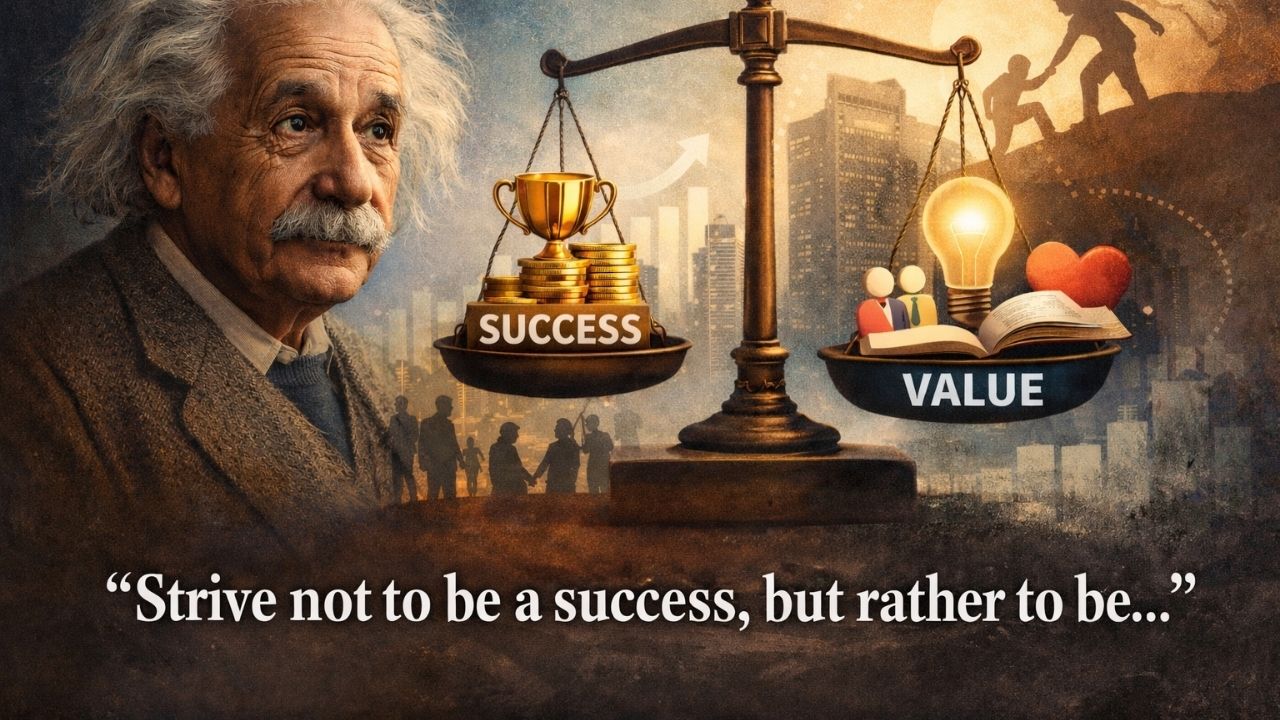

Albert Einstein remains one of the most cited thinkers in modern history, not only for his scientific contributions but also for his reflections on human purpose. His words continue to surface in public discourse because they speak to enduring social and professional challenges.
The quote, “Strive not to be a success, but rather to be of value,” has gained renewed attention in an era increasingly shaped by performance metrics, rankings, and public visibility. It raises a fundamental question about how achievement should be defined and measured.
At a factual level, Einstein’s perspective aligns with long-term observations in economics, education, and organizational science, where sustainable progress is closely linked to value creation rather than individual acclaim.
In many societies, success is often measured by income, job titles, awards, or public recognition. These indicators are efficient to measure, but often limited in scope. They reflect personal advancement rather than broader contribution.
Value, by contrast, is defined by outcomes that extend beyond the individual. It includes improvements in knowledge, efficiency, equity, or quality of life. Studies on productivity and institutional performance consistently show that systems that prioritize value creation outperform those focused solely on competitive success.
Einstein’s statement does not dismiss ambition. Instead, it reframes ambition as a tool for contribution rather than self-validation.
| Criterion | Conventional Success | Value-Oriented Contribution |
|---|---|---|
| Primary Focus | Personal achievement | Collective benefit |
| Measurement | Salary, rank, visibility | Impact, usefulness, outcomes |
| Longevity | Often temporary | Long-lasting |
| Social Effect | Competitive | Collaborative |
This distinction explains why value-based work often continues to generate benefits long after traditional success markers lose relevance.
Einstein’s career provides documented examples of value-driven decision-making. After global recognition in 1919 following experimental confirmation of general relativity, he chose academic and research-focused roles over commercial opportunities.
Historical records show that he declined political authority and prioritized intellectual independence. He also supported displaced scholars during periods of political persecution in Europe, contributing directly to the preservation of scientific knowledge.
These actions demonstrate that his philosophy was not abstract but applied consistently in real-world choices.
Modern economies increasingly rely on knowledge-based work, where collaboration, innovation, and ethical decision-making are critical. Research in organizational behavior indicates that teams that emphasize shared value creation experience greater resilience, trust, and long-term performance.
In sectors such as healthcare, education, technology, and public administration, outcomes are evaluated less by individual recognition and more by measurable societal benefit. Einstein’s quote remains relevant because it mirrors this structural shift.
It also offers a counterbalance to short-term thinking, encouraging decisions that prioritize durability over immediate reward.
Value creation is observable across everyday professional and social settings. It is often incremental and cumulative rather than dramatic.
Common, evidence-based expressions of value include:
Such actions contribute to systems rather than personal branding, aligning closely with Einstein’s principle.
| Area | Data-Based Indicators |
|---|---|
| Education | Learning outcomes, skill transfer |
| Workplaces | Productivity gains, team stability |
| Communities | Access improvement, service reach |
| Innovation | Adoption rates, long-term utility |
These indicators show that value, while sometimes less visible, can be assessed through tangible results.
Einstein’s scientific work continues to influence technologies such as satellite navigation and advanced physics research decades after his lifetime. These applications illustrate how value-driven contributions compound over time.
Beyond science, his engagement with peace, education, and civil rights demonstrates how expertise can extend to ethical responsibility. His legacy endures not because of titles alone, but because of lasting impact.
“Strive not to be a success, but rather to be of value” offers a durable framework for evaluating achievement in both personal and institutional contexts. It challenges narrow definitions of success without rejecting progress or ambition.
In a data-driven world focused on measurable outcomes, Einstein’s words remind us that the most meaningful metrics are those tied to contribution, usefulness, and long-term benefit.
Einstein emphasized contributing positively to others and society through knowledge, service, or ethical action, rather than focusing solely on personal recognition.
No. The quote reframes success, suggesting that achievements gain deeper meaning when they create lasting value beyond the individual.
Modern workplaces and economies increasingly depend on collaboration, innovation, and long-term impact, all of which align more closely with value creation than short-term success metrics.
Value can be assessed through outcomes such as productivity improvements, learning gains, social impact, and long-term usefulness of innovations.
Einstein consistently prioritized research, education, and humanitarian efforts over wealth or power, demonstrating alignment between his philosophy and actions.

Aslam Imandar is a dedicated Indian content writer at BhandaraDCCB.in, with a keen focus on recruitment notifications, exam updates, government schemes, and result announcements. With an eye for detail and a commitment to accuracy, he simplifies complex updates for job aspirants and students across India.