
The Gig Economy Strike That Never Was

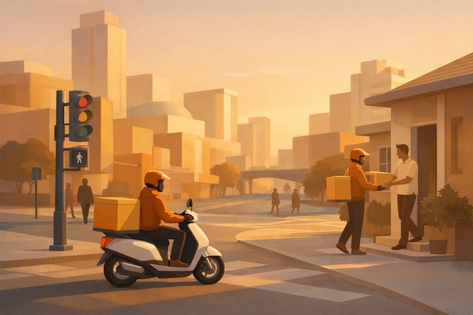

In the last days of 2025, as many in the country were preparing for the New Year’s celebrations, a potential problem was brewing in the background in the form of a gig-worker strike which could have disrupted food delivery and quick-commerce services, making a dent on the New Year’s Eve celebrations. Union leaders had warned of large-scale participation and significant breakdowns.
What unfolded, however, was far more subdued. Platforms such as Zomato and Blinkit went on to record their highest-ever single-day volumes, collectively processing over 7.5 million orders with more than 4.5 lakh active delivery partners on the ground.
Despite that, the limited disruption did raise an important question: if the gig economy is as structurally exploitative as it is often portrayed, why did it function almost seamlessly on a day predicted to expose its fragility? Or is the dominant narrative about gig work increasingly detached from how most participants actually engage with it?
The Strike That Never Happened
On 31st December 2025, several unions, including the Indian Federation of App-Based Transport Workers and the Telangana Gig and Platform Workers Union, called for a nationwide protest. Their demands focussed on higher per-order payouts, social security coverage, protection from algorithmic opacity, and safer working conditions.
In some cities, delivery partners did voice their concerns in public forums and those concerns do deserve serious engagement. But at the national level, operations continued largely uninterrupted. Zomato and Blinkit both reported record order volumes, with the majority of delivery partners choosing to stay active during peak hours. Whilst unions had cited significant confirmed participation ahead of the strike, this did not translate into visible service gaps or systemic disruption.
Gig Economy Is Not Fringe, It’s Structural
Firstly, there should be a clear idea about the exact nature of the gig economic sector to have a fair idea about the concerns raised above. When we talk about the gig economy in India, the debate often treats it as a fragile, marginal experiment, something temporary, precarious, and waiting to be “fixed”.
This perception is not completely true if one looks at the data, notably the NITI Aayog’s Trends and Projections released in 2022 which projected India’s gig workforce to grow from about 7.7 million workers in 2020–21 to nearly 23.5 million by 2029–30, making it one of the fastest-expanding segments of the labour market.
This growth is not confined to niche app-based or digital roles; retail trade, sales, and transportation already account for a majority of gig workers, with sales and motor vehicle driving alone comprising over half the workforce. This sector will contribute 4.1 per cent to GDP by 2030, primarily through voluntary participation for flexibility in urban and rural areas.
It is pertinent to understand that this is not a purely low-skill phenomenon either; almost half of gig work falls in the medium-skilled category, reflecting how platform-based work has absorbed livelihoods that once sat squarely in the informal sector. With over 70 million jobs across construction, manufacturing, retail, transport, and logistics projected to become “giggable,” the real question is no longer whether the gig economy is here to stay, but whether our public discourse has kept pace with its scale, diversity, and economic function.
A closer look could explain this further. To start with, earnings are built on two components: a base pay per order and layered incentives that rise with volume and peak demand. Base pay typically ranges between ₹20–₹50 per order, depending on city, distance, and platform, with additional per-kilometre compensation beyond a base radius.
On an average day, this translates to roughly ₹40–₹70 per order for food delivery and ₹40–₹50 for quick commerce. Crucially, these are not fixed ceilings. During high-demand periods, like during the New Year’s Eve, incentives can push payouts to ₹120–₹150 per order.
That volatility is not a flaw of the system; it is more like a balance between individual choice and platform efficiency rather than coercion. Whilst delivery partners retain the right to decline orders, repeated rejections can reduce future allocations.
Gig Economy Debate Needs Clarity, Not Misplaced Empathy
The debate around gig work in India is increasingly driven by moral outrage rather than material facts. Gig workers, especially in food delivery and quick commerce, are routinely portrayed as overworked, underpaid, and structurally exploited.
Whilst concern for worker welfare is necessary, the current discourse often assumes precarity as an inherent truth, without examining how gig work actually functions on the ground.
In a detailed public clarification, Zomato founder Deepinder Goyal laid out platform-level data that complicates many of these assumptions. His argument is not that the gig model is perfect, but that much of the empathy directed at gig workers is misplaced because it misunderstands the nature of gig participation itself.
According to platform data shared by Goyal, in 2025, the average earnings per hour (EPH), excluding tips, for a Zomato delivery partner stood at ₹102, up from ₹92 in 2024, which is a year-on-year increase of nearly 11 per cent. Over a longer horizon, this growth has been steady rather than stagnant. Importantly, this calculation includes all logged-in hours, including waiting time, making it a conservative and honest measure of earnings.
Zomato Delivery Partner Earnings Per Hour (EPH).
Gig Work as Flexible, Supplemental Income, Not Disguised Employment
Goyal went on to further clarify that, if a delivery partner were to work 10 hours a day for 26 days a month, an upper-bound scenario rather than the norm, gross earnings would amount to roughly ₹26,500 per month. Even after accounting for fuel and maintenance costs of about 20 per cent, net monthly earnings come to approximately ₹21,000.
Importantly, this calculation already includes waiting time between orders, making it a conservative estimate. On top of this, delivery partners retain 100 per cent of customer tips, which average ₹2.6 per hour in 2025, transferred instantly and without deductions. This is not a picture of suppressed or opaque compensation, but of transparent, predictable earnings tied directly to participation.
However, it is quintessential to note here that most delivery partners do not treat gig work as a full-time occupation, and the data bears this out.
In 2025, the average delivery partner on Zomato worked only 38 days in the entire year, logging about seven hours on each working day. Merely 2.3 per cent of partners worked more than 250 days in the year. This is not an anomaly; it reflects the foundational logic of gig work. Partners choose when to log in and log out, which areas to serve, and whether to work at all on a given day.
There are no assigned shifts, no fixed geographies, and no penalties for inactivity beyond the duration of a chosen gig.
Calls for mandatory PF and fixed salaries rest on a false premise, that gig work is continuous and permanent. For most people, it is neither; it is voluntary, flexible, and supplemental. Another frequently raised concern is that the quick-commerce delivery timeline, particularly the much-debated “10-minute delivery”, forces delivery partners into unsafe driving behaviour.
Goyal’s clarification directly addresses this assumption. Delivery partners are not shown customer-facing time promises, nor are they subjected to countdown timers. Faster deliveries are driven primarily by store proximity, not speed.
In 2025, the average distance travelled per order on Blinkit was just 2.03 km, with an average driving time of around 8 minutes, implying an average speed of approximately 16 km/h. On Zomato, where delivery times are longer, average speeds were about 21 km/h.
Comparable driving speeds across platforms make it clear that faster delivery promises do not automatically mean unsafe driving. Road safety challenges stem from wider structural factors, not platform-imposed time pressure alone.
On welfare, the assumption that gig workers are left without social protection is also incomplete. In 2025 alone, Zomato and Blinkit spent over ₹100 crore on insurance coverage for delivery partners. This included accident insurance of up to ₹10 lakh, medical coverage with OPD benefits, loss-of-pay insurance, and maternity coverage. These premiums are fully borne by the platform, and claims are processed without deductions.
Beyond insurance, platforms have introduced targeted support mechanisms where vulnerabilities are most visible, periodic rest days for women delivery partners, income tax filing assistance (used by 95,000 partners), access to a gig-variant of the National Pension System (with over 54,000 enrolments), and SOS services for emergencies such as accidents or vehicle breakdowns.
What the Pay Comparison Actually Reveals
It is worth placing gig earnings alongside the alternatives that most delivery partners realistically face. Entry-level jobs in retail typically offer take-home pay in the range of ₹15,000–20,000 a month, whilst freshers in BFSI roles earn about ₹18,000–22,000.
Against this backdrop, delivery work does not sit at the bottom of the labour market, as it is often portrayed. The more honest distinction lies elsewhere: unlike formal-sector jobs that promise increments, promotions, and role mobility over time, delivery earnings are largely utilisation-driven. Once a rider reaches a certain number of hours or deliveries, income tends to plateau.
How the Model Works on the Ground
If we look at the data from Eternal’s Q3 FY25 shareholder letter, it shows partners logging in at least eight hours a day for 26 days a month earning an average of ₹27,726 in 2024 (excluding fuel costs), up from ₹23,709 in 2021. However, earnings have largely stagnated since 2023, even as order volumes rose.
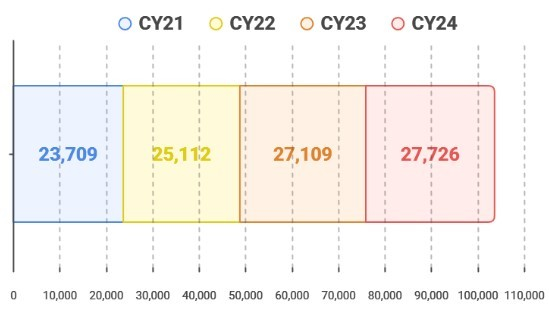
Average Delivery Worker Monthly Earnings (in Rs).
As of Q2 FY26, the combined monthly active delivery workforce across Zomato and Blinkit stood at nearly 8.94 lakh partners, a scale that underlines both the economic relevance of the model and its inherent limits. The takeaway is not that gig work is a dead end, but that it was never designed to mirror a traditional career ladder, and pretending otherwise only clouds the real policy debate.
When Ideology Hijacks Economics
The policy case behind this outrage is far weaker than it sounds. Markets are not moral villains; they are equilibria. The wages in gig platforms reflect what consumers are willing to pay and what workers are willing to accept, given available alternatives.
Raising costs overnight, through forced benefits, wage floors, or rigid employment classifications, does not magically improve lives. In a price-sensitive country like India, it reduces demand, shrinks platforms, and eliminates jobs altogether.
We have seen this movie before: regulate imperfect jobs out of existence, and what remains is unemployment, not dignity. Yet there is this tendency among unions and activists, particularly those with a communist instinct, to moralise markets whilst not doing much to facilitate job creation. They do not run loss-making businesses. They do not sign payrolls. They do not worry about unit economics.
Politics Outrage and the Denial of Agency
Every few months, a familiar spectacle unfolds where social media declares a moral emergency for gig workers, complete with boycott calls, strike appeals, and righteous anger, often led not by gig workers themselves, but by activists who have never logged into a delivery app.
The first thing this outrage denies is worker agency. If gig workers truly wished to strike en masse, platforms would simply stop functioning due to supply shortages. If the apps are still running, it means thousands of delivery partners have chosen to work that day. What moral authority do we have to override that choice? Why should a gig worker’s decision to earn income today be vetoed by someone posting Instagram stories from the comfort of a salaried job?
This is where the narrative becomes dishonest. Gig work is not factory labour with fixed wages; it is a task-based, consensual contract. Reducing demand through consumer boycotts doesn’t “pressure platforms”, it cuts directly into workers’ earnings.
You are not standing in solidarity; you are deciding, on their behalf, that they should earn less today for a hypothetical future benefit. Kill the model prematurely, and you don’t punish founders; you erase lakhs of livelihoods.
A Transient Workforce, Not a Trapped One
One uncomfortable reality of the gig economy is its high churn, often misread as exploitation when it is, in fact, transience by design. Platforms like Zomato and Blinkit see large numbers of delivery partners exit each month, not necessarily because they are forced out, but because gig work is rarely intended to be permanent. Many leave voluntarily as their circumstances change or better opportunities arise.
The accusation of “exploitation” often says as much about the observer as it does about the job itself. These platforms employ people who might otherwise be excluded from formal, skilled employment, offering income pathways that, whilst imperfect, help families stay afloat and invest in the next generation’s mobility.
In short, the gig economy is neither a moral utopia nor the dystopia it is often made out to be. It is a large market responding to real constraints, of skills, capital, and opportunity.
Recently, one of India’s most persistent assumptions about work and dignity got challenged in a YouTube interview by Loveena Kamath. Speaking to delivery partners in Bengaluru, she found that entry-level Swiggy and Zomato riders earn between ₹40,000 and ₹50,000 a month, figures that comfortably exceed what many entry-level IT engineers take home, often around ₹20,000.
Whilst these numbers definitely counter the stereotype of gig work as subsistence labour, the perception lingers that delivery work is merely a stopgap, whilst white-collar employment is seen as the “real” career. This perception needs to keep up with the realities of India’s formal tech sector.
Companies like Infosys have faced long-standing criticism for stagnant fresher pay, with entry-level salaries fixed at ₹3.5 lakh per annum for years. Whilst the upper end of pay bands has expanded dramatically for select roles, the floor has barely moved. At the same time, the cost of acquiring these degrees has steadily climbed: a software engineering education today typically costs anywhere between ₹1.5 lakh and ₹4.5 lakh.
What this ends up creating is a batch of graduates burdened with rising education costs and flat entry-level wages, as opposed to the gig workers who with minimal upfront investment often earn more in the short run. It is telling how silent the same activists are about legacy IT services firms that have frozen entry-level salaries for decades whilst compounding profits. Why is outrage reserved for visible gig workers and not invisible office cubicles? Perhaps guilt is easier than consistency.
Rethinking the Narrative
The hard truth is this: gig work is a fallback, not a forever promise. Treating it like permanent employment misunderstands its purpose and harms the very people it claims to protect.
Before calling for boycotts, ask yourself a simpler question: have you tipped generously, paid higher delivery charges willingly, or improved conditions within your own household employment?
Empathy that overlooks agency is not empowerment; it is paternalism. As the gig economy matures, the challenge is not to force it into the mould of traditional employment, but to design protections that respect its flexibility whilst addressing genuine risks.