Work in the Age of AI: Are Indian Organisations Redesigning Jobs – or Simply Automating Them?

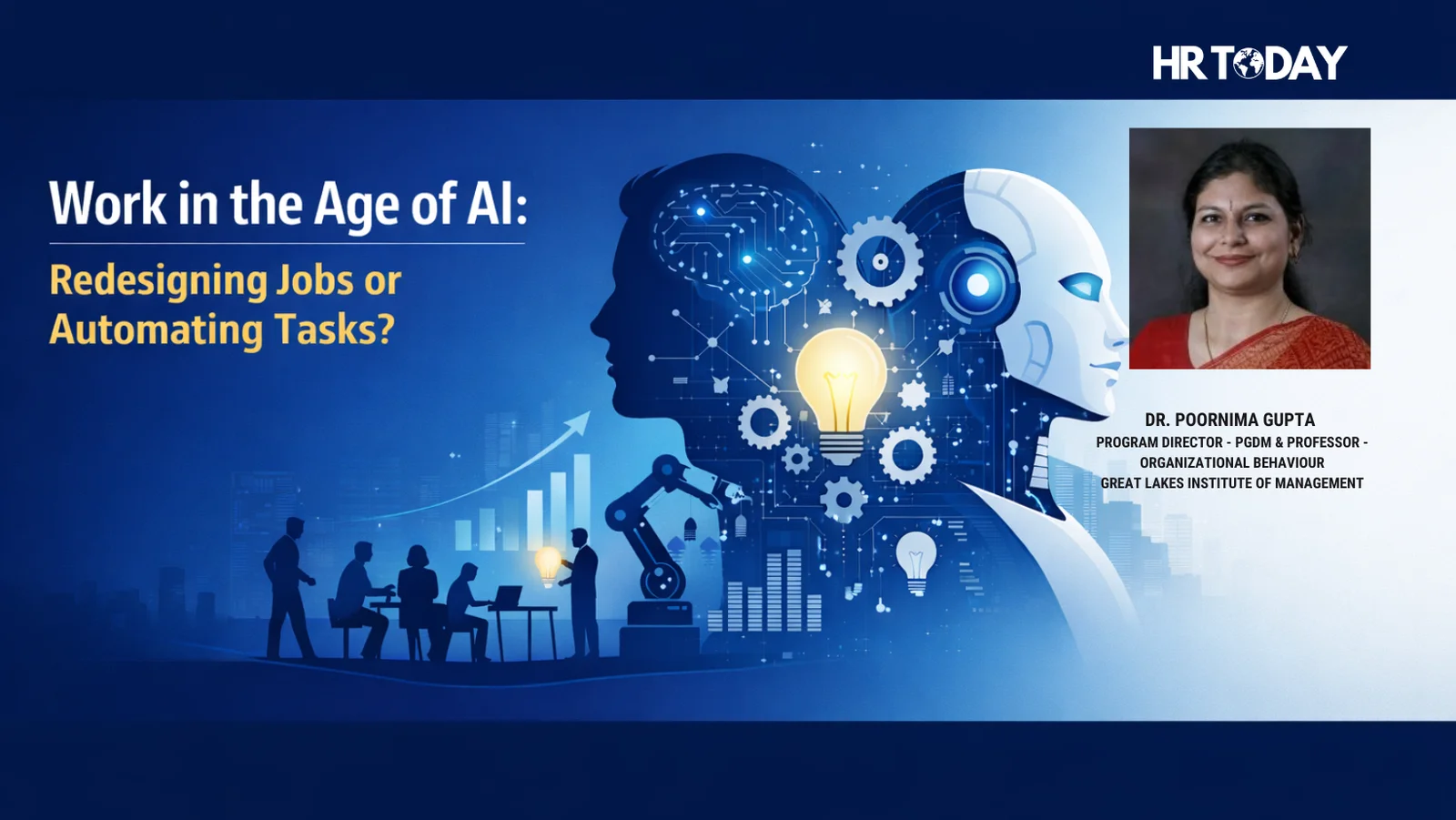

Artificial intelligence is rapidly reshaping how work gets done across India’s IT services, banking, digital economy and education. From code generation and customer service chatbots to AI-enabled assessments in training and education, AI is now embedded in everyday workflows.
Yet a deeper question persists for leaders: Are jobs being redesigned—or largely getting automated?
What does this mean? It is a distinction that matters enormously not just strategically, but humanly. The difference between an organisation that redesigns its workforce and one that merely automates it is the difference between a future where employees grow alongside technology and one where they are gradually rendered peripheral to it.
If we see the trends, they reveal a transition in progress, where automation is widespread, but true work redesign is still emerging.
Thought leaders, including Deloitte, advocate reimagining work as a partnership: humans define problems, machines generate solutions, and humans validate outcomes.
In India, this model is already visible in pockets. AI is being used as an assistant, automating repetitive, time-consuming tasks such as data entry, report generation, and basic data analysis. This is largely enabling employees to focus on higher-value work like client engagement, decision-making, and innovation.
For example, Tata Consultancy Services (TCS) has integrated AI into software development through platforms like Ignio and generative AI tools to transform enterprise IT operations, making them faster, more resilient, and autonomous. Routine coding and testing tasks are increasingly automated, enabling engineers to focus on architecture, problem-solving, and client-specific solutions.
Similarly, Infosys has deployed its Topaz AI platform to embed AI across services right from customer support to enterprise analytics, thereby enhancing employee productivity rather than replacing roles outright.
Despite these advances, most Indian organisations are still applying AI at a task level, not a job level.
Take the banking industry, which uses AI extensively for customer service chatbots (like EVA). These systems reduce turnaround time and improve efficiency—but the core structure of roles in operations and customer service remains largely unchanged.
In e-commerce, Flipkart uses AI for demand forecasting, inventory management, and personalised recommendations. While this has improved productivity and customer experience, it has not yet fundamentally redefined most operational roles.
We have experienced a similar shift before. With the rise of computers in the 1990s, roles like typists and traditional secretaries declined. However, they did not disappear entirely—they evolved into higher-value positions such as executive assistants, requiring coordination, communication, and decision support. AI appears to be following the same trajectory. Routine-heavy roles, especially in BPO, customer support, and entry-level IT services are most susceptible to automation. But history suggests that roles will evolve, not just vanish, provided organisations invest in reskilling.
AI is undeniably boosting productivity across organisations, faster project delivery in IT services, reduced manual errors in banking operations, improved customer experience in digital platforms and also enhancing personal coaching in education
At Wipro, for instance, AI-driven automation is streamlining internal processes and client delivery, allowing teams to handle more complex work with the same or fewer resources.
However, this creates a tension. If employees become significantly more productive, organisations may require fewer people for the same output or expect higher output from the same workforce.
If we do the cost-benefit analysis for Automation vs Redesign,
Both TCS and Infosys have launched substantial internal reskilling programmes to prepare their workforces for AI-augmented roles. These are meaningful commitments, and they signal something important: the organisations most likely to thrive are those that treat workforce capability as a strategic asset, not an operating cost.
Forward-thinking HR leaders are beginning to reshape their operating models accordingly — moving toward skills-based hiring, designing roles that integrate technical, analytical, and distinctly human capabilities, and building learning ecosystems that evolve alongside the technology itself.
The stakes extend beyond individual organisations. India has an opportunity to strengthen its position as a global AI talent hub — not by producing workers who service AI systems, but by developing professionals who direct them, question them, and create value through them.
That future, however, is not inevitable. It requires organisations to ask a different and more demanding question than the one many are currently asking.
The organisations that succeed will not be those that ask, “What can AI replace?”
But those who ask, “How can we redesign work so humans and AI create more value together?”
Just as the IT revolution transformed India’s workforce in the 1990s, AI will redefine work once again—only faster and more profoundly.
Read Also : The Great Rewiring: What India’s new labour codes really mean for employers
India’s Airline Crisis: When Efficiency Overrides Resilience
Rethinking Talent in the Age of AI: Why Workforce Agility Starts with the 4Bs