2 years on, where does Mohan govt stand on ‘Modi-Guarantees’?: Jobs for every family, free education remain biggest hurdles; youth remain sceptical – Madhya Pradesh News


Yogesh Pandey, Bhopal1 hour ago
Two years after the BJP’s landslide win in the 2023 Madhya Pradesh Assembly elections, questions remain over the delivery of key promises made under ‘Modi’s Guarantee’. While the Mohan Yadav government claims steady progress, several flagship assurances such as jobs for every family, free education up to Class 12, and IIT–AIIMS-style institutes are still far from reality.
A review of the BJP’s manifesto shows mixed results, with a few schemes moving ahead and many others yet to take shape.
BJP’s historic victory and a surprise CM
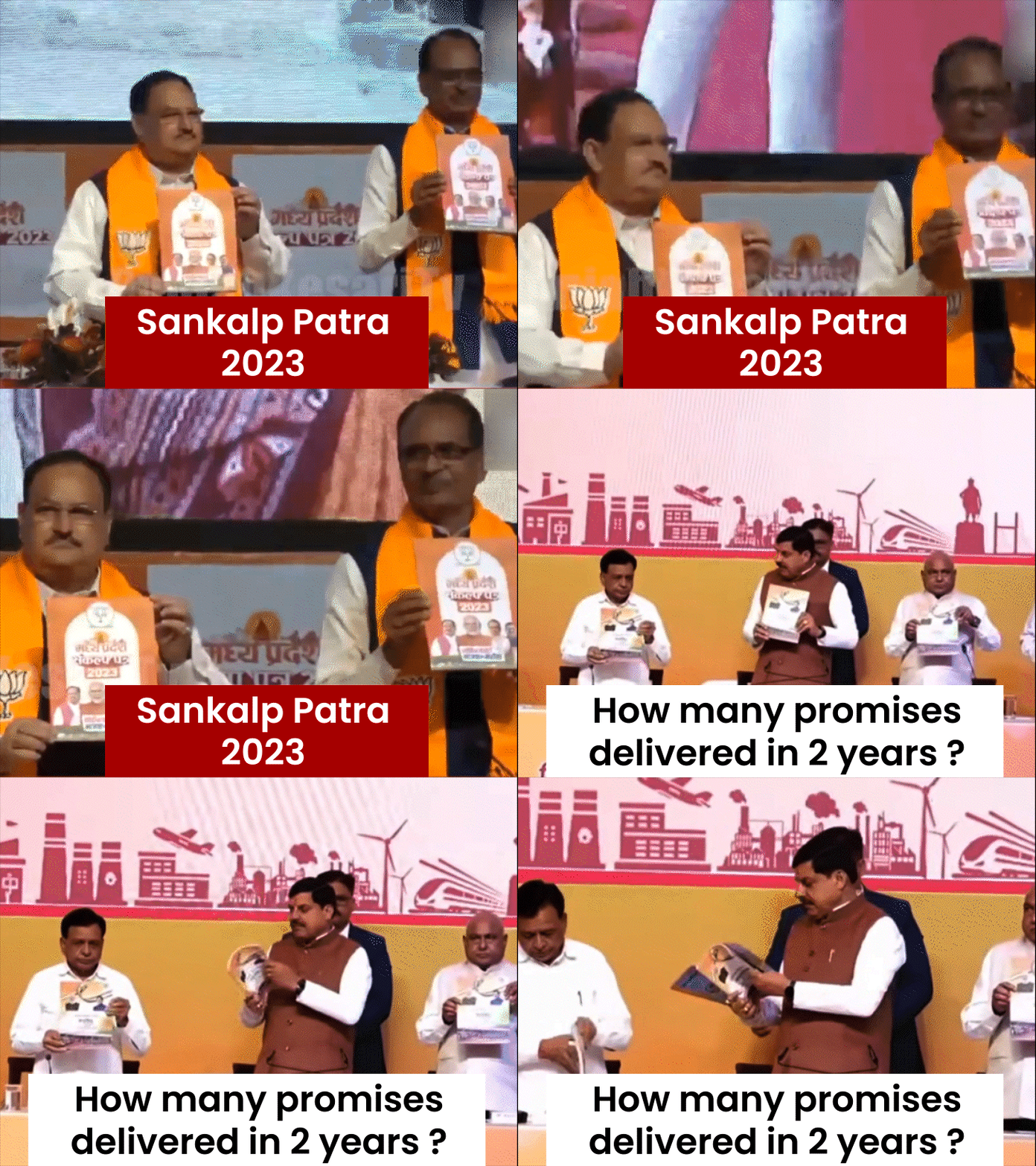
Just before Diwali in 2023, the BJP released its manifesto titled ‘Modi’s Guarantee, BJP’s Trust’. The slogan said that Prime Minister Narendra Modi lived in the heart of Madhya Pradesh.
The message worked. After polling on 17 November, results on 3 December gave the BJP 164 of 230 seats. It was the party’s biggest win in the state since 2003. After the victory, PM Modi surprised many by naming Dr Mohan Yadav, a three-time MLA from Ujjain South, as Chief Minister.
On 13 December, the Mohan Yadav government completed two years in office.
Big question after 2 years
As the BJP government completes two years in Madhya Pradesh, the first question that arises is: how many of its promises have been fulfilled so far?”
A review shows that major promises like employment for every family, housing for all homeless people, and free education up to Class 12 are still incomplete. The government, however, insists it is committed to delivering every promise over five years.
1. Job for every family: Limited progress
This was the most ambitious promise in the manifesto.
So far, the government has issued appointment letters to about 11,000 people in two years. The stated target is 2.50 lakh jobs.
Officials say recruitment for police and Anganwadi workers has been approved. Vacant posts in departments are also being reviewed. Still, the situation remains difficult for many young people.
Chief Minister Mohan Yadav has declared 2025 as the ‘Year of Employment’. He says investment proposals worth Rs 32 lakh crore were received at investor meets, and Rs 8.57 lakh crore worth of projects are under implementation.
Madhya Pradesh now ranks third among states in attracting investment proposals.
BJP’s claim on employment
BJP spokesperson Dr Vani Ahluwalia says the government is working in an organised manner on jobs, housing, and skill development. She adds that industries coming through conclaves are creating new employment opportunities.
State media in-charge Ashish Agrawal claims that 60,000 direct jobs have been created in two years. He also says over 2 lakh jobs have come through the industrial sector. The BJP claims Madhya Pradesh will soon become a surplus employment state.
Youth remain unconvinced
Many young people disagree. LLB student Surbhi Tripathi says vacancies are far fewer than the number of applicants. She adds that even after the Patwari recruitment scam, no strong action was taken. Another aspirant, Aman Kushwah, says most recruitments remain on paper. Exams are delayed, and question papers often get leaked.
2. IIT–AIIMS-type institutes: Still on paper
The manifesto promised institutes on the lines of IITs and AIIMS.
The government has focused on medical colleges. Madhya Pradesh now has 19 government medical colleges. Four more have been announced in Damoh, Tikamgarh, Panna, and Katni.
However, there is a serious shortage of teachers and trained staff. The Chief Minister says the government is considering higher salaries to attract doctors to smaller cities.
The promised ‘Madhya Pradesh Institute of Medical Science’, similar to AIIMS, has not yet taken shape. There is also no visible progress on a ‘Madhya Pradesh Institute of Technology’.
3. Houses for Ladli Behnas: Scheme moves ahead
This is one promise where progress is visible. The manifesto promised houses for Ladli Behnas along with financial assistance. For this, the state introduced the Chief Minister Jan Awas Yojana in 2023. To reduce costs, the state requested the Centre to merge it with Pradhan Mantri Awas Yojana 2.0. Approval has now been received, clearing the way for implementation.
4. No family will be homeless: Government’s claim
To meet this promise, a survey of people living on government land began in 2020. The government claims that ownership rights for land or houses have been given to 39.60 lakh people. Despite this, slum settlements continue to exist in many cities.
5. Breakfast and free education: Promise on hold
The manifesto promised a nutritious breakfast along with the Mid-Day Meal in government schools. Even after two years, this has not started. The Mid-Day Meal scheme continues as before.
The promise of free education up to Class 12 for poor children has also not seen any direct action. Existing schemes like free bicycles for girls and laptops or scooters for meritorious students are continuing. There is still no clear roadmap for free education.
6. Pulses and oil at ration shops: Yet to arrive
The government promised pulses and mustard oil at ration shops along with grains. At present, only grains are being distributed. Pulses and oil have not reached ration shops. The government says free grain is being given to 1.33 crore families, but there is no update on pulses and oil.
How the BJP manifesto was prepared
Before the elections, the BJP organised Jan Ashirwad Yatras across divisions. These lasted 21 days. During the yatras, intellectual meets were held in 52 districts. Public suggestions were collected and later studied to prepare the manifesto.
Jayant Malaiya, chairman of the manifesto committee, says the document is meant for five years, not just two.
‘Even Mohan Yadav did not know he would be CM’
Senior journalist Girijashankar says governments are theoretically bound by manifestos, but in practice, this rarely happens. He explains that experts draft manifestos, while politicians implement them. When the manifesto was released, Mohan Yadav himself did not know he would become Chief Minister.
He also points out that populist promises began in the 1980s, starting with NT Rama Rao in Andhra Pradesh, and later spread nationwide. Girijashankar adds that most voters never read manifestos, as they are released just days before polling.