
2025: The year India’s economy found its balance of growth, jobs and stability | SME Futures



2025 has been a defining year for India’s economic story. If one year can be described as a moment of economic alignment for India, this year would qualify convincingly. Growth accelerated, inflation softened sharply, unemployment declined to multi-year lows, exports expanded despite global headwinds, and macroeconomic stability held firm. Together, these shifts transformed what could have been a volatile global period into one of confidence and consolidation for the Indian economy.
At a time when several large economies grappled with inflation shocks, geopolitical trade disruptions, and tightening financial conditions, India delivered a rare combination, high growth with low inflation, supported by domestic demand, prudent monetary management, and sustained reform momentum.
By the end of 2025, India had not only strengthened its near-term outlook but also reinforced its long-term ambition of becoming a high middle-income economy by 2047.
India entered 2025 already among the world’s fastest-growing major economies. But as the year unfolded, growth surprised on the upside.
Real GDP expanded 8.2% in Q2 FY 2025–26, up from 7.8% in Q1 and 7.4% in Q4 FY 2024–25, marking a six-quarter high. The acceleration was driven largely by robust private consumption, strong services activity, and sustained industrial output.
With GDP valued at USD 4.18 trillion, India surpassed Japan to become the world’s fourth-largest economy, and projections now suggest it could displace Germany to become third within the next few years, reaching USD 7.3 trillion by 2030.
High-frequency indicators reinforced this momentum. Inflation stayed below tolerance thresholds, credit flows remained strong, financial conditions benign, and urban consumption strengthened further—creating what policymakers described as a “Goldilocks phase” of growth without overheating.
In a country where nearly 26% of the population is aged between 10 and 24, employment outcomes are as critical as GDP numbers. In 2025, the labour market delivered encouraging signals.
The Periodic Labour Force Survey (PLFS) showed a sustained decline in unemployment alongside rising participation levels—suggesting that growth was being absorbed by real job creation.
By November 2025, the unemployment rate (CWS basis, age 15+) declined to 4.8%, down from 5.4% in October, marking the lowest level since April 2025. The decline was particularly pronounced among women, both in rural and urban areas.
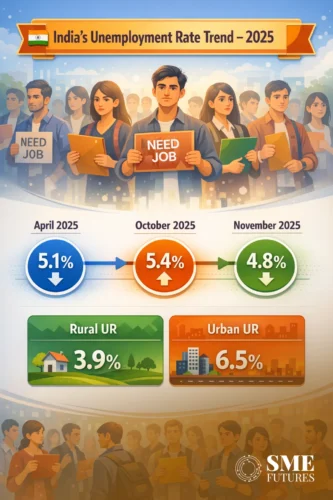
Equally important were participation indicators. The Labour Force Participation Rate (LFPR) rose to 55.8%, while the Worker Population Ratio (WPR) increased to 53.2%, signalling deeper labour market engagement and inclusive growth.
Perhaps the most striking macroeconomic achievement of 2025 was the sharp moderation in inflation.
Consumer Price Index (CPI) inflation, which stood at 4.26% in January, softened steadily through the year, reaching historic lows of around 0.25% in October before edging up slightly to 0.71% in November.
This decline was particularly notable because it ran counter to typical seasonal pressures, driven by correction in food prices and effective supply-side management.
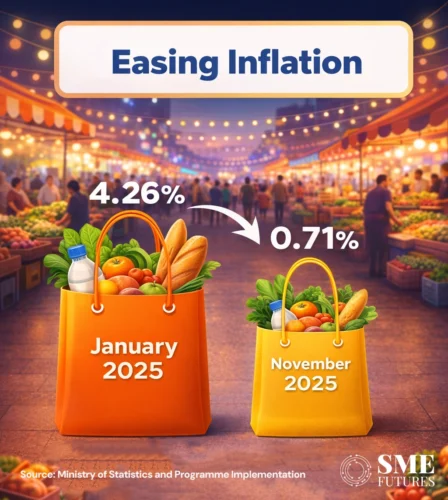
With inflation comfortably within the RBI’s tolerance band, the central bank reduced the policy repo rate by 25 basis points to 5.25%, adopting a neutral stance that balanced growth support with price stability. RBI has also lowered its CPI inflation forecast for FY 2025–26 to 2.0%, down from 2.6%.
Wholesale Price Index (WPI) inflation mirrored this moderation, turning mildly negative by November—further easing cost pressures for producers and supporting investment sentiment.
Despite global trade disruptions, India’s external sector demonstrated resilience throughout 2025.
Merchandise exports grew from USD 36.43 billion in January to USD 38.13 billion in November, supported by strong performance in engineering goods, electronics, pharmaceuticals, petroleum products, and agri-commodities.
Several product categories recorded double-digit growth, including cashew, marine products, electronic goods, and engineering exports.
| Merchandise Export Growth in 2025 (In USD Million) | |||
| Commodities | Jan’2025 | Nov’2025 | Growth |
| Cashew | 34.93 | 57.42 | 64.39% |
| Marine Products | 540.75 | 877.65 | 62.30% |
| Other Cereals | 28.36 | 37.53 | 32.33% |
| Electronic Goods | 4105.46 | 4813.66 | 17.25% |
| Engineering Goods | 9418.06 | 11012.20 | 16.93% |
| Coffee | 115.73 | 134.83 | 16.50% |
| Petroleum Products | 3561.76 | 3931.52 | 10.38% |
| Ceramic Products and Glassware | 326.43
|
355.17
|
8.80%
|
| Spices | 343.01 | 358.46 | 4.50% |
| Fruits and Vegetables | 303.16 | 314.47 | 3.73% |
Services exports remained a key stabiliser, growing 8.65% to USD 270.06 billion between April–November 2025, driven by computer services and business services.
Trade diversification also gained momentum, with India strengthening partnerships with the UK, Oman, New Zealand, and expanding trade ties with China, UAE, Germany, France, and Australia.

India’s external sector entered 2026 with solid buffers.
Foreign Direct Investment showed renewed momentum, with gross FDI rising 19.4% in the first half of FY26 and net FDI jumping 127.6%, aided by lower repatriation.
By the end of 2025, India’s economic resilience was reflected in upgraded growth forecasts from global institutions:
This convergence of domestic strength and global confidence reinforced India’s trajectory towards long-term economic transformation.
More than a year of strong numbers, 2025 represented proof of concept. It showed that India could grow rapidly while maintaining price stability, create jobs without overheating the economy, and remain externally resilient amid global uncertainty.
As India looks towards 2047, the milestones of 2025 offer not just optimism—but a credible roadmap for sustainable, inclusive growth.
(All data, statistics, and figures cited in this article are sourced from official Government of India publications and releases, including PIB research and related government datasets.)