Sitharaman highlights Rs 17.1 lakh crore capex push, higher states’ share, jobs plan and AI-skilling focus

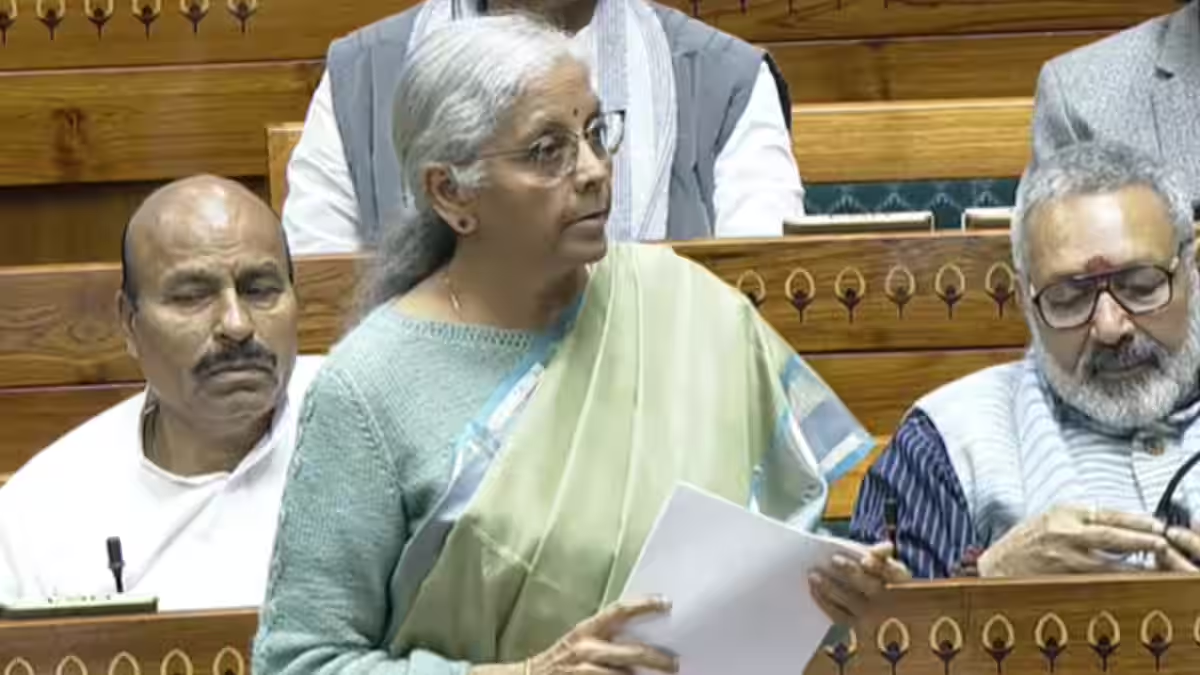

Budget 2026-27: Union Finance Minister Nirmala Sitharaman on Wednesday said the effective capital expenditure for the financial year 2026-27, including spending by states and union territories, has been pegged at Rs 17.1 lakh crore, or 4.4 per cent of the gross domestic product (GDP), calling it a major step towards achieving the goal of Viksit Bharat.
Replying to the debate on the Union Budget 2026-27 in the Lok Sabha, Sitharaman said public capital expenditure has been raised from Rs 11.2 lakh crore in the Budget Estimates of 2025–26 to Rs 12.2 lakh crore in FY27. Taken together with allocations for states and UTs, the effective capex stands at Rs 17.1 lakh crore.
She also assured that 41 per cent of central taxes would continue to be devolved to the states.
The finance minister said states’ share in central devolution is estimated at Rs 25.44 lakh crore in the coming year, marking an increase of Rs 2.7 lakh crore from the previous year. On the recommendation of state finance ministers, she added, interest-free capital expenditure loans for 50 years under the SASKI scheme have been raised to Rs 2 lakh crore.
Highlighting the government’s thrust on human capital, Sitharaman said skilling has been integrated into education to prepare students for employment and entrepreneurship. “We have said that instead of waiting to qualify and finishing your education and coming out and seeking where should they go for acquiring skills, the skilling element can be brought into education itself and at the end of the day when they come out, students can say I can become entrepreneur and this kind of a mega centre can be kept next to any industrial cluster that any state has,” she said.
She said the government plans to work with states to set up mega entrepreneurship-building centres near industrial clusters, which could function as higher education and innovation hubs.
On artificial intelligence education, Sitharaman said, “AI education is not just kept at elite level, but it is now for the masses,” adding that AI has been introduced at all levels of education and that girls’ hostels are necessary to encourage STEM participation.
Speaking on infrastructure, Sitharaman said the government is expanding focus beyond roads.
“It’s not just roads, it’s not just national highways. We are also looking at waterways, so that the cost of logistics may come down and states which are not connected to sea ports will have advantage of moving goods faster at a lesser cost,” she said.
Addressing concerns raised by members about employment, she said, “…Many members spoke about the youth and raised the issue that no new policy is being brought to generate employment for them. I want to state clearly that the five regional medical hubs will promote medical tourism and create opportunities…”
She said five regional medical hubs will be established to promote medical tourism and create about one lakh employment opportunities over the next five years. She added that five large textile-to-leather parks will also be set up to generate employment and that a major elderly care ecosystem is being prepared under which 1.5 lakh caregivers will be trained this year.
Referring to MSME hubs, Sitharaman said, “200 legacy clusters, which have been known for decades as those places which supported MSME and they produce and export – it can be Ludhiana, Jalandhar or Kanpur or centres near Bihar, it can be anywhere in Bengal, we have volunteered that it can be funded, upgraded and given the modern instruments.”
She also said the Centre is willing to collaborate with states to set up mega textile parks focused on industrial textiles and new-age manufacturing segments.
In the Rajya Sabha, the Finance Minister will reply to the discussion on the Union Budget 2025-26 on Thursday.