
AI, work-from-home no threat to office demand: IndiQube’s Meghna Agarwal

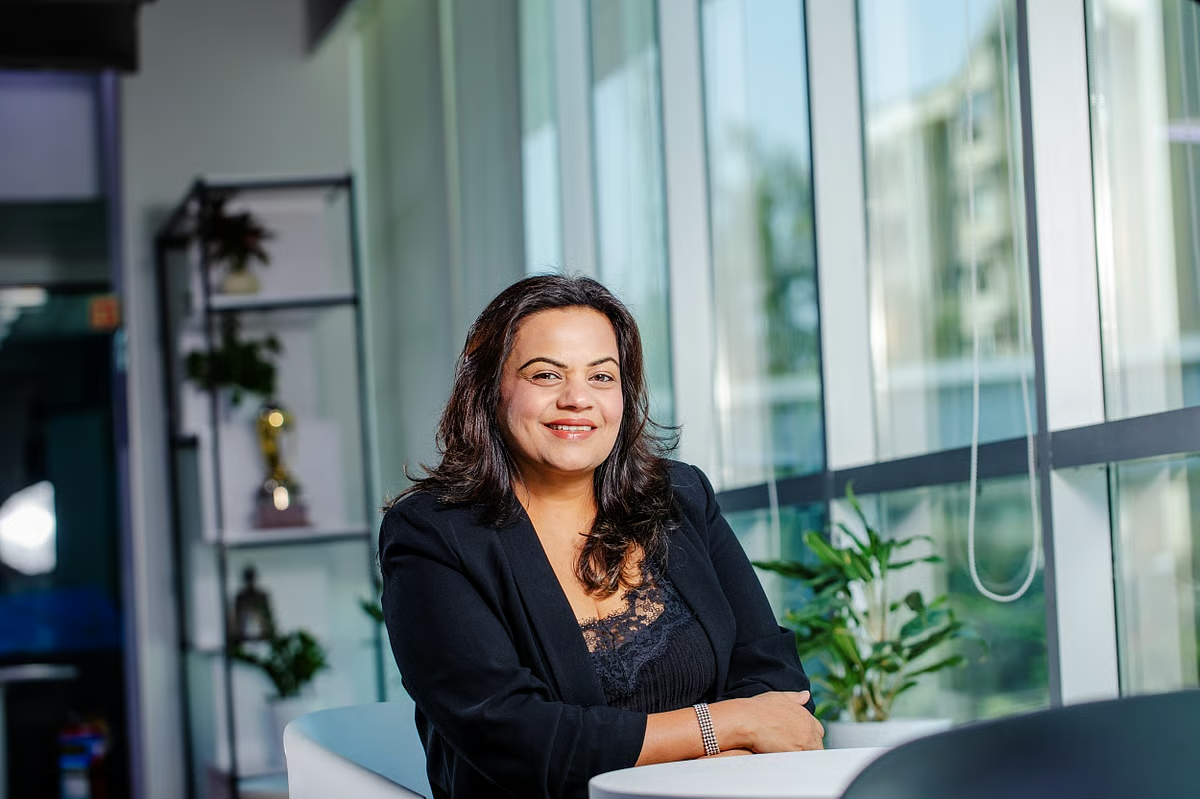

IndiQube Spaces co-founder Meghna Agarwal said the managed-workspace provider is seeing no let-up in office demand and that any jobs displaced by artificial intelligence (AI) are being more than compensated for by a wave of new-age companies and global capability centres (GCCs), that are hiring aggressively.
In an interview with Fortune India, Agarwal pushed back on the narrative that AI and hybrid work have turned into headwinds for the commercial real estate sector, arguing instead that the numbers tell a very different story. “If there were any real impact, we wouldn’t be reporting 37% revenue growth [in FY26]. If anything is wrong, it should show up in the numbers. It isn’t showing up,” said Agarwal.
Agarwal cited a recent industry report to make the case that AI is, on a net basis, expanding rather than shrinking employment. While the number of people hired by any individual company may have fallen, the number of companies doing the hiring has risen sharply. “There are so many companies that have emerged because of AI, and they are hiring; companies you have not even heard of,” she said, adding that the technology has also driven a wave of reskilling.
She drew a distinction between disruption and displacement. AI will redefine jobs rather than simply eliminate them, she argued, comparing the effect to a pyramid in which lower-end roles may thin out but middle-layer roles, particularly in testing and verification, would expand. AI may write code but that code cannot be shipped untested, she said, pointing to a major e-commerce platform that suffered a significant outage after inadequately tested AI-generated code went live.
“Nobody fully knows how reskilling and redefining will play out but on the ground, we are seeing different kinds of companies coming in and hiring,” said Agarwal
On the work-from-home debate, Agarwal said hybrid working was neither new nor disruptive to demand, noting that 70-75% of IndiQube’s large clients already operate three-days-in-office policies.
Crucially, she said, those three days require dedicated rather than shared desks, as employees want a permanent space of their own rather than rotating seats. Companies had also hired heavily while taking up only about half the space they would otherwise need, in anticipation of hybrid models, meaning the lower space utilisation has already been absorbed into the market.
Agarwal said she had been in the US three weeks earlier, where conversations about AI-led disruption remained largely speculative. “People are talking about it, but it’s still a wait-and-watch situation. Nobody really knows what is going to happen.”
Far from being a threat, Agarwal positioned uncertainty, geopolitical and technological, as a structural tailwind for the flexible-workspace model. The greater the uncertainty, the less willing clients are to lock themselves into high capital expenditure or a single building, pushing them toward flexible space that allows them to expand or contract as needed.
She pointed to India’s emergence as the only stable market for GCCs amid Middle East unrest, with China ruled out on talent-depth concerns. “If you need 100 architects or developers, where is the depth of talent? It is all India,” she said, noting that the US has roughly 3,000 banks, very few of which have set up GCCs in India yet. “Eventually they will come, because operations and technology have to run from India.”
Agarwal said IndiQube’s GCC client ratio has risen over the previous year, with only a marginal increase in interior and capital-expenditure costs from logistics disruptions, cushioned by the fact that the company’s manufacturers are India-based, insulating it from currency swings.
The optimism is reflected in IndiQube’s growth plans. The company beat its FY26 guidance of around 30% top-line growth by seven percentage points, posting 37% growth, while keeping EBITDA in its guided 18-21% band and PAT at 8-10%. For FY27, Agarwal guided to a “sustainable and healthy” 25-30% top-line growth, describing the business as “annuity income” with cash flows visible two to three quarters in advance.
The company aims to add 1.5-2 million sq ft of rent-paying area every year, roughly 33,000 to 44,000 seats, while resisting the temptation to grow recklessly. “We won’t grow 50% one year and 20% down the next. It is a marathon, not a sprint. It is real money we are dealing with, so asset quality and defensibility matter,” said Agarwal.
Expansion will be guided by a micro-market strategy rather than a city-led one. IndiQube classifies India’s 50-60 micro markets into green, yellow and red zones based on vacancy resilience, with about 75% of new additions going into deeper penetration of single-digit-vacancy “green” markets such as Koramangala and HSR in Bengaluru, Guindy in Chennai, Baner in Pune and Andheri in Mumbai. The rest is split between higher-potential “yellow” markets and cautiously approached “red” zones entered only on confirmed client demand.
Tier-II cities such as Coimbatore and Kochi have worked well, Agarwal said, though the company remains cautious about aggressive tier-II expansion given supply constraints, weak compliances and a fragmented landlord base. Supply, in fact, was one of the two main risks she flagged, noting that compliant, good-quality supply is scarce even in prime micro markets, forcing IndiQube to renovate roughly a third of its portfolio.
Platform play deepens with VAS
Underpinning the demand story is IndiQube’s pivot from a pure real-estate player to a workspace platform. Value-added services (VAS), covering interiors, facilities management, housekeeping, transport and food, have grown from 12% to about 15% of revenue, and Agarwal expects this to reach around 18% in the coming year.
With more than 40% of clients signing pan-India deals, VAS has become an entry point into spaces the company does not even lease, effectively expanding its addressable market from the roughly 80 million sq ft absorbed annually to India’s entire one-billion-sq-ft commercial real estate stock.
“Real estate is just the domain. This is a service play, and the employee is the hero of the story. The more the uncertainty, the more this model’s penetration grows,” she said.