
Early-Career Hiring Is Down, But Largely Because Of Remote Work Instead Of AI: LSE Paper

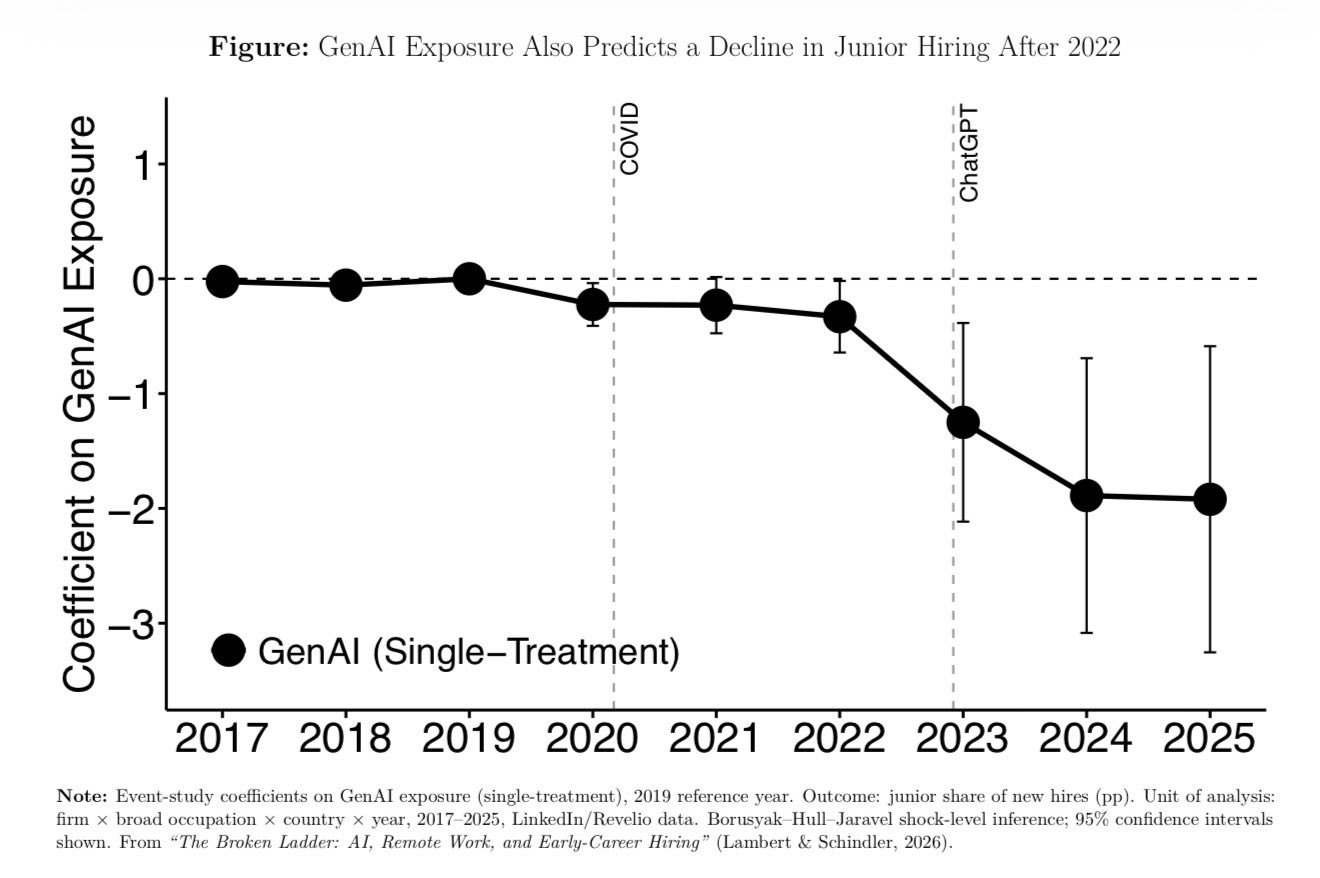

AI is being blamed for the fall in entry-level job openings, but there might be an entirely different factor causing the decline.
A new working paper titled The Broken Ladder: AI, Remote Work, and Early-Career Hiring by Peter John Lambert and Yannick Schindler argues that the widely documented drop in junior hiring has less to do with generative AI and far more to do with the post-pandemic normalization of working from home (WFH). The paper draws on two large datasets — 243 million new hires and 407 million online job postings — collected across the US, UK, Canada, and Australia between 2017 and 2025.
The decline in early-career hiring has been hard to ignore. Studies from Stanford and Harvard have both pointed to generative AI as the primary culprit, citing steep drops in junior employment concentrated in AI-exposed occupations like software development and customer service. The Stanford study, which used ADP payroll records, found a 13% relative employment decline for workers aged 22–25 in the most AI-exposed roles since late 2022. The Harvard study found similar patterns, with junior headcount at AI-adopting firms falling 7.7% over just six quarters from early 2023.
The story has resonated: GenAI arrived, firms realized they needed fewer junior workers to do routine tasks, and early-career hiring collapsed. It is a clean narrative. Lambert and Schindler argue it is also incomplete.
The core problem identified in The Broken Ladder is one of omitted variable bias. GenAI exposure — the measure used in most prior studies to explain the junior hiring decline — is strongly correlated with another post-pandemic shift: the degree to which occupations shifted to remote work. White-collar, routine-cognitive jobs, which are most exposed to GenAI, also happen to be the jobs most likely to have gone remote. Treating GenAI as the sole driver, without accounting for WFH, risks attributing to AI an effect that belongs to remote work.
Using difference-in-differences designs at the occupation, region, and firm level, the authors test both variables — GenAI exposure and WFH exposure — first separately, then jointly. When estimated separately, a two-standard-deviation increase in either GenAI or WFH exposure predicts roughly a 5 percentage point fall in the junior share of new hires by 2025, and about a 3 percentage point drop in the share of job ads requiring limited experience.
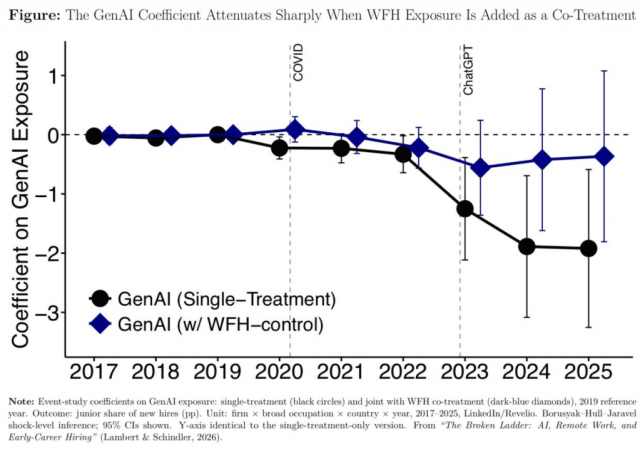
Then comes the key finding: when both variables are included together, the GenAI coefficient attenuates sharply and often becomes statistically indistinguishable from zero. WFH exposure, by contrast, remains a strong and robust predictor of declining junior-share across every specification the authors test.
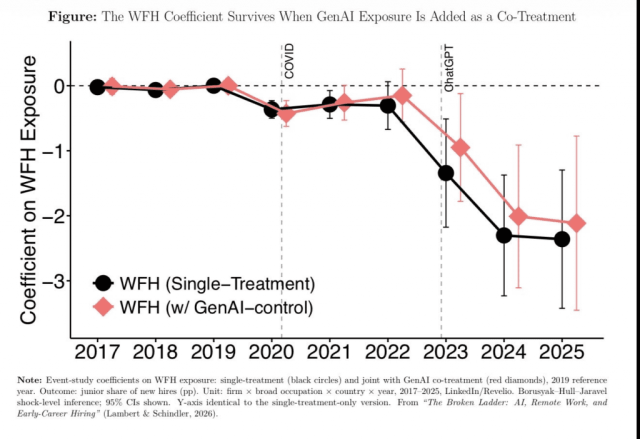
Even replacing the continuous WFH exposure measure with a simple binary dummy — did this occupation shift to remote work or not — is enough to render the GenAI effect insignificant.
The paper proposes a stylized theoretical model to explain the mechanism. Remote work raises the costs of supervision, monitoring, and on-the-job learning. These costs fall disproportionately on junior employees, who require more managerial investment, closer oversight, and structured learning environments to develop competency. When WFH makes all of that harder and more expensive, firms become less willing to make those investments. The result is a pullback in junior hiring — not because AI has made those roles obsolete, but because remote work arrangements have made them organizationally harder to justify.
Supervision and mentorship, which are easy in-office interactions, become friction-heavy virtual coordination tasks. The “out of sight, out of mind” dynamic hits new and junior hires hardest. Senior workers, who have already built institutional knowledge and require less hand-holding, are largely unaffected.
The findings carry a more optimistic implication than the prevailing AI-displacement narrative. Organizational friction from remote work feels more tractable than technology-induced displacement. If WFH is the true driver, then firms that return employees to the office — a trend already well underway, with companies across finance, tech, and media mandating in-office attendance — could see junior-hiring recover as the frictions diminish.
The AI-jobpocalypse framing, in this reading, may have been overstated. That does not mean AI is harmless to early-career workers — but the evidence that it is the primary cause of the hiring decline is weaker than it appeared once you control for the simultaneous rise of WFH.
Lambert and Schindler are careful not to claim that GenAI is irrelevant. They acknowledge it may yet play a significant role as capabilities improve and adoption deepens. But for now, their data suggests that the broken ladder is more a product of where people work than the tools they use to do it.