
The Urban Cost of Automation

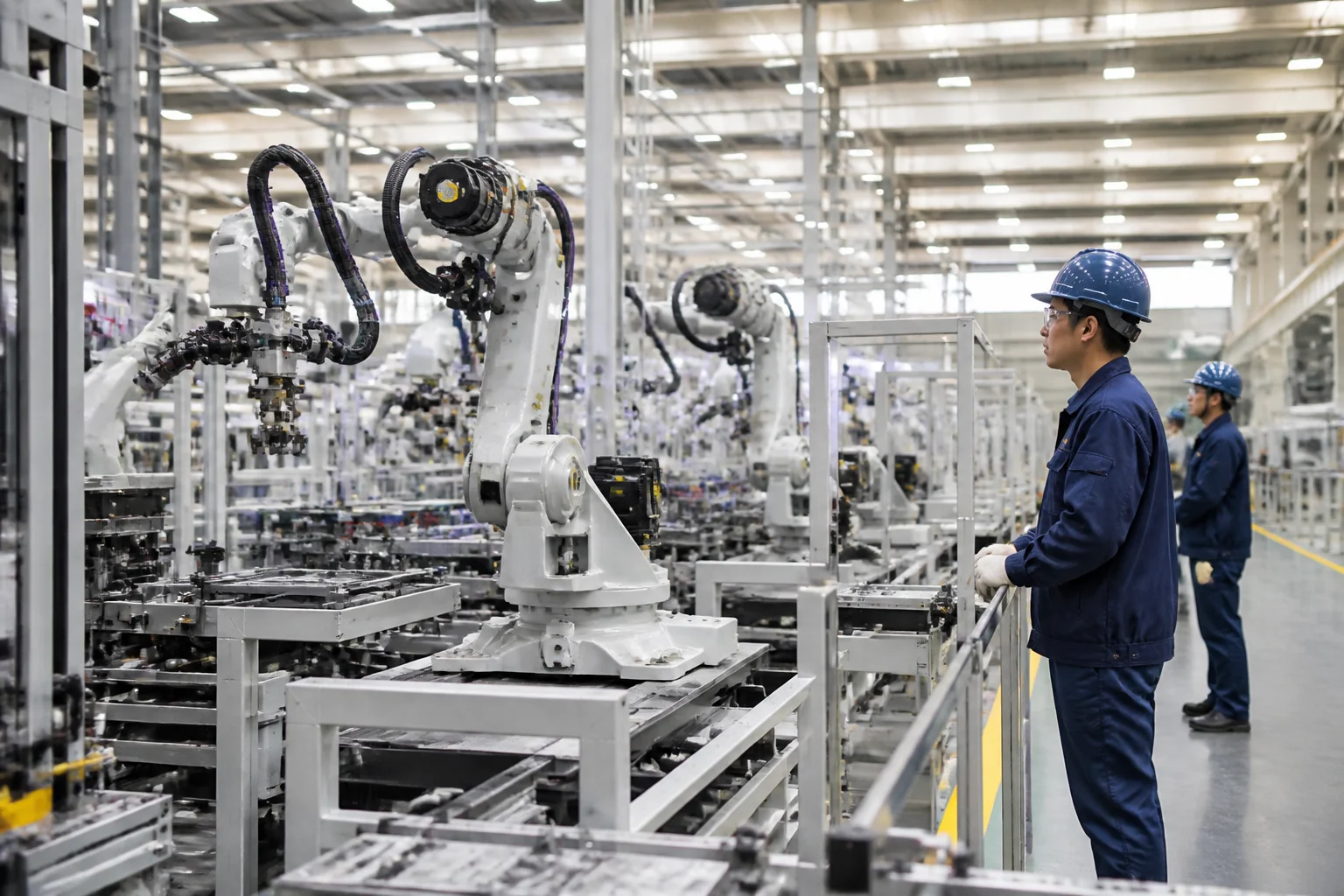

China’s employment crisis is no longer confined to factory workers displaced by automation or graduates struggling to enter white-collar careers. It now spans the industrial, construction and service economies that helped drive the country’s urbanisation. The recent dismissal of 107 graduates by auto-parts manufacturer Changzhou Xingyu Automotive Lighting has become a widely discussed example of a broader problem: China is producing more through increasingly efficient systems, but not creating enough stable work for the people entering or leaving those systems.
The incident at Xingyu drew attention because of its timing. The company hired 440 fresh graduates and dismissed 107 of them only weeks later, offering them a severance payment or a transfer to factory-floor work. Local regulators intervened after the episode attracted public criticism. The company acknowledged “management failures and a lack of empathy” and suspended its human-resources director. Days later, it reported first-half revenue of about $1 billion and approved a dividend of 56.6 million yuan.
The episode does not establish that one company’s conduct represents the behaviour of China’s entire manufacturing sector. It does, however, show how labour-market pressure is being experienced by workers: not simply as a gradual change in employment patterns, but as sudden insecurity after years of education or industrial work.
That insecurity is visible in the scale of China’s graduate cohort. The country sent a record 12.7 million graduates into the workforce this year, while unemployment among people aged 16 to 24 stood at 15.6 per cent in May, according to the report. That rate was more than twice the level for people only a few years older. The figures point to a mismatch between the supply of educated workers and the number of suitable entry-level jobs available to them.
The mismatch has been building for years. Universities expanded their intake, but the supply of white-collar employment did not keep pace with the growth in graduate numbers. Artificial intelligence is now adding pressure at the point where many young workers traditionally began their careers. Entry-level roles, which once allowed graduates to acquire experience before moving into more specialised work, are increasingly exposed to automation and organisational restructuring.
The policy response has included changes to higher education. Beijing has removed thousands of university programmes described as obsolete, with many of the affected courses in the humanities, while encouraging institutions to offer more technology- and artificial-intelligence-related degrees. Officials have also launched a six-month national hiring campaign and discussed using AI to help create 12 million urban jobs this year.
Those measures reveal the central difficulty. Education policy can alter the type of graduates entering the market, but it cannot by itself guarantee that the economy will generate enough stable positions. The report cites an Economist Intelligence Unit researcher describing the employment problem as persistent since 2020 and not meaningfully improved. The challenge is therefore not only whether workers have the right qualifications. It is whether economic growth is translating into broad-based demand for their labour.
The pressure is also affecting the workers who built China’s manufacturing and construction economy. Factory employees describe several forces operating at the same time: automation, the movement of some jobs to countries with lower labour costs and the contraction of construction activity after the real-estate downturn. Between 2021 and 2025, more than 14 million workers left China’s construction industry, according to the report.
Construction is a particularly important part of the urban employment system because it connects real-estate finance, local development, infrastructure activity and household incomes. When the property sector contracts, the effect is not limited to developers or home sales. It reaches contractors, migrant labourers, materials suppliers and workers whose income depends on new building activity. The reported decline in construction employment shows how a real-estate crisis can become a wider livelihood crisis.
Workers displaced from formal employment are increasingly moving into less secure forms of work. China’s gig workforce is projected to reach 320 million this year, up from 280 million last year, according to the report. The growth of platform-based work does not necessarily mean that the economy has created an equivalent number of high-quality jobs. It may instead indicate that people are using delivery, transport or other flexible work to compensate for the disappearance of regular employment.
The report gives the example of a former Foxconn worker delivering takeout for less than a dollar per order. It also refers to a construction worker who now pays more toward social security than his former employer did. These examples illustrate the institutional gap between employment and protection. When workers move from factories or construction sites into gig work, their income, benefits and responsibility for social-security contributions may change substantially.
China’s manufacturing numbers complicate the idea that the country is simply losing its industrial base. Rishi Shah, partner and economic advisory lead at Grant Thornton Bharat, told NDTV that China’s manufacturing employment peaked at 152 million in 2013 and had declined to 134 million, a reduction of roughly 18 million jobs or 12 per cent of the peak workforce, according to OECD research.
At the same time, China’s share of global manufactured exports has continued to rise. Shah argues that the combination of higher manufacturing output and fewer workers points primarily to increased productivity and automation rather than a collapse in production capacity. Geopolitical changes and supply-chain diversification have contributed to the shift, but he describes them as secondary to the productivity transition.
This distinction matters for cities. A factory economy can remain globally competitive while becoming less capable of absorbing workers at the scale it once did. Industrial output may grow even as employment falls. For urban regions built around manufacturing clusters, that creates a difficult adjustment: the economic base remains productive, but the relationship between production and mass employment weakens.
India’s manufacturing opportunity must therefore be read carefully. The report cites Ministry of Commerce data showing that Production-Linked Incentive schemes had generated 1.45 million jobs and Rs 2.4 trillion, or roughly $29 billion, in investment by FY26. Shah describes this as real but early progress in capturing some activity shifting through global supply chains.
The same assessment warns against treating assembly work as the endpoint. To build a durable manufacturing position, India would need to expand into components, research and advanced manufacturing. The report identifies quality, innovation and supply-chain depth as continuing challenges. China’s experience suggests why these issues matter: attracting production is not the same as ensuring that industrial growth produces a large and stable workforce.
The broader policy landscape is therefore divided between industrial upgrading and employment protection. China’s leaders have promised stronger protections for gig workers and introduced hiring measures for graduates. Universities are being redirected toward technology and AI-related programmes, while policymakers are attempting to use new technologies as part of the response to unemployment. Yet the report indicates that these measures have not matched the scale of the labour-market disruption.
The underlying urban question is how cities should adapt when productivity rises faster than the supply of ordinary jobs. For decades, China’s industrial and construction systems absorbed workers moving out of poverty and into expanding urban economies. The current transition is different. The economy is not described as running out of ambition or production capacity; it is struggling to provide accessible, stable employment for both workers without university degrees and those who have recently earned them.
The evidence supplied in the report confirms a shift from employment-intensive growth toward more automated and uneven growth. It also shows that the consequences extend beyond factories into construction, real estate, universities and the gig economy. What remains uncertain is whether new industries and public employment measures can create work at the scale required. The performance of graduate hiring campaigns, the quality of gig-worker protections and the ability of manufacturing policy to move beyond assembly are the developments that will determine whether China’s productivity gains become a wider urban employment recovery.