
The Urban Cost of Automation

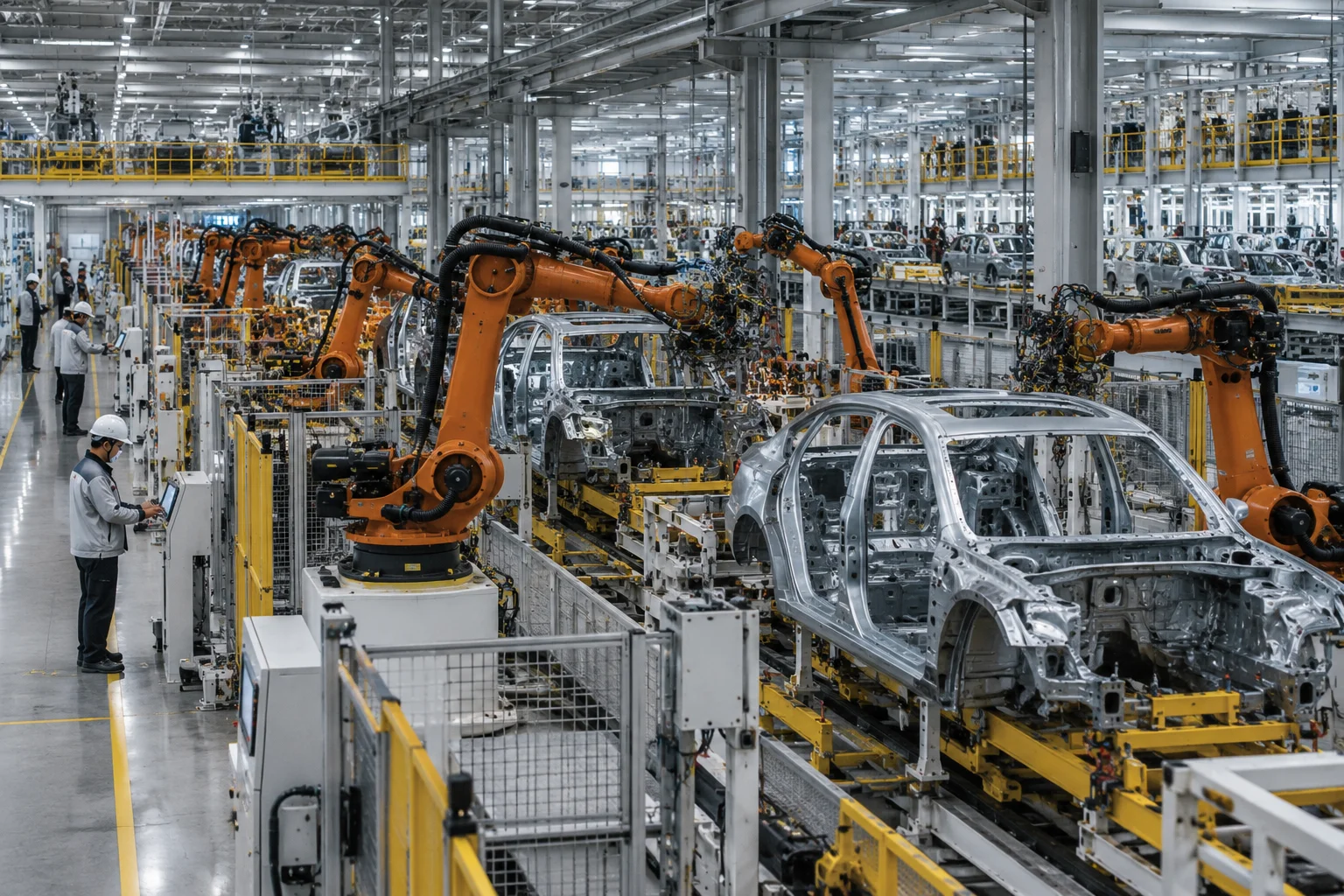

China’s job crisis is no longer confined to a single factory or a temporary slowdown. The dismissal of 107 recent graduates by auto-parts manufacturer Changzhou Xingyu Automotive Lighting, only weeks after the company hired them, has become a window into a wider transformation of the country’s labour market. Manufacturing output remains substantial, but the factories, construction sites and office sectors that once absorbed millions of workers are no longer creating jobs at the same pace.
The episode at Xingyu drew attention because of its abruptness. The company hired 440 fresh graduates this year and later dismissed 107 of them, offering them a choice between a small payout and reassignment to factory-floor work. Local regulators intervened after the incident attracted public attention. The company acknowledged what it called “management failures and a lack of empathy” and suspended its human resources director. Days later, it reported first-half revenue of about $1 billion and approved a 56.6-million-yuan dividend.
The details made the dispute appear to be a question of corporate conduct. But the broader evidence suggests a deeper problem: China is producing more graduates and more technologically advanced output while generating fewer conventional routes into stable employment. That tension is particularly important for cities, where jobs, housing demand, household spending and social security systems are closely connected.
China sent a record 12.7 million graduates into the workforce this year, according to the report. Youth unemployment among people aged 16 to 24 stood at 15.6 per cent in May, more than twice the rate for people only a few years older. The figures describe a labour market in which educational expansion has outpaced the growth of suitable entry-level employment.
The mismatch is not limited to graduates. China’s factory workforce is also being reshaped by automation, supply-chain changes and the weakening of construction activity. Between 2021 and 2025, more than 14 million workers left the construction industry as the country’s real-estate bubble burst. Construction had long been a major source of employment for workers without university degrees, as well as a crucial link between urban development, household incomes and local government revenues.
As that sector contracted, displaced workers moved into less secure forms of employment. China’s gig workforce is projected to reach 320 million this year, up from 280 million last year, according to the supplied report. The growth of platform and informal work indicates that people are still finding ways to earn, but it also suggests that stable jobs are disappearing faster than comparable replacements are being created.
This distinction matters. A fall in factory employment does not necessarily mean that manufacturing itself is collapsing. Rishi Shah, partner and economic advisory lead at Grant Thornton Bharat, told NDTV that China’s manufacturing employment peaked at 152 million in 2013 and fell to 134 million thereafter, a decline of roughly 18 million jobs. Yet China’s share of global manufactured exports continued to rise. Shah argued that the combination of higher output and fewer workers points primarily to automation and productivity gains rather than a simple loss of industrial capability.
That reading complicates the common idea of a factory decline. China may still be producing more, exporting more and building technologically advanced industries while employing fewer people in traditional manufacturing roles. For workers, however, the distinction between productivity-led transformation and industrial decline can be less meaningful. Both can result in fewer available jobs, especially for people whose skills do not match the new production system.
The problem is also visible among graduates. Universities expanded enrolment for years, but the supply of white-collar jobs, particularly graduate-level jobs, did not keep pace. Entry-level office roles are now facing additional pressure from artificial intelligence and other forms of automation. These jobs traditionally allowed graduates to acquire initial experience, even when the work was routine. If those positions shrink, the transition from education to employment becomes more difficult.
The result is a graduate glut alongside a factory workforce under pressure. These groups are often treated as separate categories, but both are affected by the same structural shift: economic growth is becoming more capital-intensive, technology-intensive and selective in the kinds of labour it requires. The economy can expand in sectors such as electric vehicles and advanced technology while remaining weak in the parts of the labour market where most people seek accessible employment.
Beijing has recognised the imbalance and begun adjusting policy. The government has removed thousands of university programmes considered obsolete, with many institutions being encouraged to move towards technology and artificial-intelligence-related courses. Officials have also launched a six-month national hiring campaign and floated plans to use AI itself to create 12 million urban jobs this year.
These measures show that the employment challenge is being treated as a national economic and administrative issue rather than only a problem for individual companies or universities. Yet the report also indicates that the problem has persisted since 2020 and has not meaningfully improved. The existence of hiring campaigns and course reforms does not by itself establish that the underlying mismatch has been resolved.
The policy difficulty is partly institutional. Universities can change courses, but they cannot determine how many jobs businesses will create. Industrial policy can support advanced sectors, but high-productivity industries may not absorb workers at the scale of older manufacturing and construction. Employment campaigns can connect applicants to vacancies, but they cannot guarantee that available positions match graduates’ qualifications or provide the stability associated with formal work.
The construction slowdown illustrates the urban consequences of this gap. The loss of more than 14 million construction jobs between 2021 and 2025 is not only a labour-market statistic. It reflects the contraction of a sector that supported migrant workers, housing development, materials suppliers, local businesses and household consumption. When construction weakens, the effects move through the wider urban economy, from employment and income to demand for homes and services.
The rise of gig work presents a similar challenge. A larger gig workforce can provide an immediate income channel, but it may also transfer more responsibility for social security, employment continuity and work-related risk from employers to individuals. The report cites the example of a former Foxconn worker delivering takeout for less than a dollar per order and a construction worker paying more into social security than his former employer did. These cases illustrate the insecurity that can accompany the transition away from conventional employment.
China’s experience also matters for India because the two countries are increasingly discussed in the same conversation about manufacturing, supply-chain diversification and industrial growth. Shah said India’s Production-Linked Incentive schemes had generated 1.45 million jobs and Rs 2.4 trillion, or about $29 billion, in investment by FY26, citing Ministry of Commerce data. These figures point to progress, but the same analysis cautions against assuming that shifting production automatically creates a durable industrial base.
For India, the central issue is not simply whether factories move from one country to another. It is whether manufacturing growth can generate sufficient employment while also developing domestic components, research capacity, advanced production and deeper supply chains. A model based mainly on assembly may capture investment without creating the broader industrial ecosystem required for sustained job creation.
China’s employment challenge therefore offers a more complicated lesson than a straightforward story of decline. It shows that a country can remain a manufacturing powerhouse while its traditional employment model weakens. Automation can raise output and exports while reducing the number of workers required. Real-estate contraction can remove millions of jobs even as technology-led sectors expand. Universities can produce more graduates even when the economy creates fewer suitable entry-level positions.
The evidence in the supplied report confirms the scale of the tension but does not establish that China has exhausted its capacity to create new forms of work. It does show that the transition is producing a difficult distributional problem: the benefits of productivity growth are concentrated in firms and sectors that can use advanced technology, while the employment risks are carried by graduates, factory workers, construction workers and gig workers.
The developments that deserve monitoring are therefore practical rather than rhetorical: whether the national hiring campaign produces stable jobs, whether university-course reforms improve graduate placement, whether protections for gig workers are strengthened, and whether manufacturing growth creates opportunities beyond high-skill and automated production. China’s job crisis is ultimately an urban question because the future of its cities will depend not only on what they produce, but on how many people can still find secure work within them.