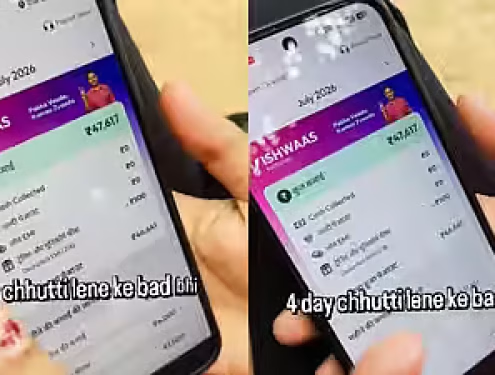
The association has called for paid cooling breaks during IMD red and orange alerts, mandatory access to drinking water and cooling shelters, in-app heat distress emergency support systems, among other measures, according to a copy of the letter reviewed by Business Standard.
April has seen an early and intense build-up of heat across large parts of India, with temperatures in several regions already crossing 40–45°C and running up to 5°C above normal in some areas. Heatwave conditions have been reported across north, central and western India, with cities in states such as Maharashtra, Punjab, Haryana and Madhya Pradesh recording temperatures above 42–45°C, while IMD has repeatedly issued alerts warning of a further rise in temperatures through the latter half of the month.
In its representation to the labour ministry, the federation argued that existing safeguards for gig and informal workers remain largely advisory in nature and lack enforceability, resulting in uneven compliance across platforms. It said delivery, ride-hailing and home-services workers continue to operate under algorithmic pressures and tight timelines even during extreme heat, with little protection against health risks arising from prolonged exposure.
India’s gig workforce expanded from 77 lakh in FY21 to about 1.2 lakh in FY25, marking a 55 per cent increase, driven by rising smartphone penetration and the scale-up of digital payments, according to the Economic Survey 2025-26. Gig workers currently account for over 2 per cent of India’s total workforce, with growth outpacing overall employment, the Survey added.
IFAT has sought conversion of the National Disaster Management Authority’s (NDMA) heatwave advisory into enforceable minimum standards that would apply uniformly across aggregators and locations during notified heatwave events. It noted that while the advisory provides a practical framework, its recommendatory status limits its effectiveness on the ground.
To operationalise binding protections, the federation has pointed to the Code on Social Security, 2020, which provides statutory recognition to gig and platform workers and enables the Centre to notify welfare schemes for them. It suggested that heatwave protection measures could be embedded within this framework as scheme-linked entitlements, backed by obligations on aggregators. The draft Social Security Code (Central) Rules, 2025, which require periodic disclosure of data on gig workers by platforms, could further support monitoring and evidence-based policymaking.
The federation has recommended that when IMD orange or red alerts are in force, platforms should provide cooling breaks of at least 20 minutes for every two hours of active work, without affecting workers’ earnings, incentives or ratings. It emphasised that such breaks should not trigger any adverse action, including reduced task allocation or deactivation of worker IDs.
The submission also called for guaranteed access to safe drinking water, oral rehydration solutions (ORS), and shaded rest areas. Platforms would be required to maintain verifiable “water access plans”, including refill points and reimbursement mechanisms, and publish the location of cooling shelters within their applications so that workers can access them without penalty.
On the safety front, the federation has proposed the introduction of in-app heat distress buttons linked to emergency support systems. These would connect workers to nearby hospitals or ambulance services in cases of suspected heat-related illness, with defined response time standards. It has also recommended that all heat-related incidents be logged against a worker’s Universal Account Number (UAN) and reviewed by the National Social Security Board for gig and platform workers.
To address income loss during extreme weather, the group has urged the government to bar automated penalties for delayed deliveries or missed tasks during heatwaves. It has proposed an earnings-protection mechanism to compensate workers for time taken off due to heat-related risks, along with a requirement that any adverse action be subject to human review and appeal.
The federation has further suggested the creation of district-level compliance dashboards to track adherence by aggregators, with penalties for repeated violations and compensation provisions for affected workers. It also cited international practices, including mandatory rest breaks and enforceable workplace heat standards in countries such as Japan, South Korea, Singapore and France, as benchmarks for India.
The representation comes amid rising concern over the impact of extreme heat on informal and gig workers, who form a growing share of the workforce but remain outside most conventional labour protections.