India’s Informal Sector and AI: Jobs, Justice, Policy



India’s informal sector is unlikely to disappear in the age of AI, but without deliberate policy interventions, it may become increasingly precarious, unequal, and exclusionary. The central issue is not whether AI will be adopted, but whether India can shape this transition to safeguard and enhance informal livelihoods rather than passively allowing technology to displace them at scale.
India’s growth story still rests on informal work: over 90 percent of workers are employed in the informal sector, mostly in tiny, unregistered enterprises with limited productivity and virtually no social protection. The e-Shram Survey illustrates that the informal non-agricultural sector alone employs over 150 million workers and continues to expand post-pandemic. This structural informality intersects with the diffusion of AI, which disproportionately affects sectors like retail, logistics, transport, and routine services, where informal workers are concentrated.
Without institutional buffers, automation that is considered manageable within Organisation for Economic Co-operation and Development (OECD) labour markets may become socially destabilising in the Indian context.
Estimates indicate that nearly 69 percent of the jobs in India are under threat from automation, with particularly high exposure in urban services and low-skill occupations. At the same time, 80 percent of non-agricultural employment is in the informal sector, implying that most workers at risk lack formal contracts, severance, or access to retraining support. Without institutional buffers, automation that is considered manageable within Organisation for Economic Co-operation and Development (OECD) labour markets may become socially destabilising in the Indian context.
Figure 1: Where AI hits hardest: Informal Workforce Share vs AI Exposure
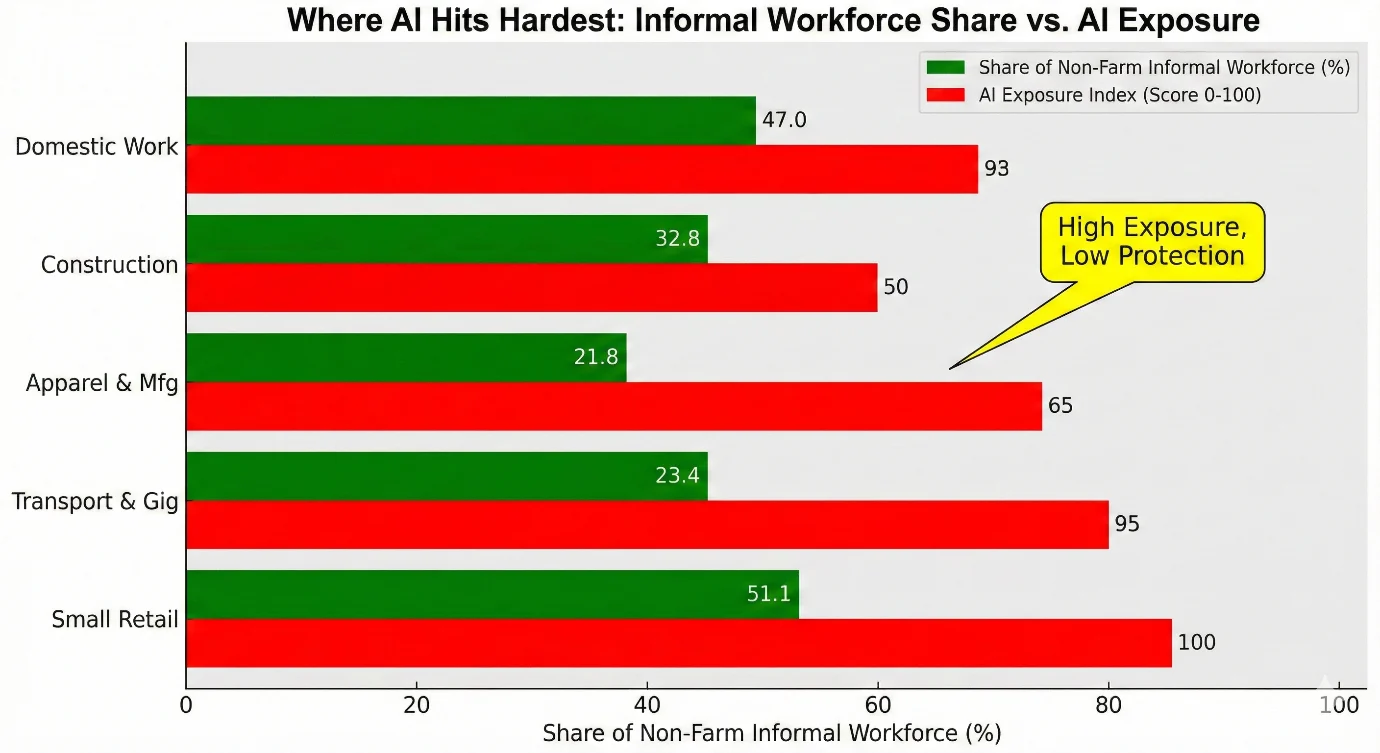
Source: World Bank; ILO; IMF
AI does not eliminate entire occupations overnight; it unbundles tasks, automating some while reshaping others. In developed and many emerging economies, this has so far produced a pattern of “task complementarity” where AI augments higher-skill workers and encourages firms to move up the value chain. In low-income and highly informal settings, however, the risks are acute. Firms adopt labour-saving technologies without corresponding investments in skills development or social protection, thereby pushing vulnerable workers into more precarious segments of the labour market.
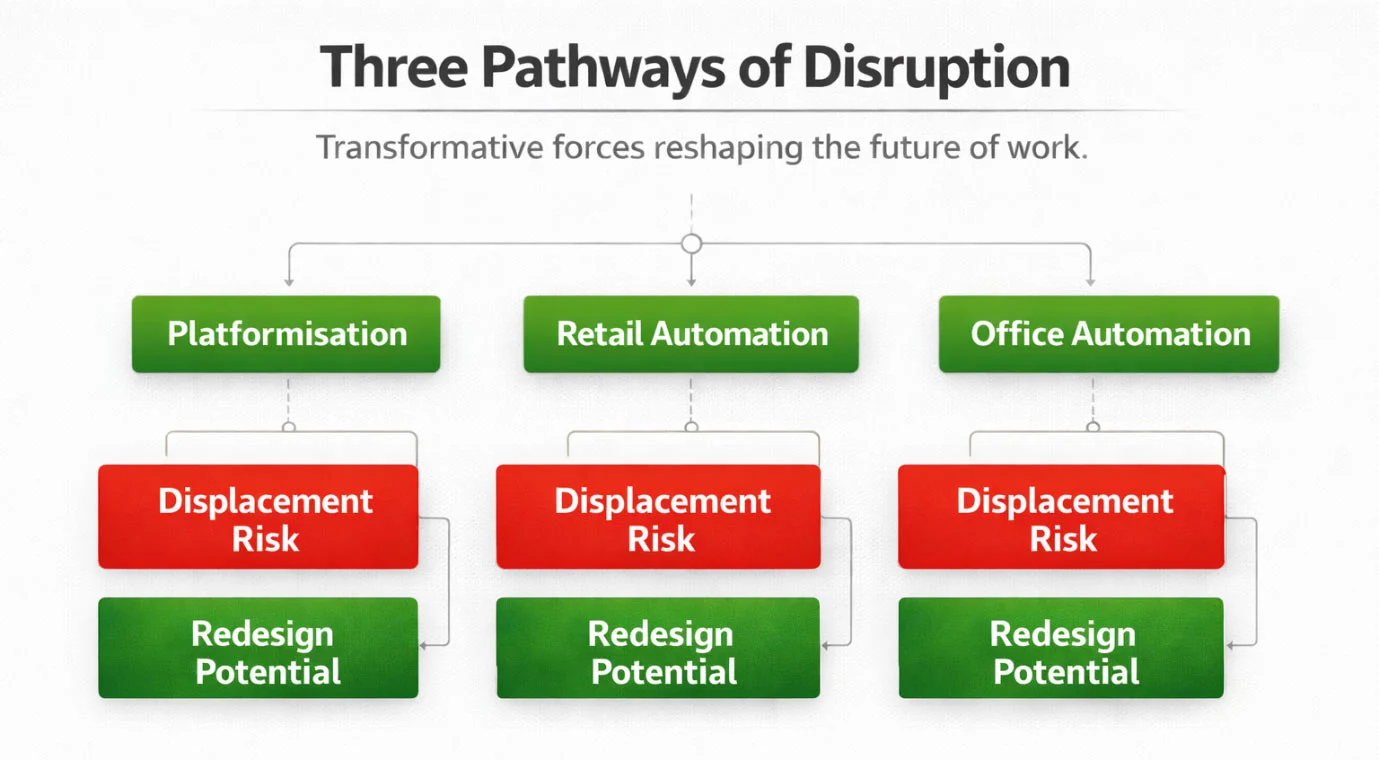
In India’s informal economy, this can unfold in three ways: First, displacement of micro-retailers and street vendors due to AI-enabled e-commerce and inventory management systems favouring larger platforms and organised chains. Second, platform-mediated gig work—touted as a new opportunity—can be reshaped by algorithmic management and automation in delivery, ride-hailing, and warehousing, compressing earnings and squeezing human tasks to the margins. Third, low-skill back-office and data-entry work, which has served as an urban mobility ladder, is particularly exposed to generative AI and process automation.
Figure 2: “Three pathways of disruption”
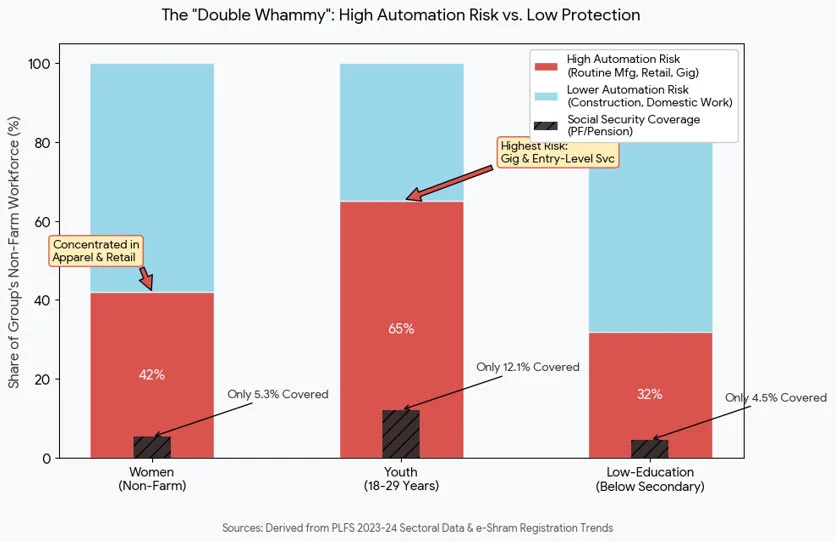
An AI transition intensifies pre-existing inequities across class, caste, gender, and geography. Women are over-represented in informal non-agricultural work, including home-based production and domestic work, which are simultaneously under-measured and increasingly exposed to digital intermediaries and labour-saving appliances. When displacement occurs without income support or childcare provision, women withdraw from paid work altogether rather than re-entering in upgraded roles.
Women are over-represented in informal non-agricultural work, including home-based production and domestic work, which are simultaneously under-measured and increasingly exposed to digital intermediaries and labour-saving appliances.
Moreover, informal workers typically offset labour-market shocks through debt, asset sales, or child labour rather than through insurance or unemployment benefits. If AI-induced restructuring is allowed to proceed without redistribution, the adjustment costs will be borne by the most vulnerable group, while productivity gains accrue to capital-rich firms and digitally skilled elites. A just AI transition, therefore, requires pre-committing to income, capability, and voice protections for workers who were never formally recognised to begin with.
Figure 3: “The unequal AI shock”Source: MoSPI-PLFS; E-Shram
The choice is not binary between blocking automation and sacrificing livelihoods at the altar of efficiency. Global evidence suggests that where states invest in skills, infrastructure, and social protection, AI can augment workers, reduce drudgery, and open new tasks—particularly in the service and care sectors. For India, the challenge is to bend this trajectory toward upgrading, not erasing, informal work.
Policy can push AI adoption toward complementing human capabilities in the informal economy. For example, digital tools can support street vendors with demand forecasting, dynamic pricing, and access to micro-credit rather than merely replacing them through automated kiosks. In construction and small manufacturing, AI-enabled safety monitoring and precision tools can raise productivity and reduce accidents while retaining human workers in higher-value tasks.
A balanced strategy demands simultaneous action on skills, protections, and institutions, rather than isolated pilots. Four priorities stand out:
India’s informal sector will likely survive the AI tsunami in the sense that millions will continue to work outside formal contracts and large firms. The greater risk is that without proactive governance, AI will hard-wire a more polarised labour market, where a thin layer of highly skilled workers ride the productivity wave while the majority absorb unprotected shocks. The window is still open to choose a different path: one where intelligent automation is deliberately directed to raise the floor of work quality, embed justice into the digital economy, and ensure that India’s AI future is not built on the invisible insecurity of its informal majority.
Hamza Ahmad is a Research Intern at the Observer Research Foundation.
The views expressed above belong to the author(s). ORF research and analyses now available on Telegram! Click here to access our curated content — blogs, longforms and interviews.