India’s Surplus Labour Trap: Gig Work, Contract Teachers, and Anganwadi Protests



In December 2025, gig workers, contractually hired professors, and the public health Anganwadi and ASHA workers were on strike over pay, safety, and social security.
These strikes have been recurring without resolution. They expose the survival struggles of India’s large and growing surplus labour force—men and women in low-productivity, low-wage jobs with long downtimes. Workers protest, but their options are bleak. They remain in exploitative, often abusive, work relationships. Strikes yield little. The alternative is to join the desperate hundreds, often thousands—many with college degrees—competing for a single public-sector post as peon, driver, or security guard.
For two-and-a-half centuries, since the Industrial Revolution, development has meant absorbing surplus labour into higher-productivity work with living wages, safeguards, and social security—shifting workers from low-productivity sectors, especially agriculture, into more productive urban employment.
In India, the near opposite has occurred. The surplus labour pool remains vast: 90 per cent of the 650 million workforce is in the unorganised sector (about half in agriculture), alongside another 350 million of working age who do not seek work. Both private and public sectors now operate as if surplus labour is inexhaustible—fuel for profit in one, a justification for underfunding public goods in the other. Institutions and incentives reinforce this assumption. Reversing it is on no one’s agenda, pious talk of “good jobs” notwithstanding. Dignified employment remains a receding dream for all but a lucky few.
In this essay, I examine three ground-level examples to reflect on lives trapped in this structural stasis and its macroeconomic costs.
On September 19, 2019, an SUV hit 25-year old Harjeet Singh’s bike, killing him, when he was out for food delivery in Chandigarh. Then, again on January 9, 2022, amid a brutal COVID wave, a drunk policeman’s car hit and killed Salil Tripathi, an “executive” at Zomato in Delhi. Tripathi, who had lost his job as a restaurant manager earning Rs. 40,000 a month, was making Rs. 10,000 at Zomato.
Without any self-consciousness, in June 2022, NITI Aayog published a report entitled: “India’s Booming Gig Economy.” The gig workforce, the report proclaimed, “was ushering in a new economic revolution globally,” and India was “the new frontier of this revolution.”
Fast forward to 2025. More delivery workers racing against time were dying in road accidents: One in Mysuru in July, another in Gurgaon in September, and at least two more in December—one in Trichy and another in Gurgaon.
Gig work presumes infinite replaceability. Despite the risks they bear, they typically earn less than survival incomes. Low and volatile net income is relentlessly eroded by rising costs. After deducting fuel, repairs, insurance, data charges, phone upgrades, vehicle maintenance, fines for traffic violations, and platform penalties, net monthly earnings for full-time delivery workers often fall below urban subsistence levels.
One delivery worker who earned Rs. 14,000 in a month was left with just Rs. 6,000 after paying for all his expenses. Adding to the stress, these workers go through long periods of no work. This is not a ladder of mobility; it’s a trap on its lowest rungs.
Also Read | Bharat Bandh 2026: Nationwide strike halts banking, industry as workers oppose labour codes
Delivery and other gig workers, such as Uber drivers, went on strike in two waves: a flash strike on December 25 and another around New Year’s Eve (December 31-January 1). They wanted fair and predictable wages, withdrawal or ban on extremely aggressive delivery timelines (especially 10–20‑minute delivery mandates), social security benefits (including health insurance, accident cover, better safety gear, and equipment), and limits on excessively long or erratic work hours.
Four States have laws on gig workers meant to provide benefits and protections. But the implementation of these laws is always “about to happen”. Much the same is true with the Union Government, which has found its benign backer in the Supreme Court. The Social Security Code (2020) explicitly included gig workers. It offered partial help by promising welfare benefits, but had no mention of fundamental labour rights that anchor job security, collective power, or fair pay.
Even the fate of the promised social security is in limbo, demonstrating yet again the “about-to-happen” phenomenon. In December 2021, the Indian Federation of App-based Transport Workers (IFAT) urged the Supreme Court to help hasten the promised welfare benefits under the Social Security Code. Filed in 2021, the case was first heard nearly three years later. Deadlines were issued; responses were sought. Yet, the matter drifted, and workers returned to the streets.
Following the strike, the government restated that gig workers were covered under the Social Security Code (2020), which had now been notified and so could be implemented. But implementation still awaits the missing rules and procedures. The Labour Ministry urged platforms to engage with workers and roll back the ultra-tight delivery goals. Some platform companies (Swiggy, Zomato, Dunzo) offered short-term “bonus top-ups” to workers who returned to work immediately; they agreed to review delivery targets, adjust ultra-fast 10–20-minute mandates in high-risk areas, and opened worker helplines.
Gig and Platform Service Workers Union members hold a protest, at Jantar Mantar in New Delhi on February 3, 2026. The 10-minute delivery promise rests on the assumption that workers are endlessly replaceable.
| Photo Credit:
Shashi Shekhar Kashyap
For labour, nothing changed. Elite Indians continue to demand the indulgence of “10-minute convenience” across an expanding range of services. And, as the strike concluded, Deepinder Goyal, CEO of Eternal Ltd. (the parent company of Zomato and Blinkit), defended the platform companies. He claimed that companies like his brought “more people into the fold, who will be able to earn some money, upskill themselves and later join India’s organised workforce.”
This is sheer nonsense. As a gig worker and organiser responded: “Delivery work is primarily a means of desperate survival, a dead-end trap with no scope for career progression or skill development relevant to the formal economy.”
Meanwhile, Goyal exemplifies the asymmetry between capital and labour. By January 21, he had announced his resignation after becoming astronomically wealthy while his company burnt investor capital. Late-stage and retail investors bore the risks. Workers were squeezed.
For workers and “executives”, only death remained a constant. Why exactly were these young men dying? Weren’t they supposed to be powering India’s demographic dividend? This is the “global frontier” that NITI Aayog celebrates?
This is not how things work elsewhere. In Turkey, where financially stressed gig workers—drawn from a large informal workforce—deliver in under ten minutes to survive, there is tight regulatory supervision. In high-income economies, rapid delivery is a high-premium, luxury niche.
When NITI Aayog predicts that the numbers of gig workers will increase rapidly, it presumes, quite reasonably, that surplus labour will remain plentiful. That assumption is driving fiscal policy—with corrosive effects—in India’s education and health sectors. Consider each.
Teachers hired on precarious short-term contracts are also in perpetual strike mode. In 2025, they launched strikes in Telangana (April), Pune and Delhi (November), and Karnataka (December). The strikes centred around the fear that they, having worked for years, might suddenly lose their jobs. They demanded regular positions instead of being kept on a leash.
Contractual university teachers, like gig workers, come from the country’s surplus labour pool. They are both a symptom and a cause of decaying higher education. Unlike gig workers, they typically do not die on their jobs but they do lack fair pay, benefits, or recognition—and perpetual stress and frequent layoffs make death by suicide a recurring event. Across the country, their terms of employment are dire, with a recent report from The Economic Times highlighting the particularly dreadful conditions in the non-metropolitan areas of Gujarat, Bihar, and Uttar Pradesh. That report carries an extraordinary story: an English “professor” in the Sanjay Gandhi Mahila College in Gaya has taught for over four decades without receiving a salary from the college; he has survived along with his wife on fees for evaluating exams and tutoring students privately.
The courts have repeatedly acknowledged such injustice (recent judgments include those from the Supreme Court, the Punjab and Haryana High Court, and the Patna High Court). In a Supreme Court case involving 18 contractual assistant professors in Gujarat, a bench led by Justice Abhay S. Oka held that denying equal pay and service benefits violated constitutional protections. The judges cited the well-known chant, Gurur Brahma, Gurur Vishnu….the teacher is the Lord. Such ritual invocations sometimes achieve redress for individuals but they have had no systemic effect in officialdom.
The contractual use of surplus educated labour is an essential element of Indian education policy. Policymakers can tout an expanding reach of higher education. Eviscerated learning has little bearing on decision-making.
Pressures to pursue this policy are great. Population growth and sub-standard schooling fuel a voracious appetite for college credentials. The meagre funds for education are dedicated to impressive physical expansion that favours capital projects—new campuses, buildings, enrollments—over maintenance, laboratories, libraries, and research support. Precarious contractual teachers fit perfectly in a university system with decaying functional capacity.
The National Education Policy 2020 did pledge to restore dignity to the teaching profession, with better pay, regularisation, and clear career paths. But statements of policy do not change into practice.

Teachers protest against “anti-education” policies at Delhi University on September 18, 2024. Many lecturers have taught for years—sometimes decades—without fair pay, benefits, or recognition as regular faculty.
| Photo Credit:
Sushil Kumar Verma
The governance system makes contractual hiring inevitable. Overlapping authority between the University Grants Commission, ministries, State governments, university administrations, and courts sustains bureaucratic fiefdoms. It also produces paralysis, delayed approvals, and hiring freezes. State and central universities have high vacancy rates for regular, tenured positions. Inevitably, much of the teaching burden falls on contractual or “guest” workers, whose ubiquitous presence has contaminated even the top universities.
The Delhi University vice-chancellor has acknowledged the need to move away from heavy reliance on guest and temporary lecturers. But he seems helpless. Delhi University’s budget has squeezed out faculty salaries, infrastructure maintenance, and library upkeep. Meanwhile, students are shying away from the university. Allahabad University, once the “Oxford of the East”, tumbled down the same slippery slope.
The rise of short-term instructors is not merely a labour issue; it alters academic incentives. Faculty on insecure contracts are themselves poorly educated. They have neither the capacity nor resources for research, curriculum renewal, or strengthening institutional norms.
The consequences are also social—recall, education is a public good. Well-educated people enhance each other’s productivity. Instead of seeking that higher equilibrium, Indian higher education has resigned itself to flashy symbolism of infrastructure and lofty words even as it continues to fail its youth. Reports on the vast numbers of engineering graduates churned out should be met not just with skepticism, they should evoke dismay. The result: outside of the handful of elite public and private universities, the system is failing the coming generations.
Should we be surprised then by college graduates applying for the jobs of peons? Should we be surprised at the much bandied “skills mismatch”?
Anganwadi workers have been protesting since at least 1998. In March that year—as a former student of mine found in the Times of India archives—they demanded implementation of higher compensation recommended by a government panel. They were asking for something the government had promised. A year later, a Mumbai-based Anganwadi worker wondered why they never got what was due: “How come the State government has money for subsidies to hotels and car manufacturers, but not for Anganwadi workers who are caring for our children?”
That question has no answer a quarter century later. Anganwadi workers provide care for children under the age of six, pregnant women, and lactating mothers. Constituted in October 1975, under the Integrated Child Development Services (ICDS) programme, this all-women community health cadre receives honoraria rather than salaries (like Accredited Social Health Activists—ASHAs—formed in 2005 under the National Health Mission).
They are a permanently informal, low-cost labour force—essential but expendable. Their less than “living wages”, as the Gujarat High Court remarked in August 2025, are a design feature of a public health strategy built on cheap female labour. Their persistence in this form is immune to the argument that dignified incomes and benefits for health care workers within an envelope of a large and expanding child and health care budget would benefit all of society.
In 2006, the Supreme Court legitimised the second-rate status of community health workers. In State of Karnataka and Others v. Ameerbi and Others (2006), the court ruled that Anganwadi workers and helpers did not hold “civil posts” obtained through formal recruitment processes and hence, were not government employees. The court declared, theirs “is not a case where the concept of minimum wage, living wage or fair wage can be brought in service.” The same principle applied to ASHA workers.
In 2018, their wages lagging glaringly behind high inflation, Anganwadi and ASHA workers got a brief reprieve. In September that year, a Cabinet decision approved a rise in the base pay they received from the Union government; State governments also raised their contribution. But since then, for six years, the Union government contribution has remained unchanged. State governments have upped their contributions marginally on an ad hoc basis.
Anganwadi and ASHA workers routinely perform tasks beyond core community health work—monitoring and surveying communities, disease surveillance, data reporting, public health messaging, and delivering essential foods—generally with little or no extra pay. They handle heavy paperwork, make home visits, conduct vaccination or nutrition outreach and, in many areas, find themselves alone in the field, facing stress, exposure to disease, and even harassment from community members. ASHA workers, in particular, bore significant risks as frontline workers during COVID-19 vaccination drives. Yet, they lack formal employment protections, adequate health insurance, assured safety measures, and reliable income security.

Anganwadi workers stage a protest demanding better wages, in Madurai on December 6, 2025. Anganwadi and ASHA workers hold up India’s public health system but yet are treated as expendable.
| Photo Credit:
Moorthy G.
In April 2022, the Supreme Court tried to redress the injustice. In the case of Maniben Maganbhai Bhariya v. District Development Officer, five Anganwadi workers—who had each worked for over two decades—had asked for gratuity payments upon their retirement. In his judgment, Justice Ajay Rastogi wrote that the 2006 decision that they were not civil servants had lost force over time, as recruitment procedures had become more systematic and formal. Yet, he wrote, “Instead of a salary, they get only a so-called paltry—much less than minimum wage—‘honorarium’ on the specious ground that they are part-time voluntary workers, working only for about 4 hours a day.” Although, he did not overturn the earlier Ameerbi decision, he said the law required that they receive gratuity.
The judge also broadened the argument to public policy. Anganwadi workers were “pivotal” to the ICDS programme, which generated large social benefits greater than the sum of their parts. “The survival, well-being and rights of children become social issues of interest to the whole community and not just to the mothers of the families concerned. ‘Socialised childcare’ also contributes to the liberation of women: it lightens the burden of looking after children, provides a potential source of remunerated employment for women and gives them an opportunity to build women’s organizations.”
Frustratingly, data is patchy. It appears though that the bold judgment has remained largely on paper. Possibly, a few States have provision for gratuity but receiving it even there requires a fight. And with wages falling behind inflation, in 2023, a parliamentary committee called on the Ministry of Women and Child Development to determine a “reasonable salary” for community health workers. Even today, Anganwadi and ASHA workers receive between Rs.7,000 and Rs.12,000 a month depending on the State. And delays in receiving the “paltry” amounts due are endemic (the Punjab and Haryana High Court even asked the Punjab Government to pay interest on overdue payments). By any measure, their compensation has fallen far behind the rise in prices since the 2018 pay increase.
In August 2024, the Gujarat High Court made another eloquent statement on the burden they carried in the service of the public good. “The irony,” the court lamented, “is that the Anganwadi workers and helpers, who fulfill the needs of pregnant and lactating mothers, health and education of minors, are deprived of living a life with dignity and respect for want of apposite remuneration.”
The judgment argued that the only explanation for their poor compensation was discrimination against women. The discrimination violated “the fundamental right of equality and equality in matters of public employment guaranteed under Articles 14 and 16(1) of the Constitution of India.” The Constitution and the public goods’ argument aligned: They were thus entitled to a “living wage,” which required that their salaries be raised substantially.
The strikes continue with metronomic regularity. While Anganwadi and ASHA workers seek fair treatment, the nation awaits a public policy priority to public goods’ provision. Not just the strikes, but the often repressive manner in which they are snuffed out remain constant features. Again, the arc is long. Tear gas, water cannon, and lathi charge in 2007 all across the country; arrests in 2023 in Haryana; physical assault of the protesting women in Hyderabad in 2024; water cannons to stop the protestors in Thiruvananthapuram in 2025.
To reiterate the obvious: Anganwadi and ASHA workers provide services with the classic features of public goods. Better child nutrition, maternal health, vaccination coverage, and early disease detection generate benefits that spill far beyond individual households. The social returns exceed the private returns, which is precisely why markets underprovide them. Preventive and early-childhood interventions reduce future health costs, strengthen human capital, and raise lifetime productivity. Underfunding them does not eliminate costs; it merely postpones and magnifies them.
And women in the workforce, while not generally considered a public good, are an instrument of social agency in disadvantaged settings.
Yet public budgeting has treated these services and women as residual rather than foundational. By classifying frontline health workers as honorarium recipients instead of salaried employees, the State limits long-term wage and pension liabilities. Informalisation thus functions as fiscal policy. A frightful trade-off is the result: the State depends on community health workers to deliver high-return public goods on which durable growth rests, but it compensates them as expendable labor—weakening them and the human capital it claims to promote.
The pattern is familiar: rhetorical sympathy, fiscal rigidity, and administrative coercion.
In 1910, India’s textile industry was ahead of emerging Japanese competition. Indian producers relied on daily-wage workers, living in chawls near the mills. Japanese producers hired increasingly better-educated (typically female) workers. They absorbed surplus labour, raised productivity, and raced ahead. All advanced countries travelled this path.
For Indian leaders, persisting surplus labour is not a developmental failure. It serves elite indulgence, profits, and regressive fiscal policy, all recast as development. Courts, businesses, and ministries operate within this elite consensus that has married post-Reagan orthodoxy—tax cuts for the powerful and deregulation—to infinitely exploitable labour.

Of the nearly billion people in the working-age population, only a small minority—about 50 million—hold secure, formal employment. The rest circulate through low-productivity, low-wage work. Here, a girl performs street acrobatics in New Delhi on October 4, 2024.
| Photo Credit:
Shiv Kumar Pushpakar
The Chief Justice mouthed this wisdom recently. He chastised labour unions for demanding fairness and warned domestic employees that legal protections and minimum wages would shrink their employment opportunities. Policy-induced precarity is a feature, not a bug: weaker rural employment guarantee and protection under the labour code blend perfectly.
The result: the vast surplus labour pool is set to grow. Of the nearly billion people in the working-age population, only a small minority—about 50 million—hold secure, formal employment. The rest circulate through low-productivity, low-wage work, often with long downtimes. Their anxiety to obtain work suppresses wages and expectations across the economy. Large cohorts of young workers in the next two decades will encounter the same conditions.
The pool is also deep. Below gig workers, contractual teachers, and poorly paid health workers are sugarcane workers in Maharashtra on the edge of debt bondage; indebted textile workers in Tamil Nadu who sell kidneys; and miners crushed in illegal pits despite occupational safety laws and repeated judicial bans. Laws exist. Enforcement does not.
Also Read | Pushing workers to the edge
Forgotten is the evidence of successful growth episodes—most recently East Asian miracles—each one of which achieved growth with equity through human-capital-centered public investment.
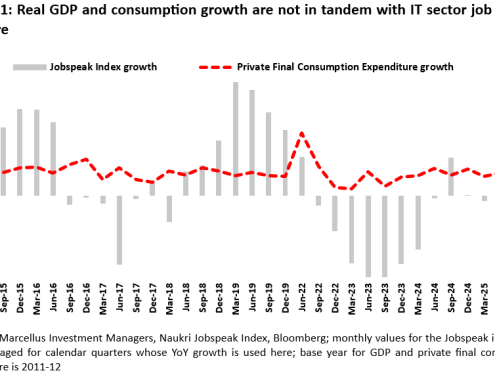
An economy built on replaceable labour will keep inflicting damage. India has thrown away its demographic dividend, pushing successive cohorts to the surplus pool. Upward mobility has become a matter of luck, inequality remains entrenched, and consumption of low-end goods remains weak, even anemic. Luxury cars, gourmet food, and expensive watches and garments post buoyant sales.
Consider a thought experiment: if the salaries of nearly three million Anganwadi workers and a million ASHA workers were doubled, how much would aggregate demand increase? Extend that logic to hundreds of millions more—gig workers, contractual teachers, domestic workers, sugarcane and textile labourers.
The incentives, however, militate against any change. For private enterprises, short-term profit overrides innovation, skills-upgrading, and better wages. For the government, politics, budgetary arithmetic, and ideology counter development logic.
The budget prioritises low taxes on the rich and corporations, subsidies to influential lobbies, and vote-buying in elections. The squeeze operates on low wages and retirement benefits—hence weak employment protections—for workers designated to build the nation’s human capital. Instead of nurturing honorably paid teachers and health workers to deliver high-return public goods, the state treats them as expendable.
Dismantling this system would be profoundly disruptive for those who must do so. They are too heavily invested in it.
Ashoka Mody recently retired from Princeton University. He previously worked for the World Bank and the International Monetary Fund. He is the author of India is Broken: A People Betrayed, Independence to Today (2023).